The International Energy Agency’s latest Global EV Outlook confirms the irreversible momentum of electrification, projecting that nearly one in three new cars sold globally this year will be electric.
The sales forecast is based on the IEA Global EV Outlook 2026 executive summary.
IEA Global EV Outlook 2026 — EV sales projected to reach 23 million units
The Tipping Point Has Arrived
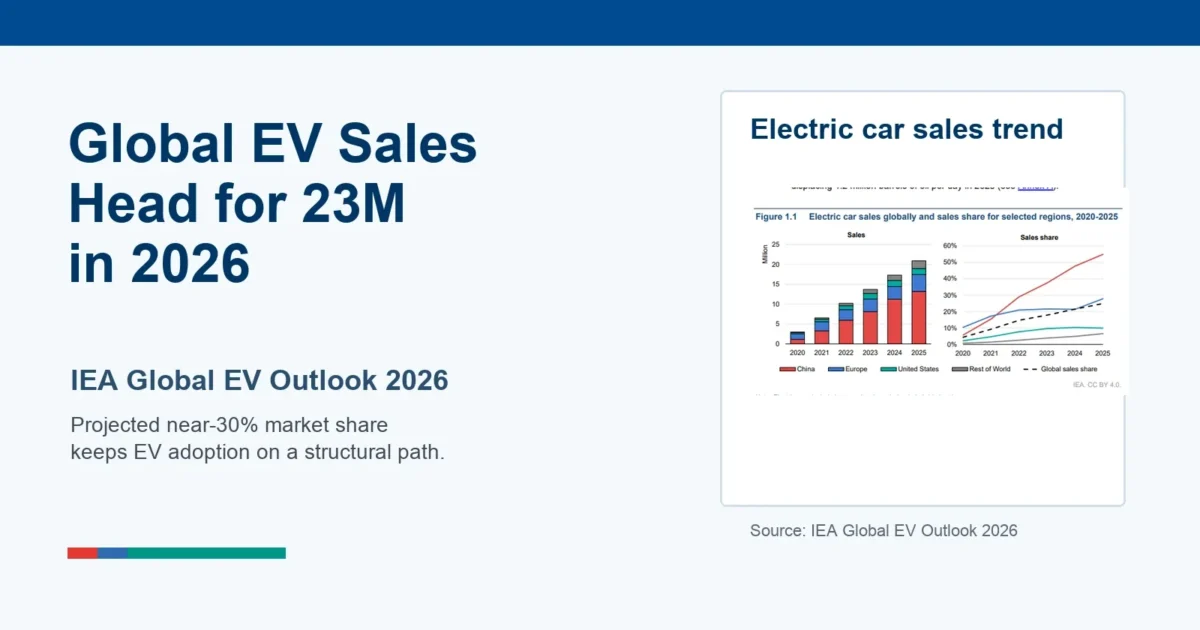
On May 20, the International Energy Agency (IEA) released its authoritative ‘Global EV Outlook 2026’ report, delivering a clear message: the electric vehicle transition has passed its inflection point. The agency projects that global EV sales — including both battery electric vehicles and plug-in hybrids — will reach 23 million units in 2026, representing approximately 30% of all new car sales worldwide.
This projection builds on remarkable momentum. Global EV sales exceeded 20 million units for the first time in 2025, growing 20% year-on-year and capturing one-quarter of the global new car market. The growth trajectory has been remarkably consistent: from 4% market share in 2020 to 14% in 2022, 18% in 2023, 25% in 2025, and now approaching 30% in 2026.
The IEA notes a fundamental shift in adoption dynamics. Early EV growth was primarily policy-driven, concentrated in markets with strong purchase incentives. The current phase is increasingly market-driven, with falling battery costs, expanding model availability, and improved charging infrastructure making EVs competitive on their own merits. In China, EVs already account for over 50% of new car sales.
Regional Divergence Remains
The global picture masks significant regional variation. China continues to dominate, accounting for approximately 60% of global EV sales. Europe, the second-largest market, has seen growth moderate as some countries phase out purchase subsidies, though the EU’s 2035 zero-emission mandate provides a firm regulatory backstop. The United States shows strong growth from a lower base, driven by IRA tax credits and significant investment in domestic battery manufacturing.
Emerging markets present both the greatest opportunity and the greatest challenge. In India, Southeast Asia, and Latin America, EV adoption remains in the single digits, constrained by higher upfront costs, limited charging infrastructure, and the predominance of two- and three-wheelers in the vehicle fleet. The IEA emphasizes that achieving global climate goals will require dramatically accelerating electrification in these regions.
Battery Supply Chain: Scaling Up, Diversifying
The IEA devotes significant attention to the battery supply chain, which has become a strategic priority for governments worldwide. Global battery manufacturing capacity is expected to reach 3,200 GWh by 2026 — more than triple 2023 levels — driven by massive investments in China, Europe, and North America.
The report identifies three key trends: first, the continued dominance of lithium iron phosphate (LFP) chemistry, which now accounts for over 40% of the global EV battery market; second, the rapid development of sodium-ion batteries as a lower-cost alternative; and third, the accelerating commercialization of solid-state batteries, with multiple manufacturers targeting 2027-2028 for volume production.
On the critical minerals front, the IEA notes that supply diversification is proceeding but remains heavily concentrated. China controls approximately 70% of global battery cell production and dominates the midstream processing of lithium, nickel, and cobalt. The United States and Europe are investing tens of billions of dollars to build domestic supply chains, but achieving meaningful diversification will take the rest of the decade.
Implications for the Global Auto Industry
For automakers, the IEA’s projections carry profound implications. At 30% market share and growing, EVs have moved from niche to mainstream. The era when early-mover advantage in EV technology could compensate for weaknesses in cost structure or manufacturing efficiency is ending. The battle is now being fought on traditional automotive battlegrounds: scale, cost, brand, and distribution.
Chinese automakers are particularly well-positioned. Companies like BYD have achieved a level of vertical integration — from lithium mining through battery production to vehicle assembly — that few global competitors can match. Chinese EV exports reached 2.5 million units in 2025, up from 1.2 million in 2024. Trade tensions represent the primary risk to this export trajectory.
For consumers, the IEA’s message is clear: the age of the internal combustion engine is not ending overnight, but its decline is now structurally locked in. By 2030, the IEA projects that EVs will account for over 50% of global new car sales. The 2026 report makes one thing unambiguous: the transition is no longer a question of ‘if’ but of ‘how fast.’