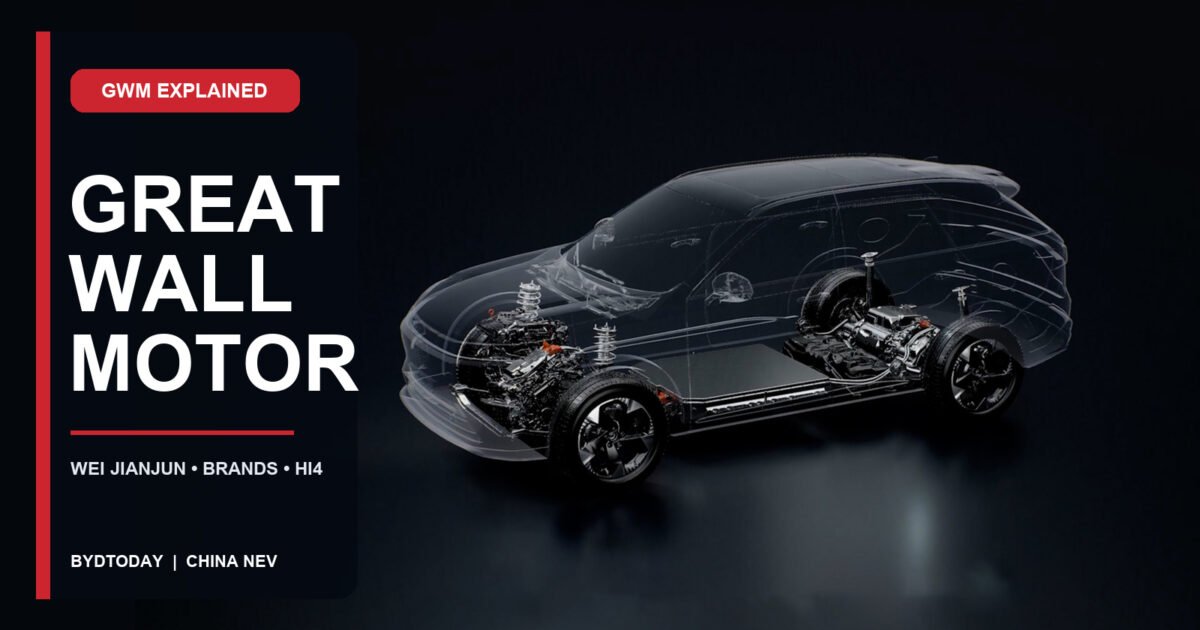
Quick Answer: Great Wall Motor (GWM) is the Chinese automaker reshaped by chairman Wei Jianjun after he joined its predecessor as general manager in 1990. Its main vehicle brands are Haval, TANK, WEY, ORA and GWM Pickup/Poer. GWM sold 1.324 million vehicles in 2025 and 583,895 in the first half of 2026. Hi4 is its family of hybrid four-wheel-drive architectures.
Last verified: July 16, 2026. First-half sales use GWM’s June 2026 exchange announcement; financial results use audited full-year 2025 and unaudited first-quarter 2026 reports.
Page role: This is BYDToday’s single Owner for Great Wall Motor, Wei Jianjun, the GWM brand structure and Hi4 strategy. Individual Haval, TANK, WEY, ORA, pickup and monthly sales reports remain supporting pages.
What is Great Wall Motor?
Great Wall Motor Company Limited is a Baoding-based Chinese automaker listed in Shanghai under 601633 and in Hong Kong under 02333 and 82333. “GWM” can mean the listed company, the master brand used in overseas markets or a prefix attached to products such as GWM Cannon. The group is broader than one SUV badge.
The current core vehicle structure covers Haval, TANK, WEY, ORA and GWM Pickup. The 2025 annual report also lists GWM SOUO motorcycles and GWM Commercial Vehicles. Haval is the volume SUV business; TANK covers premium off-road SUVs; WEY targets premium family vehicles; ORA is moving beyond its former women-focused battery-EV niche; and GWM Pickup includes Poer/Cannon products. These are operating brands inside one group, not separately listed automakers.
GWM differs from a pure battery-EV startup. Its product portfolio spans gasoline, diesel, conventional hybrid, plug-in hybrid and battery-electric vehicles. The company calls this an all-powertrain strategy. That breadth can serve markets with different charging and fuel conditions, but it also means more platforms, brands and technologies to fund.
Who is Wei Jianjun—and did he found GWM?
Wei Jianjun, also written Wei Jian Jun and known internationally as Jack Wey, is GWM’s chairman and executive director. The current annual report says he joined Baoding Great Wall Motor Industry Company, GWM’s predecessor, as general manager in 1990 and has chaired the listed company since June 2001. He is responsible for overall strategy and business development.
The founder label needs a boundary. GWM’s official history traces the original factory to 1984, before Wei arrived. A 2005 annual report records that he undertook contractual operation of the business in 1991. He therefore did not create the first factory from nothing; he is the controlling entrepreneur who rebuilt the predecessor around pickups and SUVs and led the modern listed company. GWM and its official WEY page commonly describe him as the founder, and WEY is named after his surname.
This distinction is more than trivia. It explains why GWM combines an older manufacturing base with a founder-led operating identity. Wei’s documented current role is chairman, not general manager of day-to-day operations; GWM’s annual report assigns daily business management to the general manager.
| Date | Milestone | Why it matters | Evidence boundary |
|---|---|---|---|
| 1984 | Great Wall Motor Factory was established. | Corporate origin predates Wei Jianjun’s management. | Official GWM history; not described as Wei’s personal startup date. |
| 1990–1991 | Wei joined the predecessor as general manager and then undertook contractual operation. | Beginning of the modern founder-led transformation. | Current and 2005 annual reports. |
| 1995–1998 | The Deer pickup entered production; GWM began exports and reached the top of China’s pickup market. | Established the pickup and overseas base. | Official history; no unsupported price advantage claimed. |
| 2001–2003 | The company was restructured; Wei became chairman; H shares listed in Hong Kong. | Created the public-company structure. | Current annual report and company history. |
| 2011–2021 | Haval H6 scaled; WEY, ORA and TANK were introduced; TANK became a standalone brand. | Turned one SUV/pickup company into a portfolio. | Brand formation, not a claim that every original model remains current. |
| 2023–2026 | Hi4 expanded across road and off-road hybrids; ONE GWM and the all-powertrain GWM ONE platform became strategic anchors. | Defines the current electrification and globalization phase. | Company technology and strategy; targets are not guaranteed outcomes. |
How the GWM brand portfolio fits together
The 2025 annual report provides a cleaner brand map than the estimates in many media summaries. Haval remained more than half of group volume. TANK and WEY carried higher-price off-road and family products. GWM Pickup stayed a large standalone business, while ORA entered a repositioning around broader global urban users and multiple powertrains.
| Brand / unit | Primary role | 2025 sales | H1 2026 sales | What the trend says |
|---|---|---|---|---|
| Haval | Mainstream and off-road-oriented SUVs; H6, Dargo and related families. | 761,487; +7.69% | 327,290; +1.82% | Still the volume base, with modest 2026 growth. |
| TANK | Premium off-road SUVs using gasoline, diesel, Hi4-T and Hi4-Z. | 234,442 | 92,653; -10.62% | Large franchise, but first-half volume weakened. |
| WEY | Premium family SUVs and MPVs; Blue Mountain and High Mountain. | 99,617; +79.36% | 44,514; +29.05% | Fast growth from a smaller base. |
| ORA | Urban electrified cars; repositioning beyond a women-only BEV identity. | 48,312 | 26,389; +89.74% | Recovery is visible, but the scale remains small. |
| GWM Pickup / Poer | Commercial, passenger and off-road pickups; Cannon in many export markets. | 178,936; +2.22% | 92,512; -3.86% | Long-term category strength with softer first-half volume. |
| Other | SOUO motorcycles and commercial-vehicle activities. | Outside the five main vehicle brand rows. | 537 in the exchange sales table. | Do not force motorcycle and heavy-truck strategy into passenger-brand totals. |
Adding brand figures can still create scope errors. The group’s 1,323,811 reported 2025 vehicle sales include categories beyond the five main brand lines, while rounded company communications often state 1.3238 million. Sales volume is also not the same as revenue, retail registrations or production.
What is GWM Hi4?
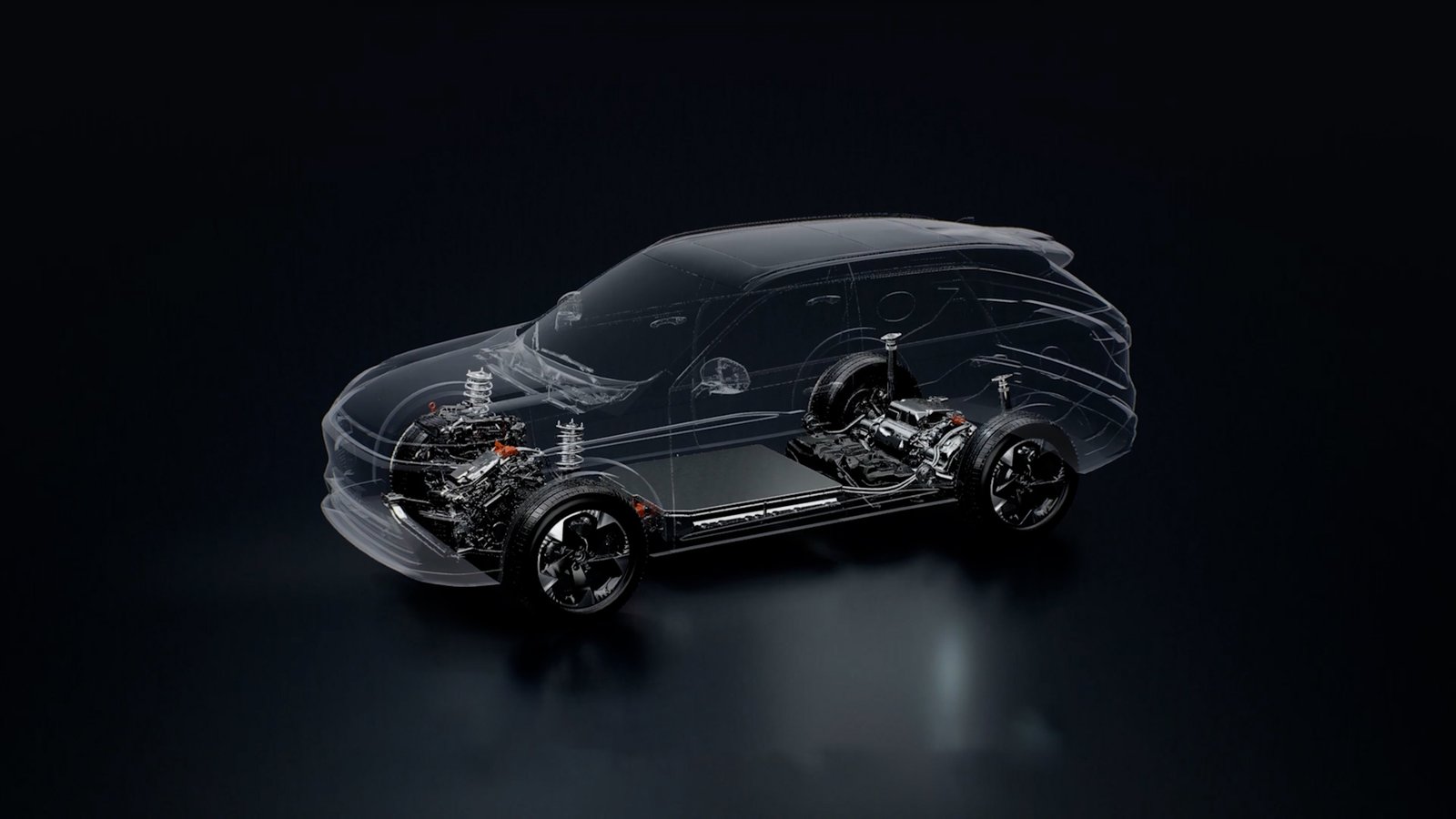
Hi4 is GWM’s family of hybrid four-wheel-drive technologies. The name combines Hybrid, Intelligent and 4WD. In the standard road-oriented layout, GWM describes front- and rear-axle motors working through a series-parallel hybrid system with torque management across both axles.
The important point is that Hi4 is not one identical powertrain. Hi4, Hi4-T and Hi4-Z use different layouts for different vehicle duties. A Haval road hybrid should not be described as mechanically equivalent to a TANK off-road model merely because both carry a Hi4 badge.
| Architecture | Primary use | Core distinction | Claim boundary |
|---|---|---|---|
| Hi4 | Road and family-oriented Haval/WEY hybrids. | Front/rear electrified four-wheel drive with series-parallel energy management. | “4WD performance with 2WD energy use” is GWM’s positioning, not a universal test result. |
| Hi4-T | Hard off-road TANK and Shanhai Cannon applications. | Longitudinal off-road hybrid with a non-decoupled mechanical 4WD structure. | Capability varies by engine, locks, battery and model. |
| Hi4-Z | Broader “all-scenario” or universal off-road use. | Power-split architecture intended to balance road efficiency and off-road performance. | It complements Hi4-T; it does not automatically replace it. |
| Hi4-G | Heavy-duty commercial trucks. | Series-parallel dual-motor system with heavy-truck DHT. | Outside the passenger-vehicle comparison. |
GWM also uses Coffee OS and Coffee Pilot names for cockpit and driver-assistance systems. These labels are separate from Hi4. VLA and NOA remain assisted-driving functions; neither a model name nor a company statement proves autonomous operation in every road, weather or legal condition. BYDToday’s driver-assistance comparison explains the wider terminology.
2025 financials and first-quarter 2026 reality
GWM’s audited 2025 results show growth with lower profitability. Revenue rose 10.20% to RMB222.824 billion, while net profit attributable to shareholders fell 22.07% to RMB9.865 billion. Gross margin declined from 19.51% to 18.04%. Research and development expense increased 12.13% to RMB10.432 billion, and selling expense rose 43.93% to RMB11.273 billion as GWM expanded direct-user channels and promoted new products and technologies.
First-quarter 2026 revenue increased 12.72% to RMB45.109 billion, but attributable net profit fell 46.01% to RMB945 million. The company said the comparison was affected by exchange gains in the prior-year period. Operating cash flow improved to positive RMB3.271 billion from a RMB8.980 billion outflow a year earlier. One quarter does not prove a full-year margin recovery.
| Metric | 2024 | 2025 | Q1 2026 | Correct reading |
|---|---|---|---|---|
| Revenue | RMB202.194bn | RMB222.824bn; +10.20% | RMB45.109bn; +12.72% | Revenue grew in both periods. |
| Attributable net profit | RMB12.660bn | RMB9.865bn; -22.07% | RMB0.945bn; -46.01% | Growth did not translate into higher profit. |
| Gross margin | 19.51% | 18.04% | Company said it rose year over year; exact headline ratio not stated in the summary. | Do not mix annual and quarterly scopes. |
| R&D expense | RMB9.304bn | RMB10.432bn; +12.13% | RMB2.242bn; +17.59% | Spending rose as profit compressed. |
| Operating cash flow | Annual scope not used here | See audited cash-flow statement | RMB3.271bn vs -RMB8.980bn | Q1 cash generation improved despite lower profit. |
What 2026 sales say so far
GWM sold 108,080 vehicles in June 2026, down 2.36% year over year. First-half volume reached 583,895, up 2.48%. Overseas sales were 291,426 for the half, almost half of group volume, while NEV sales were 144,634. Those two subsets overlap because exported vehicles can also be NEVs.
The brand mix was uneven. WEY and ORA grew strongly, Haval edged higher, and TANK and pickups declined. The result is more informative than a single group growth rate: GWM is gaining in some electrified and premium families without yet showing broad-based acceleration.
For the latest monthly context, use BYDToday’s GWM export update. The broader China NEV export tracker and Australia Chinese-brand analysis are supporting market pages, not replacements for this company Owner.
How GWM’s overseas strategy works
GWM calls its model “ecosystem globalization”: local production, local operations, cross-cultural branding and supply-chain security rather than exports alone. In 2025, it reported 506,787 overseas sales, up 11.60%, across more than 170 countries and regions and over 1,500 overseas channels.
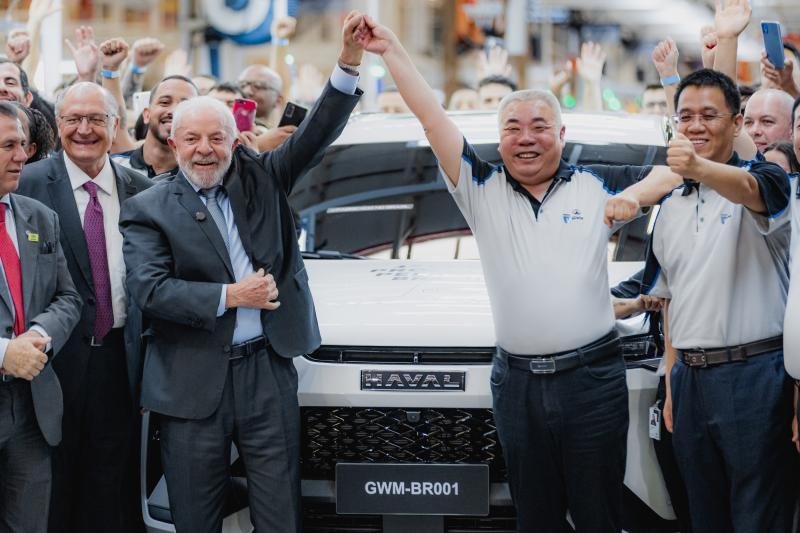
The company reported three full-process overseas vehicle manufacturing bases, including Thailand and Brazil, plus KD operations in markets such as Ecuador, Malaysia and Pakistan. Its Brazil plant began operation in August 2025. These are company-reported network figures, not proof that every GWM brand or model is sold, serviced or homologated in every listed country.
Company targets versus verified results
GWM’s 2025 annual report includes a 2026 performance framework of 1.8 million vehicle sales and RMB10 billion in attributable net profit. Those numbers are targets or assessment conditions, not completed results and not a promise to investors. After six months, reported sales of 583,895 represented about 32% of the volume target without seasonality adjustment.
The same boundary applies to the GWM ONE platform, VLA driver assistance and overseas expansion. A platform compatible with multiple powertrains is a development capability, not evidence that every configuration is in production. A product shown at an auto show is not a delivered vehicle. A distribution plan is not a local warranty network until the market operator confirms it.
What to watch next
- Haval scale: whether Hi4 and new products can lift the largest brand beyond low-single-digit growth.
- TANK resilience: whether off-road electrification can reverse the first-half decline without weakening pricing.
- WEY and ORA repeatability: high growth matters only if it persists after new-model launch effects.
- Profit conversion: whether revenue, R&D and direct-channel investment translate into stronger annual profit and margin.
- Overseas localization: whether Brazil, Thailand and other production sites improve delivery, service and economics.
- Technology clarity: compare exact Hi4 hardware, battery, assisted-driving sensors and software eligibility at model and trim level.
Explore the wider system: Use the China NEV Knowledge Hub to move between company and founder Owners, technologies, vehicles and markets.
Frequently Asked Questions
What is Great Wall Motor?
Great Wall Motor, or GWM, is a Chinese automaker listed in Shanghai and Hong Kong. It sells SUVs, pickups and electrified vehicles through several brands.
Who founded Great Wall Motor?
GWM traces its original factory to 1984. Wei Jianjun joined the predecessor as general manager in 1990, undertook contractual operation in 1991 and led the modern company; GWM commonly describes him as its founder and he remains chairman.
Which brands does GWM own?
GWM’s main vehicle brands are Haval, TANK, WEY, ORA and GWM Pickup/Poer. Its annual report also lists GWM SOUO motorcycles and GWM Commercial Vehicles.
What is GWM Hi4?
Hi4 is GWM’s family of hybrid four-wheel-drive architectures. Standard Hi4, off-road Hi4-T, power-split Hi4-Z and heavy-truck Hi4-G use different layouts for different duties.
How many vehicles did GWM sell in 2025 and the first half of 2026?
GWM reported 1,323,811 vehicle sales in 2025 and 583,895 in the first half of 2026. The first-half figure was 2.48% higher year over year.
Can you buy GWM vehicles in the United States or United Kingdom?
GWM has an official UK retail presence, but model and brand availability must be checked locally. It does not advertise an equivalent official US consumer sales network; imported vehicles or traded shares do not establish local warranty and service coverage.
Sources
- Great Wall Motor / HKEX, 2025 annual report and audited results
- Great Wall Motor / HKEX, first-quarter 2026 report
- Great Wall Motor / HKEX, June and first-half 2026 sales announcement
- Great Wall Motor, official company history
- Great Wall Motor / HKEX, 2005 annual report and Wei Jianjun’s early operating history
- Great Wall Motor, official Hi4 technology page
- Great Wall Motor, official TANK platform and Hi4-T page
- Great Wall Motor, 2026 Beijing Auto Show technology and product update
- Great Wall Motor, Brazil factory opening, August 16, 2025
- Great Wall Motor, official WEY brand history and naming
- BYDToday, Source Methodology and Editorial Policy