Quick Answer: GAC Group is a Guangzhou state-controlled, Shanghai- and Hong Kong-listed automaker. Its self-developed portfolio includes Trumpchi, Aion and Hyptec, while GAC Toyota and GAC Honda are separate 50% joint ventures. Zeng Qinghong retired in February 2025; Feng Xingya is chairman and Xia Xianqing is general manager. H1 2026 sales rose, but a wider loss was forecast.
Last verified: July 17, 2026. Governance, sales, financial, ownership, technology and overseas-production claims use GAC or Hong Kong Stock Exchange material available on that date. Preliminary results and company targets are labeled rather than treated as completed outcomes.
Page role: This is BYDToday’s single Group Owner for GAC. It explains the company, leadership, brands, joint ventures and technology boundaries. The Aion turnaround analysis, Aion V UK launch guide and Southeast Asia market analysis remain supporting pages. Model launches and local prices belong on separate URLs in the knowledge hub.
What is GAC Group?
Guangzhou Automobile Group Co., Ltd., abbreviated GAC Group, is a dual-listed Chinese automobile company: SSE 601238 and HKEX 2238. Its controlling shareholder is Guangzhou Automobile Industry Group, a state-owned enterprise. The Q1 2026 filing showed that controlling shareholder holding 54.02% of GAC’s total share capital. This is a state-controlled listed group, not a founder-owned startup.
“GAC Motor” can create confusion. In many export markets it is the consumer-facing name for GAC’s own vehicles. In the listed company’s filing, GAC Motor Co., Ltd. is defined as GAC Trumpchi, a wholly owned subsidiary. GAC Group is the broader parent that also consolidates Aion and other businesses and accounts for Toyota and Honda joint ventures separately.
The current leadership is also different from the older dossier. Feng Xingya has been chairman since February 3, 2025. Xia Xianqing became general manager on November 16, 2025, ending Feng’s concurrent general-manager role. A June 2026 HKEX board list confirms both as executive directors. Zeng Qinghong is a former chairman, not a current executive or founder.
Where does Zeng Qinghong fit in GAC’s history?
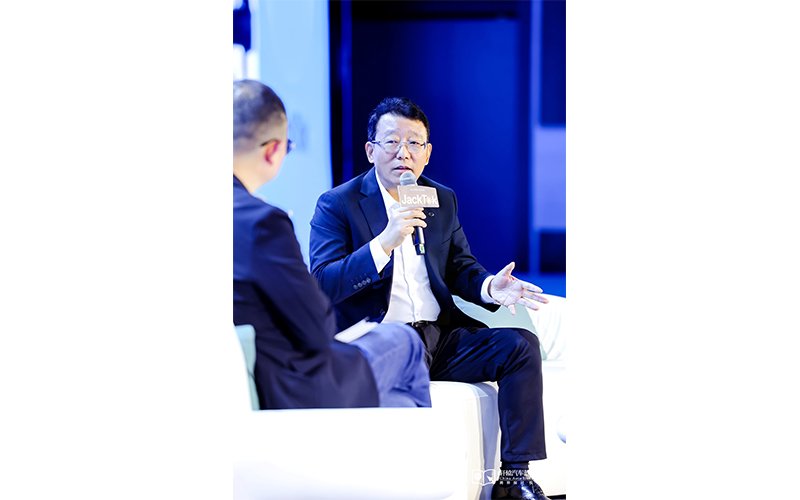
Zeng Qinghong was an important long-serving GAC executive, but he did not privately found or own the group. He led GAC through a period spanning joint-venture scale, the development of self-owned brands and the early Aion expansion. His widely repeated 2022 comment that vehicle companies were effectively “working for battery makers” was a criticism of battery-cost pressure, not proof that GAC lacked its own battery-system engineering.
On February 3, 2025, Zeng resigned as chairman and executive director after reaching retirement age. GAC’s exchange announcement states that he no longer held any position in the group. Describing him as current chairman in 2026 is therefore wrong. His role belongs in the leadership timeline and historical entity record.
GAC’s industrial story predates both Zeng and the present corporation. The official brand story traces Guangzhou’s automotive roots to a public bus repair factory that built a bus in 1954. The modern group was formed in 1997 by combining local automotive assets. GAC Honda followed in 1998 and GAC Toyota in 2004. GAC established its R&D center in 2006, then launched its first self-owned passenger-car brand in 2010.
| Year | Milestone | Why it matters | Boundary |
|---|---|---|---|
| 1954 | Guangzhou bus-repair operation built an early local bus. | Official industrial root of Guangzhou automobile manufacturing. | Predates the present listed company. |
| 1997 | Guangzhou Automobile Group formed from local assets. | Beginning of the modern group structure. | No single private founder owns GAC. |
| 1998 / 2004 | GAC Honda / GAC Toyota established. | Built scale, manufacturing and joint-venture income. | Both are 50% joint ventures, not owned brands. |
| 2006–2010 | GAC R&D Center established; Trumpchi-era self-owned brand launched. | Created an independent product and engineering path. | Global “GAC Motor” naming varies by market. |
| 2017 / 2023 | GAC Aion company formed / Hyptec brand introduced. | Added mainstream and premium NEV portfolios. | Hyptec operates inside the Aion perimeter. |
| 2025 | Zeng retired; Feng became chairman; Xia later became general manager. | Current governance replaced the old chairman-president structure. | Zeng holds no current group position. |
| 2025–2026 | Qijing launched with Huawei; Aion local production began in Austria. | Expanded ecosystem and overseas-localization models. | Partnership does not equal Huawei equity ownership. |
2025 results: lower sales, a large loss and two revenue scopes
GAC sold 1,721,489 vehicles in 2025, down 14.06% from 2,003,058 in 2024. Self-developed-brand sales were about 609,200, down 22.83%. NEV sales reached 433,600, down 4.64%, while energy-efficient vehicles rose slightly to 454,600. The mix of NEVs and energy-efficient vehicles increased to 51.6% of group volume, showing that powertrain transition continued even as total volume fell.
The revenue scope requires care. GAC reported RMB96.54 billion of consolidated revenue, down 10.43%, and also presented RMB367.16 billion of revenue on an aggregated basis, down 8.59%. The larger number incorporates a broader operating view that includes important joint ventures. It must not be substituted for the audited consolidated revenue line.
Net loss attributable to shareholders was RMB8.78 billion. Consolidated gross loss was RMB5.43 billion, equivalent to a negative 5.62% gross margin, and operating cash outflow was RMB16.20 billion. GAC attributed the result to weaker volume, higher selling spending, self-owned-brand impairments and lower investment income as GAC Honda restructured capacity and staff.
Entity performance diverged. GAC Toyota sold 756,000 vehicles, up 2.44%. GAC Honda fell 25.22% to 351,926. Trumpchi fell 23.02% to 319,161, and the GAC Aion entity fell 22.62% to 290,081. These figures are company sales, not necessarily retail registrations.
2026 YTD: sales recovery has not yet produced financial recovery
GAC’s H1 2026 exchange filing recorded 773,085 vehicle sales, up 2.35%. Self-owned-brand sales reached about 346,000, up 35.69%, while NEV sales rose 68.8% to 260,158. Self-owned-brand exports reached 121,500, up 132%. The mix changed faster than the group total.
GAC Aion sold 181,579 vehicles in H1, up 67.08%, and Trumpchi sold 164,373, up 12.36%. GAC Toyota rose 3.29% to 356,000. GAC Honda fell 55.82% to 68,318, illustrating why a group-wide “turnaround” headline can obscure continuing joint-venture pressure.
Financial recovery remained incomplete. Q1 total operating revenue was RMB20.23 billion, up 1.76%. The attributable net loss narrowed 10.29% to RMB656 million, but the adjusted attributable loss widened to RMB1.38 billion. The difference reflects non-recurring gains, including disposal effects.
PENDING: On July 10, GAC forecast an H1 2026 attributable net loss of RMB4.06–4.57 billion and an adjusted loss of RMB4.8–5.6 billion. The filing explicitly says these are preliminary, unaudited estimates; formal interim results were expected in late August. They are not presented here as final financial statements.
| Period | Vehicle result | Financial result | How to read it |
|---|---|---|---|
| FY 2025 | 1,721,489; -14.06% | RMB96.54bn consolidated revenue; RMB8.78bn attributable loss | Audited full-year group result. |
| FY 2025 aggregated | Same vehicle scope | RMB367.16bn aggregated revenue | Broader operating view; not consolidated revenue. |
| Q1 2026 | 379,929; +2.38% | RMB20.23bn total revenue; RMB0.66bn attributable loss | Actual unaudited quarterly filing. |
| H1 2026 sales | 773,085; +2.35%; NEV 260,158 | No final interim statement yet | Sales filing; no revenue extrapolation. |
| H1 2026 forecast | Sales slightly higher | RMB4.06–4.57bn estimated attributable loss | Preliminary and unaudited; final result pending. |
Which brands belong to GAC?
Trumpchi is GAC’s wholly owned mainstream passenger-vehicle business, covering combustion, hybrid and plug-in hybrid products. Aion is the principal mass-market NEV brand and operates through GAC Aion New Energy Automobile Co., Ltd., a GAC subsidiary. Hyptec is the premium NEV brand within that same operating perimeter; it is not a separate listed automaker.
GAC combined Aion and Hyptec into a business-unit structure during its reform. The H1 2026 “GAC Aion” entity figure therefore provides a legal reporting line but not a clean public split between every Aion and Hyptec badge. A Group Owner should explain the perimeter without inventing brand-level sales that the filing does not disclose.
GAC Toyota and GAC Honda are each 50%-owned, jointly controlled entities. Their revenue is not consolidated as though GAC owned 100%. The listed company recognizes its share through equity accounting. After a 2025 capital increase, GAC continued to hold 50% of GAC Honda, with Honda Motor at 40% and Honda Motor (China) at 10%. GAC Toyota remained a 50% joint venture.
Former ventures should not be placed in the current operating matrix. GAC Fiat Chrysler entered bankruptcy proceedings, while the former GAC Mitsubishi entity ceased normal vehicle-production status and was restructured. Their historical models do not make Jeep or Mitsubishi current GAC-owned brands.
| Name | What it is | GAC relationship | Do not infer |
|---|---|---|---|
| Trumpchi / GAC Motor Co. | Mainstream self-developed passenger-vehicle business | Wholly owned subsidiary | Export “GAC Motor” naming is not the entire listed group. |
| Aion | Mainstream NEV brand and operating company | Controlled GAC subsidiary | An earlier IPO plan is not a completed listing. |
| Hyptec | Premium NEV brand/series | Inside GAC Aion and the combined Aion-Hyptec BU | Not a separate listed company. |
| GAC Toyota | Vehicle manufacturing and sales company | 50% jointly controlled entity | Toyota is not a GAC-owned marque. |
| GAC Honda | Vehicle manufacturing and sales company | 50% jointly controlled entity | Honda is not a GAC-owned marque. |
| Qijing / AISTALAND | GAC-Huawei co-developed smart-EV brand | Legal company held within GAC’s consolidated perimeter | Huawei technology cooperation is not disclosed equity ownership. |
What is Huawang, Qijing and GAC’s Huawei relationship?
Huawang was the original name of a GAC project company incorporated in March 2025. GAC’s 2025 annual report defines the renamed company as Qijing Intelligent Automobile Technology, branded in English as AISTALAND. The listed company holds 71.43%, while GAC Aion holds 28.57%. Both stakes sit within the GAC group perimeter.
Huawei is the technology and ecosystem partner, not a shareholder disclosed in that ownership definition. GAC says Qijing combines its vehicle, manufacturing and three-electric-system capabilities with Huawei QianKun assisted driving, cockpit, user ecosystem and marketing resources. The GT7 entered production and launch activity in June 2026. That product milestone does not turn every GAC-Huawei component supply relationship into the same collaboration model.
This boundary also corrects the dossier’s tendency to treat “using Huawei” as one category. A Trumpchi or Hyptec model fitted with Huawei software remains a GAC-brand product. Qijing is a distinct co-developed brand operated through a dedicated GAC-controlled company.
| Layer | GAC role | Huawei role | Status |
|---|---|---|---|
| Qijing company | 71.43% listed company / 28.57% GAC Aion | No equity disclosed in GAC’s annual-report definition | GAC-controlled legal entity. |
| Qijing products | Vehicle engineering, three-electric systems, manufacturing | QianKun assistance, cockpit, ecosystem and marketing cooperation | GT7 production/launch confirmed by June 2026. |
| Other GAC models | GAC brand, product and channel ownership | Selected systems or components | Supplier/cooperation scope varies by model. |
Magazine Battery and solid-state battery: what is real now?
Magazine Battery is primarily a battery-pack safety and thermal-management technology brand. It describes cell protection, isolation, cooling, monitoring and pack structure; it does not mean that every cell chemistry or cell supplier is identical. Needle-puncture or other demonstration results should not be converted into a guarantee that a production vehicle can never burn.
GAC’s all-solid-state program is earlier-stage. The company said its pilot line entered operation in November 2025 and could produce automotive cells above 60Ah. A pilot line validates process, yield and repeatability before mass production. It is not proof of commercial fleet-scale output.
PENDING: GAC’s stated 2026 step is small-batch vehicle installation and testing. At the July 17 cutoff, the primary-source spine did not confirm a customer-delivered, mass-produced GAC vehicle using an all-solid-state battery. Range, energy-density and launch-year claims therefore remain development targets rather than retail specifications.
| Technology | Confirmed status | 2026 boundary | Do not infer |
|---|---|---|---|
| Magazine Battery | Production pack-safety technology used by GAC NEVs | Multiple generations and model applications | Not one universal cell chemistry. |
| In-house battery ecosystem | GAC has battery R&D, pack and manufacturing investments | Operates alongside external suppliers and partners | Not every vehicle cell is internally made. |
| All-solid-state cell | Pilot line operating; above-60Ah process capability claimed | Small-batch vehicle testing planned | No confirmed retail mass production at cutoff. |
Overseas production: confirmed factories versus targets
GAC reported approximately 125,000 overseas terminal sales for self-developed brands in 2025, up about 48%. At year-end it covered 87 countries and regions, operated 630 sales and service outlets and had five overseas knock-down factories. By the end of Q1 2026, the company reported 102 countries and regions and 650 outlets.
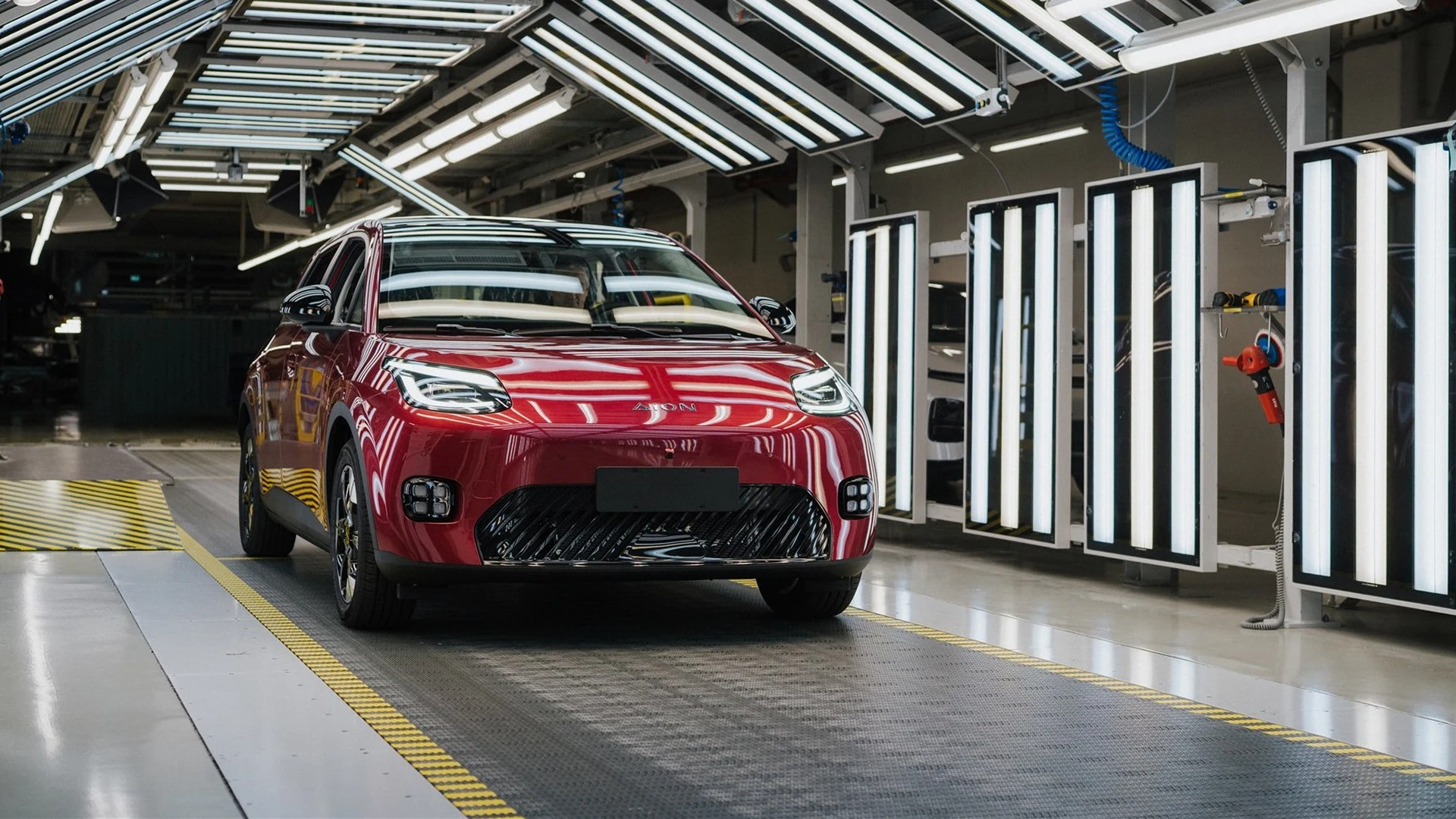
European production is no longer only a plan. Aion UT production started at Magna’s Austria facility on March 18, 2026, following the earlier Aion V program. This is localized assembly through a manufacturing partner; it should not be described as a wholly owned GAC European factory.
H1 self-owned-brand exports reached 121,500, up 132%. GAC’s 250,000 overseas-sales target for 2026 and one-million target for 2030 are PENDING: company objectives, not achieved results. Likewise, a distributor, parts warehouse or announced construction project is not automatically a producing vehicle plant.
What to watch next
GAC’s next test is not simply whether volume rises. The company must improve the economics of Aion and Trumpchi while funding Hyptec, Qijing and overseas expansion. It must also stabilize Honda’s steep volume decline and convert GAC Toyota’s localized EV progress into durable joint-venture income.
Three disclosures will be especially important: the final H1 financial result in place of the preliminary forecast; evidence that higher self-owned and export volume improves gross margin and cash flow; and a dated solid-state vehicle-test result rather than another future target. Readers should keep wholesale, retail, consolidated and joint-venture metrics separate.
Frequently asked questions
What is GAC Group?
GAC Group is a Guangzhou state-controlled automobile company listed in Shanghai as 601238 and Hong Kong as 2238. It combines consolidated self-developed vehicle businesses with separately accounted joint ventures.
Who owns GAC Group?
GAC Group is publicly listed and controlled by state-owned Guangzhou Automobile Industry Group, which held 54.02% of total share capital in the Q1 2026 filing. It is not privately owned by a founder or chairman.
Is Zeng Qinghong still chairman of GAC Group?
No. Zeng Qinghong retired and left all GAC Group positions on February 3, 2025. Feng Xingya is the current chairman, and Xia Xianqing has been general manager since November 16, 2025.
Which brands does GAC own?
GAC’s self-developed portfolio includes Trumpchi, Aion and Hyptec. Hyptec sits within the GAC Aion perimeter. Qijing is operated through a GAC-controlled company and co-developed with Huawei; Toyota and Honda are joint-venture brands, not GAC-owned marques.
What is GAC’s relationship with Toyota and Honda?
GAC Toyota and GAC Honda are each 50%-owned, jointly controlled vehicle companies accounted for as joint ventures. Their full revenue is not consolidated into GAC Group as if they were wholly owned subsidiaries.
Is GAC’s solid-state battery in production?
GAC’s all-solid-state pilot line is operating and the company says it can make automotive cells above 60Ah. Small-batch vehicle installation was planned for 2026, but no customer-delivered mass-production solid-state GAC vehicle was confirmed at the July 17 cutoff.
Sources
- GAC Group / HKEX, 2025 annual report
- GAC Group / HKEX, Zeng Qinghong retirement and Feng Xingya appointment
- GAC Group / HKEX, June 2026 board list
- GAC Group / HKEX, Q1 2026 report
- GAC Group / HKEX, June and H1 2026 sales report
- GAC Group / HKEX, preliminary H1 2026 estimated results
- GAC Global, official brand history
- GAC Group, all-solid-state battery pilot line
- GAC Group, Qijing brand and Huawei cooperation
- GAC Global, AION UT production in Austria