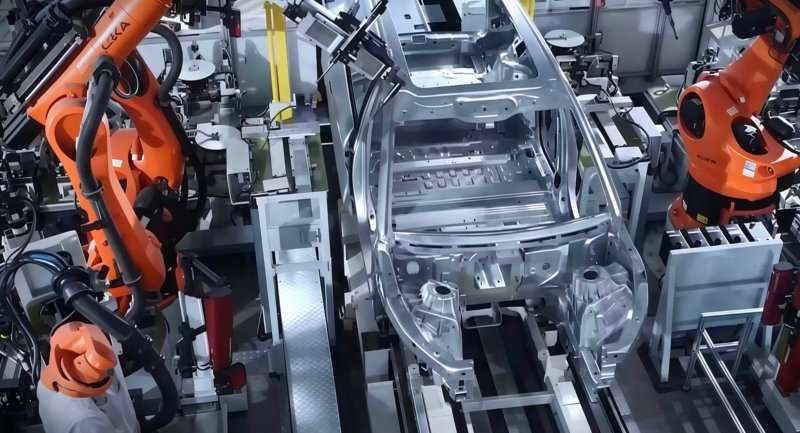
China has established a four-tier smart factory system encompassing over 43,700 manufacturing facilities nationwide, the Ministry of Industry and Information Technology (MIIT) announced on June 8, 2026. The program has delivered measurable results: product defect rates are down 47% and R&D cycles have been shortened by 38% across participating plants.
The system categorizes factories into four levels: 35,000 basic-level facilities with initial digitalization and connectivity; 8,200-plus advanced-level plants with significant automation; 500-plus excellence-level factories with deep AI integration; and 15 “leading smart factory” candidates representing the global state of the art. For the first time, AI capability has been included as a mandatory evaluation benchmark for excellence-level and leading factories, with requirements that will become progressively stricter over time.
Real-World Impact
Case studies illustrate the transformation. TBEA Shenyang Transformer Group, an excellence-level factory, integrated a digital platform connecting simulation, production scheduling, execution, and monitoring, reducing product R&D cycles by 21% and increasing production efficiency by 40%. The factory also developed a transformer health assessment algorithm using real-time operational data that can issue condition warnings 8 to 12 hours before problems materialize.
At Hengli Shipbuilding in Dalian, tasks that previously required two planners working for over two weeks are now completed by AI software in approximately 30 minutes, with human engineers focused on verification and adjustment. The productivity gains are not incremental — they represent fundamental shifts in how complex industrial tasks are organized and executed.
EV Industry as AI Testbed
The electric vehicle sector has been identified as a priority industry for future leading smart factories and large-scale industrial AI deployment. Avatr’s 5G AI factory already produces one vehicle every 60 seconds, while Xiaomi’s EV plant has become a public attraction where visitors observe large-scale automated vehicle production — turning manufacturing transparency into a brand-building exercise.
The broader smart manufacturing ecosystem has reached significant scale. The smart manufacturing equipment, industrial software, and system solutions industry now exceeds 4.5 trillion yuan ($665 billion), with system integration services surpassing 770 billion yuan ($114 billion). MIIT’s future focus areas include industrial foundation models, sector-specific AI models, and high-quality industrial datasets, with a push toward more autonomous “agent” capabilities for robots, machine tools, and industrial control systems.
The 47% defect rate reduction and 38% faster R&D cycles are not marginal improvements — they represent structural competitive advantages that will compound as AI integration deepens. For the global EV industry, where Chinese manufacturers already lead in scale and cost, the smart factory program adds another dimension of competitive pressure that will be difficult for competitors without similar state-backed industrial modernization initiatives to match.
Sources
- CarNewsChina, China builds 43,000 smart factories as AI becomes mandatory benchmark
- CCTV, via MIIT announcement
- MIIT, Ministry of Industry and Information Technology