Quick Answer: Changan Automobile is the listed automaker inside the state-owned China Changan Automobile Group. Zhu Huarong is its current chairman and transformation leader, not its founder. The portfolio spans Changan/Nevo, Deepal and Avatr, with different ownership and Huawei roles. Changan reported 2.913 million vehicle sales in 2025.
Last verified: July 17, 2026. Leadership, shareholding, sales and financial claims use current company, exchange or regulatory disclosures. Company plans are labelled as targets rather than completed results.
Page role: This is BYDToday’s single Owner for Changan Automobile, Zhu Huarong and the group’s brand, ownership, technology and globalization structure. Deepal, Avatr, Nevo and monthly sales stories remain supporting pages.
What is Changan Automobile?
“Changan” can refer to more than one entity. China Changan Automobile Group Co., Ltd. is the central state-owned parent created in July 2025. Chongqing Changan Automobile Co., Ltd. is the operating automaker listed in Shenzhen under 000625 and 200625. The listed company makes and sells vehicles through its own businesses and joint ventures; it is not the same legal entity as every brand, dealer or affiliate using the Changan name.
The company’s official global site describes Changan UNI, Changan Nevo, Changan LCV, Deepal and Avatr as self-owned brands or product businesses, while Changan Ford and Changan Mazda are joint ventures. The important boundary is economic control: Deepal is consolidated as a Changan subsidiary, Avatr is an associate led by Changan as its largest shareholder, and Nevo is a product sequence within the Changan brand rather than another listed company.
Changan is also not a pure battery-electric startup. Its portfolio includes combustion, plug-in hybrid, range-extended and battery-electric vehicles. That breadth helps it serve markets with different charging conditions, but it also makes brand, technology and sales comparisons easy to misread unless the reporting scope is stated.
Who founded Changan—and what is Zhu Huarong’s role?
Changan’s official corporate history traces its industrial heritage to the Shanghai Marine Artillery Bureau established in 1862 and its automobile manufacturing phase to 1984. Neither date supports calling Zhu Huarong the founder. He is the executive who has led the modern company’s latest transformation.
The 2025 annual report identifies Zhu as chairman and Party secretary of both the listed Changan Automobile and China Changan Automobile Group. Current parent-group news in June 2026 still identifies him as the group’s Party secretary and chairman. He became chairman of the listed company in June 2020 after a career that included technical, engineering and senior management roles inside Changan.
Zhu’s strategic imprint is visible in Changan’s “Third Business Venture,” the Green/Intelligent/Vast Ocean plans and the shift toward a three-brand global narrative built around Changan, Deepal and Avatr. That makes him a leader and accountable decision-maker, not a historical founder. This distinction also avoids turning a state-owned industrial lineage into a personal startup story.
| Date | Milestone | What changed | Evidence boundary |
|---|---|---|---|
| 1862 | Changan traces its heritage to the Shanghai Marine Artillery Bureau. | Provides the state-industrial lineage used in corporate history. | Heritage date, not the incorporation date of today’s listed automaker. |
| 1984 | Changan entered automobile production through minivehicle technology cooperation. | Beginning of the modern vehicle-manufacturing business. | Not a Zhu Huarong founding event. |
| 1996–1997 | Chongqing Changan Automobile was established and its shares listed in Shenzhen. | Created the public-company structure used for current financial reporting. | Listed company is narrower than the current parent group. |
| 2001–2006 | Changan Ford and Changan Mazda joint-venture structures expanded. | Added foreign-brand manufacturing and earnings exposure. | Joint ventures are not wholly owned Changan brands. |
| 2017–2023 | Third Business Venture, electrification, Deepal, Avatr and Changan Nevo/Qiyuan took shape. | Built the current intelligent-NEV portfolio. | Brand launches do not make all three entities legally identical. |
| 2020–2026 | Zhu Huarong became listed-company chairman; the new China Changan Automobile Group was established in 2025. | Concentrated transformation leadership and reorganized the state-owned parent. | Zhu is current leader, not founder; parent and listed company remain distinct. |
How Changan, Deepal, Avatr and Nevo fit together
The simplest brand map is a control map. “Changan” is both the master name and the mainstream vehicle business. Changan Nevo is the global English name for 长安启源, often romanized Qiyuan in Chinese-market coverage. Deepal operates through Deepal Automobile Technology and is controlled by the listed company. Avatr is a separate associate with its own outside investors.
Huawei’s role also differs by brand. It supplies smart-driving and cockpit technologies to selected models and is deeply involved in Avatr’s intelligent-vehicle stack, but Huawei is not an Avatr shareholder. Changan’s 2025 annual report says Avatr and the Deepal S07 are among vehicles using Huawei Qiankun ADS. A technology supply agreement does not transfer brand ownership.
| Brand / business | Position | Ownership boundary | Huawei / CATL boundary | Do not confuse it with |
|---|---|---|---|---|
| Changan / UNI / LCV | Mainstream passenger cars, SUVs and light commercial vehicles. | Core listed-company operations. | Uses Changan technology plus selected suppliers; CATL is a strategic battery partner. | The entire parent group or every joint venture. |
| Changan Nevo / Qiyuan | Mainstream intelligent electrified sequence inside the Changan brand. | Not a separately listed automaker; official global English name is NEVO. | Technology and supplier content vary by model. | BYD Yuan, despite the similar English spelling of Qiyuan. |
| Deepal | Technology-oriented mass-market NEVs using BEV and range-extended products. | Changan held approximately 51% and consolidated it as a subsidiary at year-end 2025. | Selected products can use Huawei ADS; that does not make Deepal a Huawei-owned brand. | Avatr’s equity structure or Huawei’s HIMA network. |
| Avatr | Higher-priced intelligent EV and range-extended brand. | Changan was the largest direct shareholder at 40.99%; its June 2026 prospectus showed about 41.57% including an indirect interest. | CATL was a shareholder; Huawei supplied intelligent solutions but held no Avatr equity. Avatr itself bought 10% of Yinwang. | A three-way equity joint venture owned by Changan, Huawei and CATL. |
| Changan Ford / Mazda | Joint-venture vehicle businesses. | Equity-accounted partnerships, not wholly owned brand operations. | Separate partner, product and technology decisions. | Changan-branded export or NEV volume. |

Technology boundaries: SDA, batteries, range extenders and Huawei
Changan’s current technology story has several layers. SDA Intelligence is the group’s vehicle-intelligence and safety architecture. Changan also develops its own vehicle platforms, battery systems, powertrains and assisted-driving functions. CATL supplies batteries and works with Changan on sodium-ion deployment, while Huawei supplies intelligent-driving and cockpit systems to selected programs.
These layers should not be merged into one universal “Changan platform.” Avatr’s CHN architecture and Huawei stack are not automatically shared by every Deepal or Nevo trim. Deepal’s range-extender system is not the same product as Changan’s plug-in-hybrid system. A sodium-ion launch statement is a rollout plan, not proof that every Changan EV already uses sodium-ion cells.
Driver-assistance language also needs restraint. ADS, navigation assistance and pilot functions remain driver-assistance systems unless a specific vehicle, operating domain and regulator authorize a higher automation level. BYDToday’s Huawei ADS comparison explains the wider terminology.
| System | Primary role | Where it appears | Correct claim boundary |
|---|---|---|---|
| SDA Intelligence | Vehicle intelligence, software and proactive-safety framework. | Group-level architecture and new intelligent products. | A strategic and technical framework; features remain model- and software-specific. |
| Deepal Super Range Extension | Engine-generator plus electric-drive system for EREV products. | Selected Deepal models. | Not a universal Changan or Avatr powertrain. |
| Avatr CHN platform | High-voltage intelligent EV architecture. | Avatr products, integrating Changan, CATL and Huawei capabilities. | Co-created technology does not mean three-party equity ownership. |
| Huawei Qiankun ADS / cockpit | Assisted-driving and intelligent-cockpit technology. | Avatr and selected Deepal/Changan products. | Huawei is a supplier and strategic partner, not owner of Changan or Avatr. |
| CATL sodium-ion / batteries | Battery cells and joint technology deployment. | Announced across the portfolio, beginning with specific production programs. | Partnership and rollout statements are not fleet-wide specifications. |
2025 sales and financial results
Changan reported 2.913 million vehicles sold in 2025, up 8.54% year over year. New-energy vehicle sales reached 1.109 million, up 51.10%, and overseas sales were 637,300, up 18.85%. These are company-wide sales figures that include subsidiaries, joint ventures and associates in the sales bulletin scope; they should not be treated as the listed company’s consolidated revenue units.
The audited financial statements tell a more cautious story. Revenue increased 2.67% to RMB163.9998 billion, but attributable net profit fell 44.34% to RMB4.0752 billion. Adjusted attributable profit excluding non-recurring items increased 8.03% to RMB2.7950 billion, while operating cash flow fell 62.15% to RMB1.8357 billion. The gap shows why volume, reported profit and underlying profit must be read separately.
2026 year-to-date sales and finance
The listed company’s June sales bulletin reported 1,118,894 vehicle sales for January through June 2026, down 17.44% year over year. Of that scope, own-brand sales were 921,586 and NEV sales were 414,201. Changan group communications used a broader 1.1956-million delivery figure for the first half, including 456,000 NEVs and 402,000 overseas units. Both can be valid within different reporting boundaries; they should not be combined.
First-quarter 2026 revenue was RMB32.7064 billion, down 4.26%. Attributable net profit was RMB350.5 million, down 74.09%, and adjusted attributable profit was RMB242.4 million, down 69.06%. The company explained that the year-on-year profit comparison was affected by prior-year foreign-exchange gains and lower current-period investment and other income. One quarter is not a full-year result.
| Metric | 2025 FY | 2026 latest | Change | Scope note |
|---|---|---|---|---|
| Vehicle sales | 2,913,260 | 1,118,894 in H1 | +8.54% FY; -17.44% H1 | Sales bulletin includes subsidiaries, joint ventures and associates. |
| NEV sales | 1,109,159 | 414,201 in H1 | +51.10% FY; -8.30% H1 | Company sales-bulletin definition; broader group communications differ. |
| Overseas sales | 637,300 | 402,000 group deliveries in H1 | +18.85% FY; +35.1% group H1 | H1 overseas number comes from group communication, not the listed-company table. |
| Revenue | RMB163.9998bn | RMB32.7064bn in Q1 | +2.67% FY; -4.26% Q1 | Consolidated accounting scope, not sales-bulletin “full-caliber” revenue. |
| Attributable net profit | RMB4.0752bn | RMB0.3505bn in Q1 | -44.34% FY; -74.09% Q1 | 2025 audited; Q1 2026 unaudited. |
Overseas strategy: Europe, Thailand and the Vast Ocean Plan
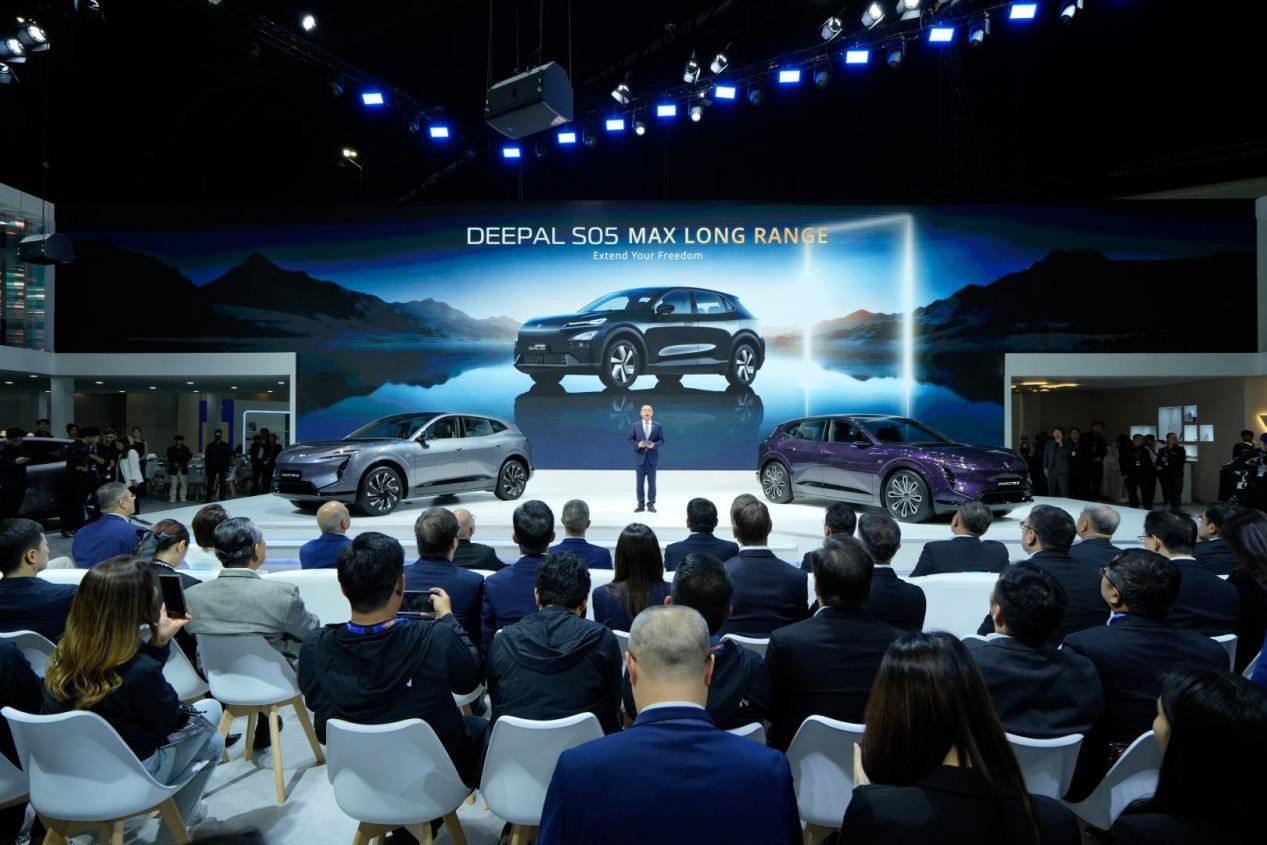
Changan’s Vast Ocean Plan is intended to move from vehicle exports toward localized products, factories, supply chains, sales and service. The company launched Changan, Deepal and Avatr in Europe in March 2025. Its first overseas NEV factory opened in Rayong, Thailand in May 2025; by November the company said it employed more than 1,000 local workers and had approximately 60% local content.
In April 2026, the group said it sold in 118 countries through 1,124 outlets and operated 22 overseas manufacturing bases with combined capacity of 350,000 units. Those are company-reported network figures. They do not mean every model is homologated, stocked or covered by factory warranty in every market.
Targets are not results
Changan’s January 2026 partner conference set full-year targets of 3.3 million total sales, 1.4 million NEV sales and 750,000 overseas sales. In April, the parent group described 2030 ambitions including 2.4 million annual NEV sales, 1.5 million overseas sales and RMB600 billion in revenue. A 2025 global presentation separately described more than five million annual vehicle sales by 2030.
These are management targets and strategic plans, not forecasts guaranteed by the exchange. The first-half listed-company sales decline shows why the difference matters. Readers should track actual monthly sales, audited margins, cash flow, brand-level disclosures and local-market availability rather than extrapolate from a launch event.
What to watch next
- Scope clarity: whether Changan reports group, listed-company and brand results with easier reconciliation.
- Deepal economics: whether higher sales and new outside capital can turn the controlled subsidiary profitable.
- Avatr execution: whether the Huawei-enabled product pipeline, Yinwang investment and possible Hong Kong listing improve scale without blurring ownership claims.
- Nevo identity: whether the NEVO global name becomes recognizable without splitting authority from the Changan master brand.
- Profit conversion: whether NEV and overseas growth translate into stronger attributable profit and operating cash flow.
- Global aftersales: whether Europe, Thailand, Brazil and other markets gain durable service, parts and warranty coverage.
For wider context, compare Changan’s batteries with BYDToday’s 2026 EV battery guide, its overseas numbers with the China NEV export tracker, and its portfolio with the Chinese EV company landscape.
Explore the wider system: Use the China NEV Knowledge Hub to move between company and leader Owners, technologies, vehicles and markets.
Frequently Asked Questions
What is Changan Automobile?
Changan Automobile is a Shenzhen-listed Chinese automaker controlled through the state-owned China Changan Automobile Group. Its operations include Changan-branded vehicles, Deepal, Avatr interests and joint ventures.
Did Zhu Huarong found Changan?
No. Changan traces its industrial heritage to 1862 and automobile production to 1984. Zhu Huarong is the current chairman and transformation leader, not the company’s founder.
Are Deepal, Avatr and Changan Nevo the same company?
No. Deepal is a controlled Changan subsidiary, Avatr is a separate associate led by Changan as its largest shareholder, and Nevo is an electrified product sequence within the Changan brand.
Does Huawei own Avatr?
No. Huawei supplies intelligent-driving and cockpit technology but does not hold Avatr equity. Changan is Avatr’s largest shareholder, while CATL is also an investor.
How many vehicles did Changan sell in 2025 and the first half of 2026?
Changan reported 2,913,260 vehicle sales in 2025. Its listed-company sales bulletin reported 1,118,894 for the first half of 2026; broader group communications reported 1.1956 million deliveries.
What are Changan’s 2030 targets?
Changan has described targets including more than five million annual vehicle sales, 1.5 million overseas sales and 2.4 million NEV sales by 2030. These are company plans, not completed results.
Sources
- Shenzhen Stock Exchange, Changan Automobile 2025 annual report summary
- Shenzhen Stock Exchange, first-quarter 2026 report
- Changan Automobile, 2025 sales and 2026 partner targets
- China Changan Automobile Group, current group leadership news
- Global Changan, company and brand overview
- Global Changan, April 2026 group strategy and 2030 targets
- Global Changan, SDA Intelligence and sodium-ion strategy
- CATL, Changan sodium-ion production partnership
- Hong Kong Stock Exchange, Avatr June 2026 listing application
- Global Changan, European brand launch
- Global Changan, Thailand factory and NEV lineup update
- BYDToday, Source Methodology and Editorial Policy