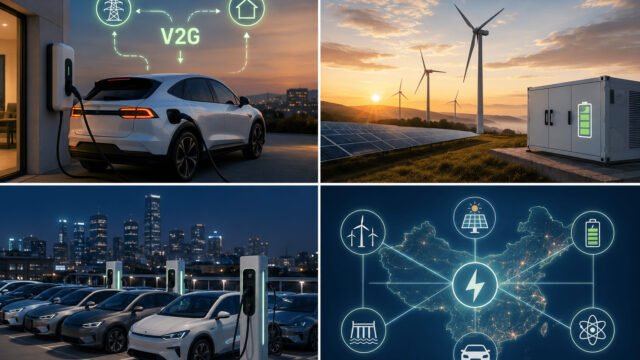
Quick Answer: China had 24.777 million EV charging connectors at the end of September 2026: 5.207 million public and 19.570 million private, according to the National Energy Administration. Those are connector—or “charging gun”—counts, not charging-station counts. Public rated capacity reached 266 GW, but capacity is not utilization. Battery-swap stations are a separate infrastructure class and must not be added to connector totals.
Last updated: October 27, 2026. The latest national snapshot covers end-September 2026 and was published by the National Energy Administration on October 22. This update adds September counts and an August-to-September comparison. Earlier monthly comparisons, Hubei supervision and National Day highway-demand evidence remain individually dated; these measures do not establish uptime or waiting times.
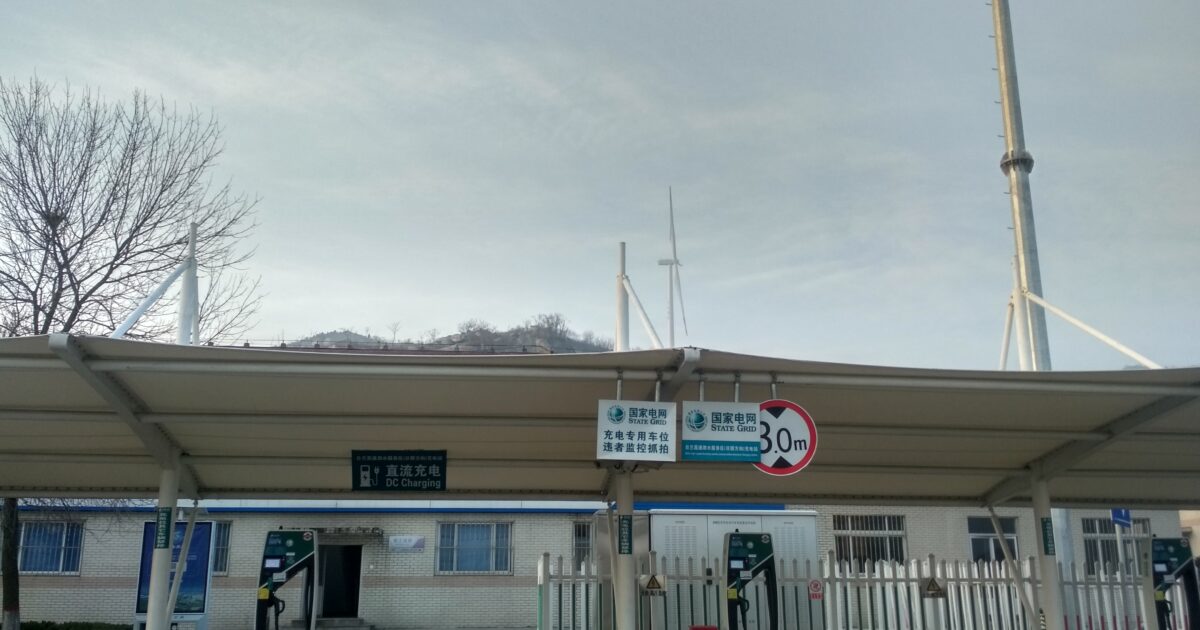
Cover: State Grid DC charging equipment in China, photographed January 4, 2020. Historical illustration, not a 2026 installation. Photo: Air7538 / Wikimedia Commons, CC BY-SA 4.0. Resized by WordPress; no editorial crop.
Page role: This is BYDToday’s single owner for China EV charging infrastructure. It explains network scale, public and private charging, DC fast charging, megawatt-class systems, standards, operators, utilization, battery swap and vehicle-to-grid. Brand-specific deployment stories remain supporting pages.
China’s charging network in one table
The National Energy Administration’s monthly series is the best starting point because it states the unit being counted. In the September 2026 release, “charging infrastructure” is explicitly reported as charging guns. A site with ten connectors can therefore contribute ten to the national total while remaining one station. A cabinet, power module or platform connection is another possible unit and should never be substituted without a definition.
| Metric | Official result | Year-on-year change | Correct interpretation |
|---|---|---|---|
| Total charging infrastructure | 24.777 million | +37.2% | Charging connectors/guns, not stations or sites. |
| Public charging infrastructure | 5.207 million | +16.3% | Public connectors/guns accessible through public or commercial networks. |
| Public rated power | 266 GW total; 51.10 kW per connector on average | Not stated in the release | Nameplate capacity. It does not show energy delivered, occupancy or uptime. |
| Private charging infrastructure | 19.570 million | +44.0% | Private connectors/guns, mainly residential and other non-public installations. |
| Private declared supply capacity | 167 million kVA | Not stated in the release | Reported electrical connection capacity; it is not directly interchangeable with public rated charging power. |
Public and private data also describe different operating systems. Public charging depends on site access, payment, parking, maintenance and the local distribution grid. Private charging is usually slower but can exploit long dwell times at home or work. A large private-connector count therefore does not mean those connectors can absorb highway or city-centre demand.
What changed from August to September 2026?
China’s reported charging-connector stock grew by 554,000 in September, but only 47,000 of that net increase was public. BYDToday calculated the differences from the August NEA release and the September NEA release. The comparison measures changes in reported month-end stock, not gross installations, unique charging sites or new locations available to every driver.
| Metric | End-August | End-September | Net change |
|---|---|---|---|
| Total connectors | 24.223 million | 24.777 million | +554,000 |
| Public connectors | 5.160 million | 5.207 million | +47,000 |
| Private connectors | 19.063 million | 19.570 million | +507,000 |
| Public rated power | 262 GW | 266 GW | +4 GW |
| Average public rated power | 50.69 kW | 51.10 kW | +0.41 kW |
| Private declared supply capacity | 163 million kVA | 167 million kVA | +4 million kVA |
Private connectors accounted for approximately 91.5% of the net increase: 507,000 divided by 554,000. They represented about 79.0% of total reported stock at September’s end. For drivers without a private parking space or permission to install charging, the national headline therefore overstates the expansion in potentially accessible public options. Even the 47,000-public-connector increase does not identify locations, access hours, prices or working equipment.
Public rated power rose about 1.5% while the public connector count rose about 0.9%, using the rounded NEA totals. The higher 51.10 kW average describes the installed power mix, not a measured average charging session. It cannot establish shorter queues, charger availability or the charging curve of a particular vehicle. Private declared capacity is stated in kVA and must not be added to public output in kW as if they were identical measures.
What remains unknown: the short September release gives no nationwide session-success rate, downtime, time occupancy, site-level demand or map of new public connectors. Route planning and fleet investment still require local operating evidence. The National Day highway charging figures below cover a later holiday-demand window, not September’s connector stock.
Earlier comparison: July to August 2026
BYDToday calculated the differences below from the two NEA month-end releases. These are net changes in reported stock, not gross installations or a count of new stations.
| Metric | End-July | End-August | Net change |
|---|---|---|---|
| Total connectors | 23.683 million | 24.223 million | +540,000 |
| Public connectors | 5.099 million | 5.160 million | +61,000 |
| Private connectors | 18.584 million | 19.063 million | +479,000 |
| Public rated power | 255 GW | 262 GW | +7 GW |
| Average public rated power | 49.97 kW | 50.69 kW | +0.72 kW |
| Private declared capacity | 160 million kVA | 163 million kVA | +3 million kVA |
Private connectors supplied approximately 88.7% of the net increase (479,000 divided by 540,000). Drivers planning a public-charging route should therefore not treat the headline increase as 540,000 additional public options. The public series grew by 61,000 connectors, without specifying their locations, availability or simultaneous usable power.
Public rated power increased about 2.7%, faster than the roughly 1.2% increase in public connector count. This is consistent with a higher average rated-power mix, but does not identify which sites were upgraded or establish faster real-world sessions. Rounded aggregate figures cannot recover a charging curve, waiting time or utilization rate.
Private connectors were approximately 78.7% of the August total. This remains a system dominated by restricted-access charging, not a count of public places where any driver can plug in.
What is being counted?
China’s industry reporting uses several units that are often translated loosely as “chargers” or “charging piles.” The distinction is essential for SEO comparisons, investment analysis and driver expectations.
| Unit | What it usually means | Can it be added to connector totals? | Common error |
|---|---|---|---|
| Connector / charging gun | One physical outlet or cable that can charge one vehicle at a time. | Yes, when the source explicitly counts guns/connectors. | Calling every connector a station. |
| Charging device / pile | A pedestal, dispenser or cabinet; it can have one or more connectors. | Only if the source defines one device as one counted connector. | Assuming a dual-gun device equals one gun. |
| Station / site | A location containing one or many charging devices, bays and connectors. | No. | Multiplying a site count by an assumed number of chargers. |
| Platform-connected point | A third-party connector visible or payable through an app or roaming platform. | Not as operator-owned infrastructure. | Presenting aggregated access as asset ownership. |
| Rated power | Maximum nameplate output of a connector, cabinet or site under stated conditions. | Not a count. | Calling rated power the real charging speed or utilization rate. |
| Battery-swap station | A site that exchanges a compatible battery pack. | No, unless it contains separately counted charging connectors. | Adding swap stations to charging guns to create a “network total.” |
The end-2025 national release illustrates why the label matters. It reported 71,500 charging piles across more than 98% of highway service areas. That figure is useful for coverage, but it cannot be compared one-for-one with the monthly series of public charging guns without checking the underlying definition.
Public, private and destination charging serve different jobs
Private charging is the volume base
Private connectors represented about 79.0% of the September 2026 national total. Their advantage is time: a car parked overnight does not need maximum power. A modest AC charger can restore a normal day’s driving while the vehicle would otherwise be stationary. The constraints are parking-space ownership, property approval, meter installation, transformer capacity and access for renters or older residential communities.
The national 2025–2027 action plan therefore requires new residential developments to build charging facilities or reserve installation conditions for 100% of fixed parking spaces. Existing communities are encouraged to use coordinated construction and operation models rather than leaving every owner to solve grid and property issues alone.
Public charging is the mobility safety net
Public networks support drivers without home charging, urban fleets, taxis, ride-hailing vehicles and long-distance travel. Their success depends on more than connector count: the right power at the right location, working payment, clear pricing, accessible bays, queue management and reliable maintenance all matter.
China’s three-year plan sets a 2027 national target of 28 million charging facilities and more than 300 GW of public charging capacity, sufficient in policy terms to support more than 80 million EVs. These are targets, not achieved results. The plan also identifies uneven rural coverage, insufficient residential access and an under-optimized public power mix as current weaknesses.
Destination and fleet charging optimize dwell time
Shopping centres, hotels, offices, depots and logistics hubs sit between home and highway use. A fleet depot can schedule vehicles and power demand centrally. A retail destination may prioritize longer dwell time and parking turnover. The business model, tariff and ideal charger power can therefore differ even when the hardware looks similar.
DC fast charging and megawatt-class charging
Charging speed is a system result. The number printed on a dispenser is only one ceiling. Vehicle voltage, battery chemistry, starting state of charge, pack temperature, thermal management, cable current, charger sharing and the site’s grid connection can all reduce the power seen by the car.
China’s 2023 update to the familiar GB/T DC interface—often called the “2015+” standard—kept backward compatibility while raising maximum current from 250 A to 800 A and supported charging power to 800 kW. It also added active cooling and temperature-monitoring requirements. A separate high-power DC coupler standard, GB/T 20234.4-2023, entered force on April 1, 2024.
“Megawatt-class” normally describes a peak nameplate capability of at least 1 MW. It does not mean every session holds one megawatt, that every car can accept it or that the national GB/T connector fleet has that capability. Passenger-car announcements can use proprietary or multi-connector implementations, while electric heavy trucks have different duty cycles and site-power requirements. BYDToday keeps BYD’s 1,000V vehicle and station claims in the dedicated Flash Charging guide.
Safety is also a system requirement. GB 44263-2024, the mandatory national safety standard for conductive EV charging systems, took effect on August 1, 2025. Higher power increases the importance of connector temperature, insulation, cooling, cable condition, protective controls and station maintenance; it does not remove those requirements.
Who owns and operates China’s charging network?
No single company owns China’s national charging total. The ecosystem includes grid companies, dedicated operators, automakers, roaming platforms, hardware suppliers, property owners and millions of private users. Operator rankings are meaningful only when they define whether they count owned connectors, operated connectors or platform-connected third-party points.
| Role | Examples | What the role can include | What not to assume |
|---|---|---|---|
| Grid-backed networks | State Grid e-charging; China Southern Power Grid Shunyichong | Grid connection, station investment, operation, payment and public-service coverage. | The whole national grid is not one company’s owned charging network. |
| Dedicated owner-operators | TELD; Star Charge | Station development, equipment, operation, energy sales, service fees and software. | Every connector visible in the app is not necessarily owned by the platform. |
| Aggregation and roaming | YKC; mobility and map platforms | Discovery, payment, roaming and access to multiple operators. | Platform-connected points are not equivalent to owned assets. |
| Automaker networks | NIO; Tesla; XPeng; Li Auto; BYD | Branded charging, customer benefits, route coverage and vehicle integration. | A vehicle’s peak charge claim does not describe every network connector. |
| Equipment and solution suppliers | Huawei and other cabinet, module, connector and software suppliers | Hardware sales, power electronics, liquid cooling, energy management and maintenance. | Equipment shipments do not prove station ownership or operation. |
| Private and property installations | Households, workplaces, depots and building operators | Restricted-access charging tied to parking and local electrical capacity. | Private connectors cannot automatically serve public demand. |
What does provincial oversight reveal about charging reliability?
A national connector count does not establish whether a particular charging session will work. A September 21, 2026 report from the National Energy Administration’s Central China regulatory bureau documents oversight of charging construction and operation in Hubei. It describes on-site supervision involving four charging-operation and power-supply enterprises, alongside engagement with the provincial energy administration.
The work covered planning, charging capability, operating services, safety responsibilities and power-supply support. The bureau highlighted price competition, monitoring-platform data governance and distribution-grid capacity as issues to examine. Its checks included electricity-price implementation and grid-connection applications.
Evidence boundary: this is a provincial supervisory update, not a national charger-reliability survey. The report gives no failed-session percentage, repair-time average or nationwide uptime result. It describes follow-up remediation as further work, not a completed finding that all problems have been fixed. September 21 is the publication date; the report does not give a separate date for every inspection.
How can drivers check a charging site before relying on it?
The following is BYDToday’s practical checklist, not a regulator-issued inspection standard. It turns the difference between an infrastructure total and a usable service into questions a driver can answer before departure:
- Check the actual location: confirm opening hours, access restrictions and the exact entrance. A point appearing on a map is not proof that its parking bays are accessible when you arrive.
- Check the payment route: establish which app, account or payment method is required before committing to a low-battery arrival. Save the operator’s support contact.
- Read the whole price: distinguish electricity, charging-service, parking and idle fees where listed. Record the displayed terms rather than assume all nearby sites use the same tariff.
- Plan an alternative: choose another reachable site and leave a reserve appropriate to the route. A national connector total cannot substitute for local availability.
- Document a failed session: retain the site and connector identifier, time, error message and payment record when contacting the operator. Do not infer a network-wide failure rate from one incident.
Fleet managers can apply the same distinction to procurement: request site-level availability records and a defined maintenance response process rather than treating installed connector count as a service guarantee. The utilization metrics below explain why uptime, occupied time and energy delivered answer different questions.
What did National Day highway charging demand show?
The National Energy Administration’s October 8, 2026 report covers October 1–7, not October 22. Its monitoring platform covered 62,700 highway charging connectors and recorded 6.711 million charging sessions using 163 million kWh. The agency reported average daily energy of 23.2566 million kWh, up 51.42% year on year.
This measures holiday electricity demand within the monitored highway network. It is not a new nationwide connector-stock total, a count of unique vehicles, or a utilization percentage. Repeat sessions can belong to the same vehicle; energy consumed and installed rated power answer different questions.
What remains unknown: the release does not provide station-level queues, failed-session rates or the distribution of waiting times. Higher aggregate demand cannot establish that every route had spare capacity or that every driver avoided delays.
Trip-planning implication: use this as evidence of holiday demand, not a service guarantee. Check the specific site’s live availability and vehicle compatibility, identify a backup stop, and allow time for local congestion. A national growth rate cannot replace those route-level checks.
Utilization: why there is no honest single national percentage
The old shorthand of assigning China one national charging-utilization percentage is not suitable for this owner page. A percentage is meaningless until the numerator, denominator, time period and scope are stated. National Energy Administration data reports connector counts and rated capacity; it does not publish one universal utilization percentage for every public and private site.
| Metric | Example definition | What it answers | Main limitation |
|---|---|---|---|
| Operational availability | Time a connector can start and complete a session ÷ scheduled service time | Is the equipment working? | High availability does not prove customer demand. |
| Time occupancy | Minutes actively charging ÷ available connector-minutes | How often is the connector physically in use? | A slow session raises occupancy without necessarily raising energy throughput. |
| Energy throughput | kWh delivered per connector per day | How much energy does the asset sell? | Needs comparable connector type, location and period. |
| Power capacity factor | Energy delivered ÷ (rated power × elapsed time) | How much of nameplate capacity is used over time? | Low values can be normal for peak-demand infrastructure. |
| Bay utilization | Occupied parking-bay time ÷ available bay time | Is the site congested? | Can include queuing, idle parking or vehicles no longer charging. |
| Swap throughput | Completed swaps per station per day | How much a swap site is used? | Theoretical maximum depends on pack inventory, charging, staffing and vehicle mix. |
A city-centre fast charger, an overnight apartment charger and a holiday-only highway overflow site should not share one benchmark. The better comparison is within similar power, access, location and demand profiles. Rated public power of 51.10 kW per connector in September 2026 is a capacity indicator, not proof that the average session ran at 51.10 kW.
The National Energy Administration separately reported that China’s charging-and-swapping service sector used 16.4 TWh of electricity in July, up 50.3% year on year. That sector-level electricity figure is evidence of growing activity, but it is not a connector-utilization rate or a direct measure of energy dispensed at public chargers. It can include swapping services and facility electricity use.
Battery swapping is a parallel network, not a charger count
A battery-swap station removes a depleted pack and installs a charged compatible pack. The experience can be faster and more predictable than DC charging, but it requires standardized vehicle interfaces, pack inventory, charging and thermal management behind the station, land, capital and high enough throughput.
NIO, CATL and other swap operators use different vehicle, pack and network architectures. Their station totals are therefore not automatically interoperable. Nor should a swap station be added to the national count of charging guns. If an integrated site has a swap bay plus eight charging connectors, the correct description is one swap station and eight charging connectors.
For network scale, vehicle compatibility and business-model limits, see BYDToday’s NIO Battery Swap and BaaS guide. NIO and CATL deployment stories carry dated company claims; this page owns the cross-industry infrastructure definition.
V2G: real pilots, not yet a universal revenue stream
Vehicle-to-grid allows a compatible EV and bidirectional charger to send energy back to the grid or a local energy system. Smart charging without export is a related but simpler tool: it shifts charging to times when electricity is cheaper or the grid has more capacity.
China’s first national V2G scale pilots cover nine cities and 30 projects. The 2025 notice asks grid companies to support connection, metering, dispatch and market participation. The National Energy Administration said in April 2026 that work was continuing on price incentives, technical standards, reverse-discharge equipment and large-scale testing. That is evidence of active deployment, but also evidence that the market rules and hardware base are still being developed.
V2G revenue therefore cannot be reduced to one guaranteed annual amount. It depends on local tariffs, market access, battery and vehicle permissions, bidirectional hardware, dispatch frequency, efficiency losses, degradation treatment and the customer contract. BYDToday’s China grid and V2G investment report is a dated supporting page, not a substitute for those project-level checks.
What drivers and investors should verify
- Drivers: check connector compatibility, real charger status, price components, parking fees, peak/off-peak tariffs, recent user reports and whether the route has alternatives.
- Fleet operators: model dwell time, daily energy, simultaneous demand, transformer capacity, charger sharing, maintenance response and demand charges.
- Site investors: separate land and grid-connection risk from hardware cost; forecast kWh throughput and service revenue rather than relying on connector count.
- Network analysts: state the date and unit beside every number; distinguish owned, operated and platform-connected assets.
- Vehicle buyers: treat a peak charging-power claim as a best-case ceiling until the model’s charging curve, temperature range and compatible local infrastructure are verified.
Explore the wider system: Use the China NEV Knowledge Hub to connect national infrastructure data with company, charging-technology, battery-swap, vehicle and market guides.
Frequently Asked Questions
How many EV chargers does China have in 2026?
At the end of September 2026, China had 24.777 million charging connectors or guns: 5.207 million public and 19.570 million private. This is not a count of charging stations.
What is the difference between a charger, charging gun and station?
A charging gun or connector serves one vehicle at a time. A charging device can have one or more connectors. A station or site can contain many devices, connectors and parking bays. Sources must define which unit they count.
Is China’s average public charger power the same as charging speed?
No. The September 2026 average of 51.10 kW is public rated power per connector. A vehicle’s real session depends on its battery, state of charge, temperature, voltage, charging curve, cable and site power.
Does China use one DC fast-charging standard?
China’s updated GB/T 20234.1 and 20234.3 interface remains backward-compatible with the 2015 system and supports up to 800 A and 800 kW. GB/T 20234.4 defines a separate high-power DC coupler. Proprietary and multi-connector systems also exist.
Are battery-swap stations included in China’s charger total?
No. A swap station is a separate facility. Only charging connectors installed at the same site should enter a connector count, and the source must count them separately.
Is V2G already a nationwide commercial service in China?
Not universally. China has nine pilot cities and 30 first-batch projects, while pricing, standards, reverse-discharge equipment and market participation are still being tested and expanded.
Does China’s charger count prove that public charging is reliable?
No. Connector totals and rated power do not measure successful sessions or uptime. The September 21, 2026 Hubei supervisory report addresses operating-service and grid issues but gives no national failure rate or completed-remediation result.
Primary and institutional sources
- National Energy Administration, September 2026 national charging-infrastructure data, October 22, 2026; checked October 27.
- NEA Central China regulatory bureau, Hubei charging-facility construction and operating supervision, September 21, 2026; checked October 20.
- National Energy Administration, August 2026 national charging-infrastructure data, September 23, 2026
- National Energy Administration reliability and quality-supervision centre, July 2026 national charging-infrastructure data, released August 24 and posted August 25, 2026
- National Energy Administration, July and January–July electricity-consumption data, August 21, 2026
- National Energy Administration, May 2026 national charging-infrastructure data, June 24, 2026
- National Energy Administration, end-2025 network and highway coverage, January 21, 2026
- National Energy Administration, Q1 2026 charging and V2G briefing, April 27, 2026
- National Development and Reform Commission, 2025–2027 charging-capability action-plan Q&A, October 15, 2025
- National Development and Reform Commission, first V2G scale-application pilot notice, April 2, 2025
- Ministry of Industry and Information Technology, GB/T 20234.1 and 20234.3 “2015+” standard update, September 13, 2023
- National Standard Information Public Service Platform, GB/T 20234.4-2023 high-power DC coupler
- National Standard Information Public Service Platform, GB 44263-2024 conductive charging safety requirements