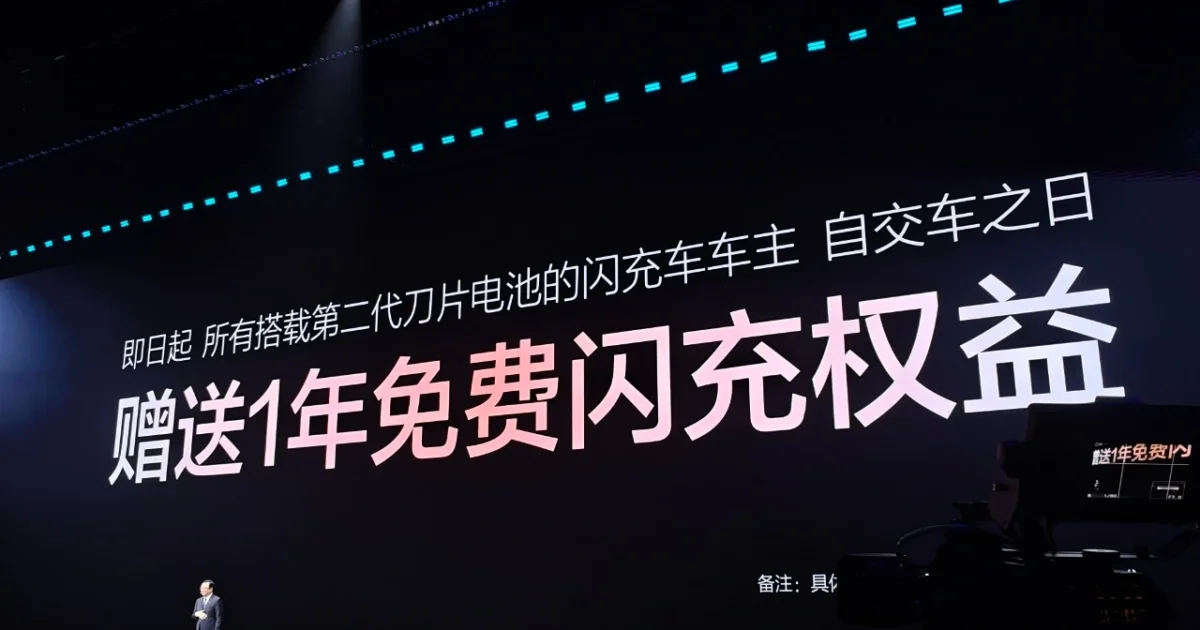
BYD CTO Sun Huajun rebukes CATL’s claim that LFP batteries in premium vehicles amount to cost-cutting, as the two battery giants clash over the definition of automotive luxury. BYD Battery Business Group CTO Sun Huajun delivering the company’s response to CATL’s premium battery claims.
The quote dispute is based on Sina Finance coverage of BYD’s response to CATL, with IT Home and 36Kr used for quote and technology-context checks.
The Spark: CATL CTO Declares NMC the Only Choice for Premium EVs
The controversy erupted on April 21, 2026, when CATL Chief Technology Officer Gao Huan took the stage at the company’s annual technology day and made a statement that sent shockwaves through the industry: “NMC (nickel-manganese-cobalt) ternary lithium batteries are the optimal solution for high-end, long-range electric vehicles.” He went further, asserting that “using LFP (lithium iron phosphate) batteries in vehicles priced above about $34,500 constitutes a form of configuration downgrade.” The remark was widely interpreted as a direct attack on BYD, which has built its entire EV lineup around LFP blade battery technology. BYD sells millions of vehicles annually, many above the about $34,500 threshold, all powered by LFP packs. Gao’s framing effectively positioned BYD’s entire premium strategy as delivering less value than competitors who opt for ternary NMC chemistry. The statement ignited fierce debate on Chinese social media, with automotive commentators split on whether battery chemistry alone should determine a vehicle’s luxury credentials.
Sun Huajun’s Rebuttal: The Whole Car, Not One Component
Nearly one month later, on May 22, BYD Battery Business Group CTO Sun Huajun delivered a forceful public response. “Battery suppliers have no standing to define what constitutes a premium vehicle,” Sun stated bluntly. “The core of premium positioning lies in the consumer’s comprehensive driving experience, not the parameters of a single component. Battery manufacturers should not overstep their role and dictate the value proposition of an entire vehicle.” Sun’s argument was both philosophical and practical. A car, he argued, is a system of systems — chassis engineering, suspension tuning, NVH (noise, vibration, harshness) control, interior materials, intelligent cockpit software, driver assistance capabilities, and yes, battery technology. To reduce the premium-or-not question to battery chemistry alone is to fundamentally misunderstand automotive engineering. The CTO pointed to BYD’s recent technological breakthroughs as evidence that LFP technology is no longer a compromise.
BYD’s Flash Charge Technology Redefines LFP Performance
Sun backed his argument with concrete technical achievements. In March 2026, BYD launched its second-generation Blade Battery with flash charging capability, setting a global production vehicle charging speed record. Under normal temperatures, the system can charge from 10% to 70% in just 5 minutes, and from 10% to 97% in 9 minutes. Even more impressive, the system maintains high-speed charging performance at minus 30 degrees Celsius, shattering the long-standing perception that LFP batteries suffer from poor cold-weather performance and slow charging speeds. These advances are transformative for the consumer experience. A driver of a BYD vehicle equipped with the second-generation Blade Battery can add hundreds of kilometers of range during a brief coffee stop. The technology effectively eliminates one of the last remaining practical advantages of NMC over LFP — charging speed. Sun acknowledged that LFP has inherent energy density limits compared to NMC but expressed confidence that BYD will further improve system-level energy density “within a few years,” narrowing the remaining gap. Source: Kuai Keji (mydrivers.com), May 22, 2026. Author: Wang Yi.