As China’s EV market matures from growth-first to profit-focused, Q1 2026 financials expose which startups are winning the new race.
Earnings comparisons are based on CnEVPost coverage of NIO’s Q1 results, Li Auto reporting, XPeng filings, and Leapmotor earnings coverage.
China’s NEV startups Q1 2026 financials: Li Auto leads profitability while others race to break even.
Profitability League Table
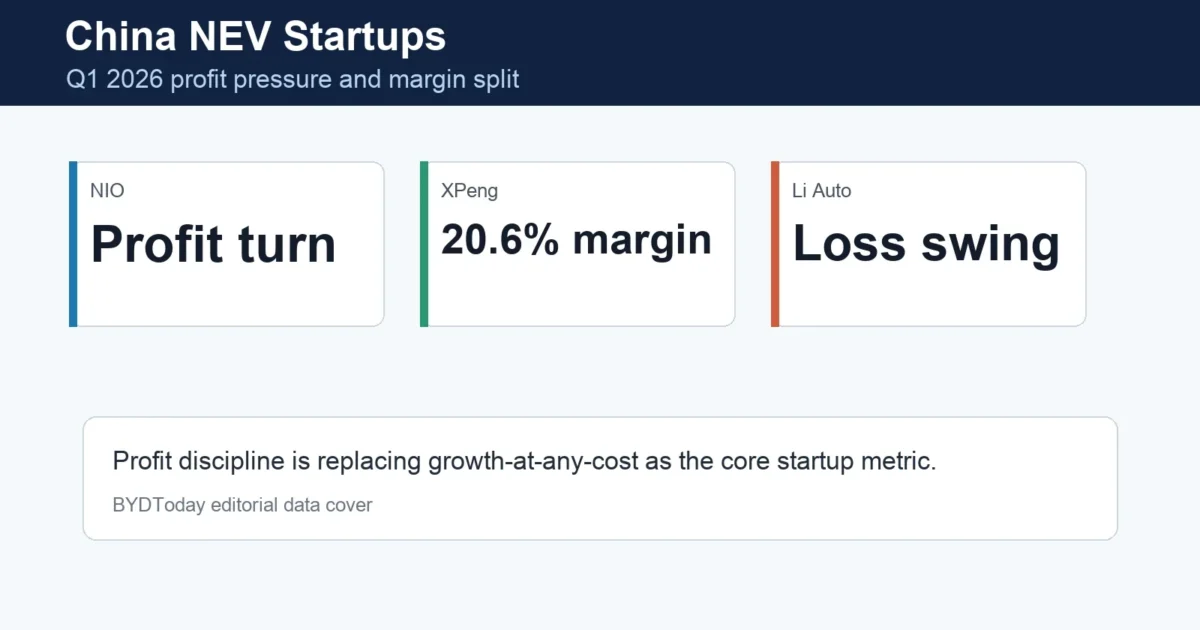
Q1 2026 financial results reveal a clear profitability hierarchy. Li Auto reported revenue of 31.24 billion yuan with net profit of 1.87 billion yuan, making it China’s only consistently profitable EV startup. The company’s vehicle gross margin of 21.3% is the highest among peers. Li Auto closed Q1 with 89.7 billion yuan in cash reserves.
Leapmotor came in second on profitability, reporting net profit of 320 million yuan in Q1. Its Q1 vehicle gross margin of 12.5%, breaking through the 10% threshold for the first time, signals that scale effects are finally materializing. CFO Wu Yeqin has guided for significant gross margin improvement in Q2.
NIO and XPeng Chase Break-Even
Both NIO and XPeng posted dramatic improvements in their loss figures. NIO’s Q1 net loss narrowed 60% year-over-year to 820 million yuan, on revenue of 15.83 billion yuan. Founder William Li Bin stated that NIO is targeting quarterly break-even by Q4 2026 and full-year profitability by 2027. NIO’s vehicle gross margin improved 5 percentage points year-over-year to 15.8%.
XPeng narrowed its Q1 net loss by more than 80% to 210 million yuan, on revenue of 13.47 billion yuan, up 25%. CEO He Xiaopeng indicated that XPeng is targeting quarterly break-even by Q3 2026, a timeline that would put it ahead of NIO on the break-even clock.
R&D Spending Remains the Common Theme
One consistent thread across all Q1 results is the level of R&D investment. Li Auto spent 3.8 billion yuan (12% of revenue), NIO spent 4.2 billion yuan (26.5% of revenue), XPeng spent 2.8 billion yuan (20.8% of revenue), and Leapmotor spent 1.2 billion yuan (10% of revenue). These investments are the price of admission to the intelligent driving arms race.
Xiaomi Auto remains in investment mode: 12 billion yuan in Q1 losses on revenue of 18.03 billion yuan, with break-even targeted for Q4 2026. As China’s EV market transitions from ‘spend-to-grow’ to ‘earn-to-survive,’ quarterly financial reports serve as a progress report on which companies can sustain both fierce competition and heavy technology investment simultaneously.