Quick Answer
The Marco Polo Drive used an all-electric Denza Z9GT on a project-stated 15,000-kilometre journey from Rome to Hong Kong in 43 days. The official route covers 31 stops across 11 countries, including the Balkans, the Caucasus, Central Asia and China. The trip documents that a manufacturer-supported electric grand tourer can cross this corridor. It is not an independent durability test because the organizers have not published a complete charging log, energy-use record, repair history or third-party test protocol.
Last verified: August 11, 2026. Route and vehicle facts are based on BYD, the Marco Polo Drive project and first-person reporting from participant Jeffrey Sachs.
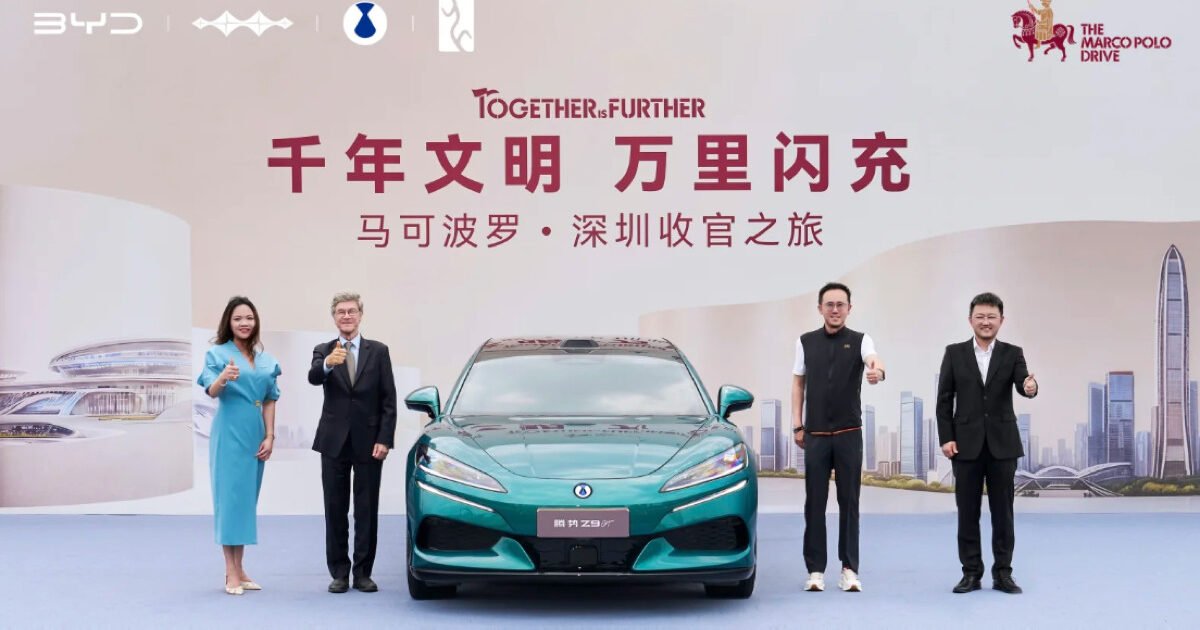
The Marco Polo Drive began in Rome in June 2026 and ended in Hong Kong in late July. Economist Jeffrey Sachs and investor Patrick Zhong led the journey, with Denza and BYD Group supporting it as vehicle partners. BYD identified the battery-electric Denza Z9GT and its Flash Charging system as central to the expedition.
The result is interesting for a reason that is narrower, and more useful, than the marketing language around it. The project created a documented cross-border use case for a new electric grand tourer and selected ultra-fast chargers. It did not publish enough technical data to certify the car, battery or charging network independently.
What route did the Denza Z9GT take?
The official project records 31 stops from Rome to Hong Kong. It reports 43 days on the road, about 15,000 kilometres and 11 countries crossed. BYD’s launch release also listed Vatican City and the countries on the planned route, so country totals can vary depending on whether Vatican City is counted separately. The stop list is the clearer record.
| Route section | Official stops | Evidence status |
|---|---|---|
| Europe and Türkiye | Rome, Maranello, Venice, Ljubljana, Zagreb, Belgrade, Plovdiv, Istanbul, Samsun, Trabzon and Rize | Listed by the official project |
| Caucasus and Central Asia | Batumi, Tbilisi, Baku, Aktau, Nukus, Khiva, Bukhara, Samarkand, Tashkent, Taraz, Almaty and Khorgos | Listed by the official project |
| China | Shanshan, Dunhuang, Xi’an, Luoyang, Suzhou, Shanghai, Shenzhen and Hong Kong SAR | Hong Kong is the final stop; Shenzhen is stop 30 |

Which Denza Z9GT completed the journey?
BYD described the expedition car as the battery-electric Denza Z9GT. The European specification announced for the trip uses a 122.49 kWh second-generation Blade Battery, a three-motor e3 platform and a claimed WLTP range above 600 kilometres. BYD quotes 850 kW, or 1,156 PS, for this version.
Those specifications describe the model, not the actual trip result. BYD and the organizers have not published a vehicle identification number, starting and ending odometer photographs, payload record or a day-by-day technical log. BYDToday therefore treats the event as a documented manufacturer-supported journey, not as a controlled road test.
Was BYD Flash Charging used on the route?
Yes, but the public evidence covers selected demonstrations rather than every charging stop. BYD says the Z9GT can charge from 10% to 70% in five minutes and from 10% to 97% in nine minutes when connected to compatible Flash Charging hardware. These are system claims, not speeds available from an ordinary public charger.
Jeffrey Sachs supplied one first-person data point from Bologna. He wrote that the car reached 97.5% in under nine minutes at a BYD Flash Charging station. BYD also announced that its first Italian Flash Charging station opened at the Denza Barchetti dealership in Bologna. BYD Europe later described Belgrade as the third stop on the journey’s Flash Charging route.
Charging context: A nine-minute result requires the matching vehicle, battery temperature, state of charge, charger and site power system. It does not mean the Z9GT will charge at that speed at every public station. See BYDToday’s BYD Flash Charging explainer for the difference between peak power, charging time and network availability.
What did the 15,000-km journey actually prove?
The project supports three limited conclusions. First, an all-electric Denza Z9GT was used for a long, multi-country journey across very different road and climate regions. Second, BYD demonstrated its Flash Charging system at selected European stops. Third, the expedition connected the vehicle launch to a real route rather than displaying the car only at motor shows.
That matters commercially. Denza is entering markets outside China, and the Z9GT is one of the first vehicles being used to introduce BYD’s newer battery and charging platform internationally. The model has also launched in Malaysia, where BYDToday separately tracks its local price, specifications and charger rollout. Read the Denza Z9GT Malaysia launch guide for that market-specific information.
What does the journey not prove?
- No independent durability certification: the trip was supported by BYD and Denza and was not run under a published third-party test protocol.
- No complete energy record: the organizers have not published total electricity consumed, average efficiency or charger-by-charger data.
- No complete reliability record: there is no public day-by-day disclosure of faults, repairs, tyres, software interventions or support vehicles.
- No proof that every driver can repeat the route today: selected Flash Charging sites and partner logistics do not establish uniform public charging access across the corridor.
- No factory or profit conclusion: the drive does not prove that BYD factories remove tariffs, reduce vehicle costs by a fixed percentage or produce a specific overseas profit margin.
Why the trip matters to BYD’s overseas strategy
The strongest strategic signal is product positioning, not a claim that one road trip changed global market share. BYD used a Denza flagship, new charging hardware and a culturally recognizable route to show how it wants the premium brand to be understood outside China.
Factories, tariffs, sales and local employment require different evidence and should not be inferred from this expedition. BYDToday maintains those measures separately in the BYD global expansion, sales and factory strategy guide. Keeping the event and the business data on separate pages prevents a promotional journey from becoming evidence for unrelated financial claims.
Verified facts versus open questions
| Claim | Status | What the source supports |
|---|---|---|
| Rome-to-Hong Kong route | Confirmed by project records | 31 listed stops; Hong Kong is the final destination |
| 43 days and 15,000 km | Project-stated | Published by the organizers and BYD; no independent odometer dataset |
| All-electric Denza Z9GT | Confirmed by BYD and participant account | The expedition used the battery-electric model |
| Under-nine-minute Bologna charge | First-person reported | Sachs reported 97.5% in under nine minutes at a BYD site |
| Full-route efficiency and reliability | Unavailable | No complete public energy, fault or repair log |
Frequently asked questions
Did a Denza Z9GT drive from Rome to Hong Kong?
The Marco Polo Drive project and BYD say the expedition used an all-electric Denza Z9GT on a 43-day, approximately 15,000-kilometre journey from Rome to Hong Kong. The official project lists 31 stops.
Was Shenzhen the final stop?
No. Shenzhen was stop 30 on the official itinerary. Hong Kong SAR was stop 31 and the final destination.
How fast did the Denza Z9GT charge?
BYD claims 10% to 70% in five minutes and 10% to 97% in nine minutes on compatible Flash Charging hardware. Jeffrey Sachs reported one Bologna session reaching 97.5% in under nine minutes. The organizers have not published every charging session from the trip.
Was the Marco Polo Drive an independent EV test?
No. It was a manufacturer-supported cultural and sustainability project. It provides a real long-distance use case, but not an independent durability, efficiency or charging-network certification.
Does the trip prove Flash Charging is available across Europe and Asia?
No. It confirms selected route demonstrations and sites. Public availability, connector access, grid capacity and vehicle compatibility still vary by country and location.
Sources
- BYD Media: Marco Polo Drive begins its 15,000-km Rome-to-Hong Kong journey, June 15, 2026.
- The Marco Polo Drive official project, route, duration and stop list.
- The Marco Polo Drive: Hong Kong final destination.
- Jeffrey D. Sachs: Marco Polo Drive of Peace, Culture and Sustainable Development, June 19, 2026.
- BYD Europe: Belgrade Flash Charging route stop and Stella Li award.