Five Battery Technologies in One Roadmap
At its Super Tech Day 2026, CATL rewrote the battery playbook with a five-product lineup spanning mass-market sodium-ion to super-premium condensed-state cells, while announcing plans to build 4,000 battery-swap-plus-fast-charge stations by year-end.
Battery technology details are based on Neware coverage of CATL Tech Day 2026 and related battery-industry reporting.
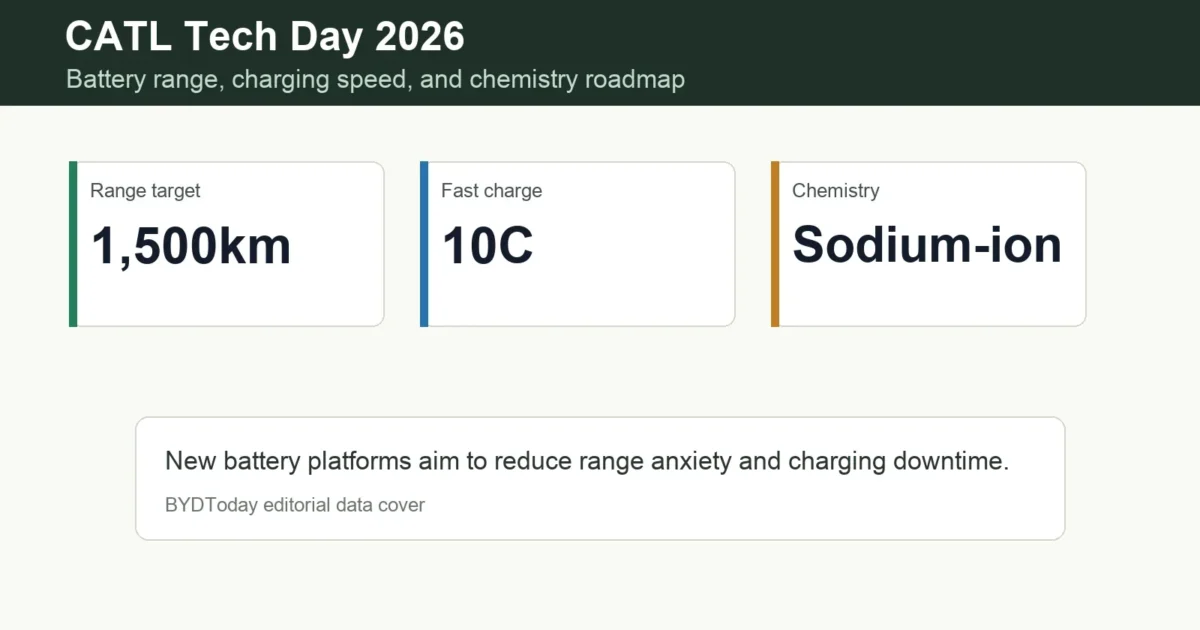
CATL’s Qilin Condensed-State Battery achieves 350 Wh/kg — a world record for mass-produced automotive batteries, enabling 1,500 km of range.
Five Products for Five Market Segments
CATL’s April 21 Super Tech Day 2026 delivered an unprecedented five-battery salvo. At the premium end, the Qilin Condensed-State Battery achieves an industry-first 350 Wh/kg energy density — sufficient for 1,500 kilometers of range in a large executive sedan — with a complete battery pack weighing under 650 kilograms. This represents the highest energy density ever achieved in a mass-produced automotive battery globally.
The third-generation Shenxing ultra-fast charging battery delivers 10C peak charging (15C maximum), taking a battery from 10% to 80% in just 3 minutes and 44 seconds, and a full 0-to-100% in 6 minutes and 27 seconds. In extreme cold at minus 30°C, it can charge from 20% to 98% in approximately 9 minutes — eliminating one of the last remaining objections to electric vehicle adoption in northern climates.
World’s First Mass-Produced Sodium-Ion EV Battery Enters Market
The NaXin (Sodium New) second-generation battery — the world’s first truly mass-producible automotive sodium-ion cell — entered volume production by end-2026. Sodium-ion batteries eliminate lithium dependency entirely, dramatically reducing raw material costs and geopolitical supply chain risk. CATL solved four critical engineering challenges: water control, hard-carbon gas generation, aluminum foil bonding, and self-generating anode technology.
The NaXin II delivers 400–600 km of pure electric range and retains over 90% capacity at minus 40°C — making it ideal for Russia, Northeast China, and other cold-climate markets where lithium batteries struggle. Launch customers include GAC Aion, Changan Auchan, Geely Star Wish, and Chery QQ3, targeting the ¥100,000–¥200,000 mainstream market segment.
From Battery Maker to Infrastructure Operator
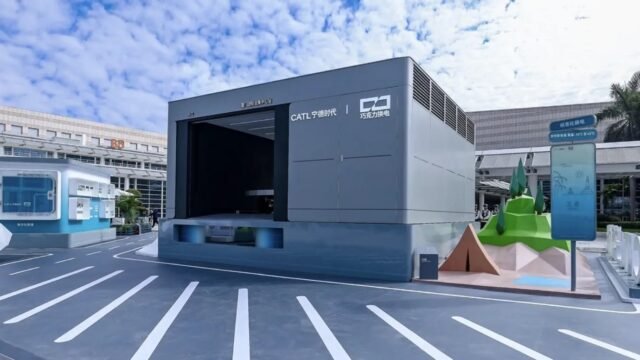
Perhaps the most transformative announcement was CATL’s infrastructure push: 4,000 combined swap-and-fast-charge stations by the end of 2026, expanding to over 100,000 by 2028 — matching China’s entire existing gasoline station network. Each integrated station features an 85% equipment reuse rate and a comprehensive power loss rate 13 percentage points lower than conventional battery-swap installations.
The V2G (Vehicle-to-Grid) function allows EV owners to sell stored electricity back to the grid during peak price hours for approximately tens of yuan per day — turning the battery into an income-generating asset. In April 2026, CATL signed a framework agreement with Sinopec to co-build 10,000 swap stations using the state oil giant’s 30,000 fuel station network, accelerating the vision of CATL becoming “the Sinopec of the electric era.”
Source references: