Quick Answer
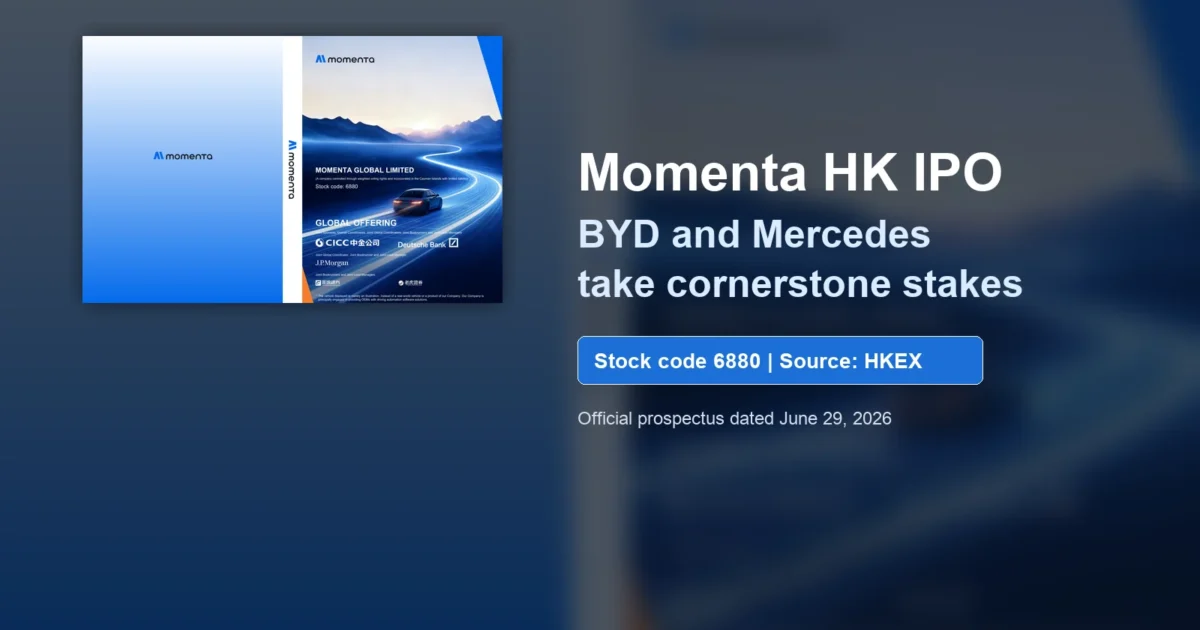
Momenta’s Hong Kong IPO is worth watching less as a one-day listing event and more as a capital-market signal for China’s smart-driving supply chain. According to Momenta’s HKEX prospectus dated June 29, 2026, Mercedes-Benz AG and BYD-linked Golden Link Worldwide Limited are existing shareholders and cornerstone investors in the offering. Mercedes is subscribing for about US$25 million, or 662,680 shares, while Golden Link is subscribing for about US$15 million, or 397,600 shares. Against a total cornerstone placing of about US$375.75 million, those tickets are small strategic signals rather than large capital commitments: roughly 6.65% and 3.99% of the cornerstone book, respectively.
Momenta is not suddenly becoming a BYD or Mercedes company. It remains an independent autonomous-driving software supplier. The important point is subtler: two major automakers, one Chinese and one European, are willing to keep a small public-market stake in a supplier whose value sits inside the next generation of Urban NOA, ADAS software, and robotaxi development.
Key IPO Terms to Know
The offering terms are straightforward, but they should be treated as preliminary until the final allotment results are published. Momenta’s HKEX filings state that the offer price is HK$295.60 per share, with stock code 6880, and expected trading on the Hong Kong Stock Exchange beginning at 9:00 a.m. on July 8, 2026. The same filing states that the offer price or number of offer shares may be reduced before the final application deadline if the coordinators and company decide to revise the offering.
| Item | Figure | Source |
|---|---|---|
| Stock code | 6880 | HKEX prospectus, June 29, 2026 |
| Offer price | HK$295.60 per offer share | HKEX global offering announcement, June 29, 2026 |
| Total offer shares | 19,938,300 shares, subject to over-allotment option | HKEX prospectus, June 29, 2026 |
| Hong Kong public offering opens | 9:00 a.m. on June 29, 2026 | HKEX global offering announcement, June 29, 2026 |
| Expected first trading date | 9:00 a.m. on July 8, 2026 | HKEX global offering announcement, June 29, 2026 |
| Total cornerstone placing | About US$375.75 million, or 9,960,080 shares at the offer price | HKEX prospectus, June 29, 2026 |
| Mercedes-Benz AG cornerstone subscription | About US$25 million; 662,680 shares; about 6.65% of the cornerstone amount | HKEX prospectus, June 29, 2026 |
| Golden Link cornerstone subscription | About US$15 million; 397,600 shares; about 3.99% of the cornerstone amount | HKEX prospectus, June 29, 2026 |
Why BYD Is Participating Through Golden Link
The BYD line in the IPO is real, but it needs to be described precisely. Momenta’s prospectus identifies Golden Link Worldwide Limited as a British Virgin Islands company wholly owned by BYD (H.K.) Co., Limited, which is in turn wholly owned by BYD Company Limited. The same prospectus states that Golden Link is an existing shareholder of Momenta.
That makes the strategic signal more interesting than the dollar amount. BYD is building its own smart-driving system under the God’s Eye and DiPilot umbrella, and BYDToday has previously covered how the company is trying to bring advanced ADAS into much lower price bands through BYD’s God’s Eye strategy. A small Momenta cornerstone stake does not mean BYD is replacing in-house development. It looks more like an option on the wider supplier ecosystem: keep building internally, but preserve exposure to an independent software Tier 1 whose Urban NOA stack may touch multiple OEM roadmaps.
That hedge matters because smart driving is not just a feature race. It is a data, validation, liability, and deployment race. A vertically integrated automaker such as BYD can still benefit from watching, investing in, or selectively using outside software suppliers, especially when those suppliers serve multiple global OEMs and accumulate cross-platform engineering experience.
Why Mercedes Keeps Showing Up
Mercedes-Benz is not a new name in Momenta’s story. The prospectus says Momenta began strategic collaboration with Mercedes-Benz in 2017 and that Mercedes-Benz AG is an existing shareholder. In the cornerstone section, Mercedes-Benz AG is again listed as a participant, subscribing for about US$25 million of the IPO shares.
For Mercedes, the signal is different from BYD’s. The European automaker has to compete in China, where local smart-driving expectations move quickly and where highway NOA, urban NOA, parking automation, and cockpit integration influence purchase decisions more than they did in the old premium-car cycle. A continued stake in Momenta gives Mercedes a financial and strategic connection to a Chinese autonomous-driving software company without implying that Mercedes is outsourcing its entire ADAS roadmap.
There is also a narrative point: a Western luxury OEM is keeping exposure to a Chinese smart-driving supplier at the exact moment geopolitical and software-supply-chain scrutiny is rising. That does not prove Chinese ADAS software will win globally, but it does weaken the simplistic view that Chinese suppliers are only relevant inside domestic brands.
What It Signals for Urban NOA and Robotaxi
Momenta’s prospectus presents the company as an autonomous-driving software supplier with two legs: solutions for mass-produced vehicles and solutions for robotaxi services. Its stronger near-term business is clearly the mass-production side. The filing says Momenta had relationships with 24 leading global OEMs and that, as of December 31, 2025, installation volume for its solutions in mass-produced vehicles exceeded 680,000 units. It also says Urban NOA installation volume in mass-produced vehicles exceeded 650,000 units.
Robotaxi is the more speculative leg. The prospectus says revenue from robotaxi services was immaterial during the track record period because the business remained at an early monetization stage. That is an important distinction for investors and industry readers. Momenta’s public-market story is not only a robotaxi story; it is a mass-production ADAS supplier story with robotaxi upside.
This is why the IPO fits a broader pattern. China’s autonomous-driving companies are moving from private technology demonstrations toward public-market comparables. WeRide and Pony.ai have already helped define investor appetite for listed autonomous-driving names, while Momenta brings a more OEM-supplier-heavy version of the thesis. For BYDToday readers, that matters because it turns smart driving from a product feature into a supply-chain capital story.
Complement or Substitute for BYD’s God’s Eye?
The better framing is complement, not substitute. BYD’s scale gives it an unusually strong reason to own core smart-driving capability: software cost per vehicle can fall rapidly when spread across millions of cars, and the company can integrate ADAS with its own vehicle architecture, electric platform, and sensor choices.
But an independent supplier such as Momenta may still be useful to BYD in three ways. First, it gives BYD visibility into a broader software supplier benchmark outside its own stack. Second, it offers optionality if certain models, markets, or features need supplier support. Third, it gives BYD a financial link to a company that may benefit even when rival OEMs adopt Momenta systems. That is a different kind of hedge from simply buying more chips or sensors.
The same logic applies to the wider China ADAS race. In a market where Huawei ADS, XPeng XNGP, Tesla FSD, BYD God’s Eye, and supplier-led systems are all competing for credibility, capital backing can become part of the product roadmap. Public investors now get a clearer way to price the supplier layer, not just the automaker layer. For more context on the competitive field, see BYDToday’s smart driving comparison and its coverage of Chinese robotaxi companies in global rankings.
Risks Investors and OEMs Still Need to Watch
The IPO documents make clear that Momenta is still loss-making. The company reported revenue of RMB742.7 million in 2023, RMB1.32 billion in 2024, and RMB2.41 billion in 2025, but it also reported net losses of RMB2.57 billion, RMB3.21 billion, and RMB3.46 billion across those same years, according to the June 29 HKEX prospectus. Its adjusted loss narrowed sharply, but profitability is not yet proven.
Robotaxi commercialization is another risk. Momenta’s own filing says robotaxi-service revenue was immaterial during the track record period and that the business remains subject to technology, regulation, capital intensity, safety, and commercial-adoption uncertainty. That matters because public markets can reward autonomy optionality quickly and punish slow commercialization just as quickly.
Customer concentration is also material. The prospectus says Momenta’s five largest customers accounted for 86.7%, 78.3%, and 62.6% of revenue in 2023, 2024, and 2025, respectively. Even with improvement, that is still a concentrated revenue base. In ADAS software, an awarded nomination does not automatically become durable production revenue if an OEM delays, changes strategy, cuts volume, or renegotiates terms.
Finally, the overseas opportunity comes with policy risk. Software-defined driving systems touch mapping, data, cybersecurity, over-the-air updates, safety certification, and sometimes national-security review. A Chinese supplier can win technical trust with global OEMs and still face regulatory friction in Europe, North America, or other markets. That is why the BYD and Mercedes subscriptions should be read as strategic confidence, not as a guarantee that Momenta’s global path will be smooth.
FAQ
Is Momenta owned by BYD?
No. Momenta remains an independent autonomous-driving software supplier. Golden Link is a BYD-linked existing shareholder and cornerstone investor, but the IPO documents do not make Momenta a BYD subsidiary.
How much are BYD and Mercedes subscribing for?
Golden Link is subscribing for about US$15 million, or 397,600 shares. Mercedes-Benz AG is subscribing for about US$25 million, or 662,680 shares. Those figures come from Momenta’s HKEX prospectus dated June 29, 2026.
Does the IPO mean BYD will stop developing God’s Eye?
No. The more likely reading is a supplier-ecosystem hedge. BYD can continue building God’s Eye internally while keeping a small strategic exposure to Momenta’s independent ADAS software business.
Why does Mercedes matter in this IPO?
Mercedes has had a long relationship with Momenta, including strategic collaboration dating back to 2017 according to the prospectus. Its cornerstone participation reinforces the idea that global OEMs still see value in China’s smart-driving software ecosystem.
Is this a robotaxi IPO?
Not exactly. Momenta has a robotaxi business, but the prospectus says robotaxi-service revenue was immaterial during the track record period. The near-term investment case is more about mass-produced Urban NOA and ADAS software, with robotaxi as longer-term upside.