Why This Matters Globally
BYD’s push toward Australia’s top-three automotive brands is not just a local milestone — it signals that a Chinese automaker can compete head-to-head with Toyota, Ford, and Mazda in a mature, developed auto market. Australia, with no domestic car industry to protect and zero tariffs on EVs, is the world’s most open testing ground. If BYD can crack the top three here, it proves the model for every other right-hand-drive, Western-aligned market — from the UK to New Zealand to South Africa. For global EV buyers, BYD’s Australian trajectory offers the clearest preview yet of what a post-ICE dealership landscape looks like.
What China Brings to the Table
At the Shark 6 Cab Chassis launch in June 2026, BYD Australia COO Stephen Collins laid out numbers that would have been unthinkable four years ago: the brand now ranks fifth nationally with roughly 9% market share, up from 16th place and 7% in 2024. The company delivered its 100,000th vehicle in April 2026 and plans to expand from 100 to 150 dealerships by year-end — with a deliberate focus on rural and provincial networks, not just metro showrooms.
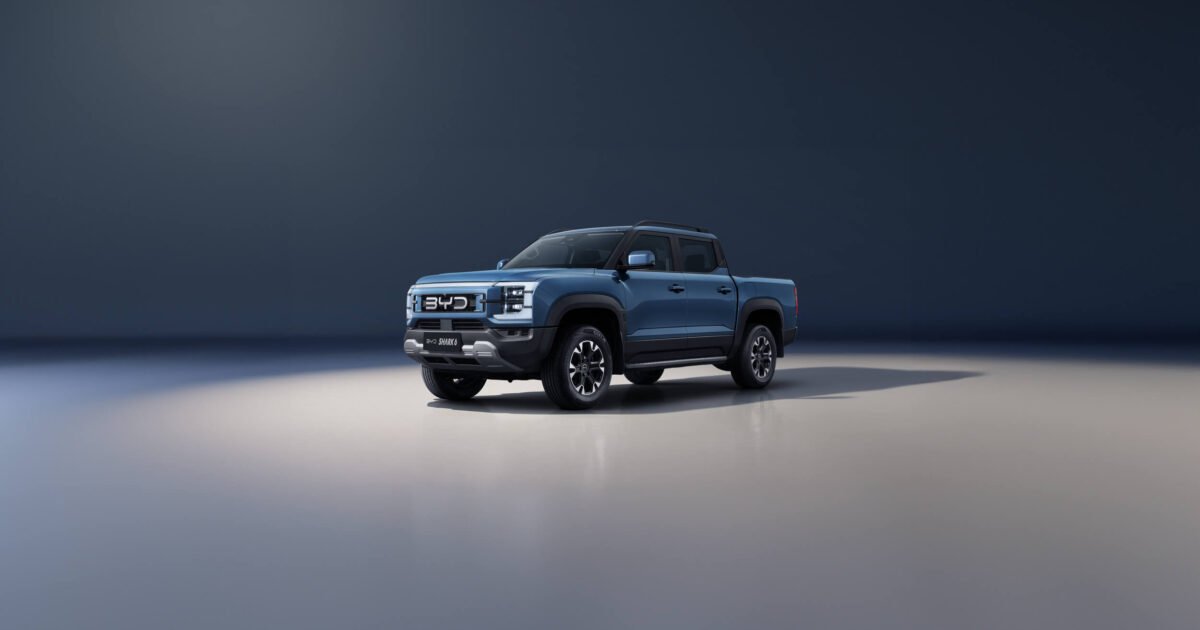
The Shark 6 plug-in hybrid ute has been the breakout star. Since its February 2025 debut, BYD has sold approximately 24,000 units, creating an entirely new PHEV ute segment where BYD now commands roughly 70% market share. The addition of Cab Chassis and Performance variants is expected to push monthly Shark sales back to the 1,500-unit range. Collins confirmed two all-new models in entirely new segments will arrive within six months, along with two major upgrades to existing models.
Behind the product offensive sits BYD’s second-generation Blade Battery and flash-charging technology, which Collins confirmed will reach Australia and New Zealand — starting with the Denza premium brand before expanding across the full BYD range. A local engineering team of 15 is now tailoring vehicles specifically for Australian conditions.
International Context
BYD’s Australian performance mirrors its global pattern: overseas markets are becoming the primary growth engine as China’s domestic market matures. In May 2026, BYD exported a record 160,644 vehicles — 42% of total volume — ending an eight-month domestic sales slump. Australia, alongside Brazil and Thailand, is one of BYD’s three volume pillars outside China and Europe.
The Australian market offers unique validation. Unlike protected European markets with tariff barriers or Southeast Asian markets with heavy government incentives, Australia’s EV adoption is purely consumer-driven. EVs and PHEVs now account for 21% of new vehicle sales, up from 13% a year ago — more than doubling in under two years without purchase subsidies. Fleet customers represent 35% of the Australian market, and BYD’s fleet penetration currently sits below that level, targeting 20% of its own mix in 2026. Councils and commercial operators that “never imagined buying a BYD” are now placing orders for Shark 6 Cab Chassis variants to replace diesel utes.
At the company’s June 9 shareholder meeting, Chairman Wang Chuanfu noted that BYD is already perceived as a premium brand in markets including Australia — a striking contrast to its budget positioning in China, where ride-hailing associations have weighed on brand image. This dual-brand reality is becoming a strategic asset: premium margins overseas offset razor-thin domestic competition.
Buyer Impact
For Australian car buyers, BYD’s top-three ambition translates into several tangible benefits. First, dealer coverage will nearly double within 18 months, meaning warranty service and parts availability in regional areas will dramatically improve. Second, the confirmed arrival of BYD’s flash-charging infrastructure — 5 minutes to charge from 10% to 70% — eliminates one of the last practical barriers to EV ownership in a country defined by long distances and sparse charging networks. Third, fleet adoption creates a secondary market of ex-fleet used EVs that will make electrification accessible to budget-conscious buyers within 3—5 years.
Collins stopped short of giving a specific 2026 sales target but said he “would still be disappointed if we’re not finishing somewhere around the top three OEMs.” For context, Toyota held roughly 18% of the Australian market in early 2026, with Mazda at 9.5% and Ford at 7.5%. With BYD already at 9% and accelerating, the podium is within reach — and that changes the purchase calculus for every Australian walking into a dealership.
Sources
- Fleet Auto News — BYD Targets Top-Three Finish as Growth Accelerates Across Australia and New Zealand
- TorqueCafe — BYD Makes History as Almost One-Third of Australia’s New Cars Come from China
- CnEVPost — BYD’s May Sales End 8-Month Decline as Overseas Volume Surges
- CarNewsChina — BYD AGM: Wang Chuanfu Projects Premium Status in Overseas Markets