NEV Exports Officially Pass the 50% Threshold
China’s NEV exports reached 424,000 units in May 2026, up 112.6% year-on-year and accounting for a record 54% of total passenger-car exports — the first time NEVs have exceeded half of China’s auto export mix. The milestone, reported by the China Passenger Car Association (CPCA) on June 8, underscores how thoroughly electrification has reshaped not just China’s domestic market but also its global trade footprint.
Total passenger-car exports hit 784,000 units in May, up 75.1% year-on-year and representing 35% of total domestic production volume — up from just 19% in May 2025. For context: in the same month five years ago, NEVs represented less than 5% of China’s auto exports. The 54% NEV export share means that for every ten vehicles China ships abroad, more than five are now electric or plug-in hybrid.
BEV Leads, PHEV Accelerates in Developing Markets
Within May’s NEV export mix, BEVs accounted for 59.3% (approximately 251,400 units) and PHEVs 36.2% (approximately 153,400 units), with EREVs making up the remaining 4.4% (approximately 18,700 units). The PHEV surge is particularly notable in developing markets — including Southeast Asia, Latin America, and the Middle East — where charging infrastructure remains uneven and buyers value the flexibility of dual powertrains.
CPCA noted that PHEV export growth substantially outpaced BEV in year-on-year terms, a trend that aligns with BYD’s global DM-i / Super Hybrid expansion and the success of Chinese PHEV models in Brazil, Thailand, and Mexico. EREVs, while still a small slice, are gaining traction in Europe where several Chinese brands have filed EREV variants for type approval.
BYD Dominates Export Rankings
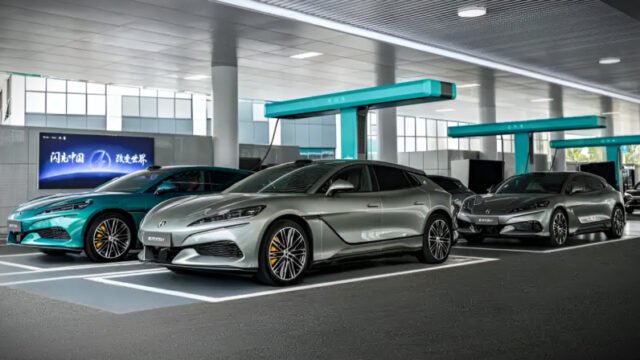
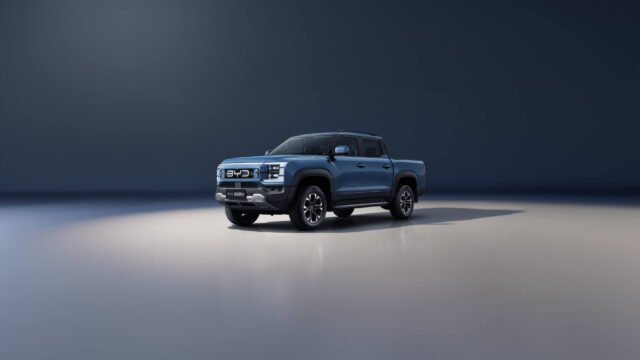
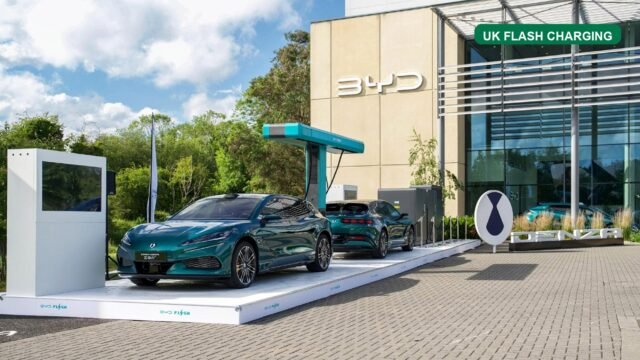
BYD remained the clear export leader in May with 155,944 units shipped abroad, extending its global lead across both NEV and total vehicle categories. Chery followed at 62,398 units, Geely at 39,811, Tesla China (exporting from Shanghai) at 38,701, and Leapmotor at 20,168 (ranking 6th, a reflection of Stellantis-assisted European distribution).
The export concentration among the top five — all Chinese brands except Tesla China — highlights how thoroughly domestic manufacturers have captured the momentum. Industry analysts note that BYD alone now accounts for approximately 37% of all NEV exports from China, a market share that would rank as a top-3 global NEV brand in many individual overseas markets.
Export Destinations and Trade Barriers
While detailed breakdowns by destination country for May 2026 have not been officially published, the established patterns from prior months show Brazil, Belgium, Thailand, Mexico, and Australia as the top NEV export destinations. Brazil in particular has emerged as Chinese NEV’s most dynamic growth market, with BYD, GAC, and Great Wall all establishing local distribution or assembly.
The 54% export NEV share also arrives amid escalating trade frictions. The European Union’s countervailing duty regime remains in force, the United States maintains a 100% tariff on Chinese NEVs, and Southeast Asian markets including Thailand and Indonesia are introducing local-content requirements. China’s NEV export machine has so far demonstrated remarkable adaptability — rerouting to developing markets, localizing assembly, and leveraging PHEV technology to bypass pure-EV restrictions.
Domestic Market Contrast: Penetration Hits 62.9%
The export surge coexists with a paradoxical domestic reality: NEV penetration hit a record 62.9% in May 2026 even as overall NEV retail sales declined marginally. The explanation is straightforward — traditional internal-combustion engine (ICE) retail collapsed by 36% year-on-year, pushing the NEV share higher even as absolute NEV sales growth moderated.
CPCA highlighted that entry-level NEV sales remained under pressure, with A00-class NEV wholesale volumes down 44% year-on-year to 87,000 units in May. The association emphasized that making NEVs affordable for mass-market buyers is essential to sustaining long-term growth, and that export expansion alone cannot substitute for a healthy domestic demand base.
Outlook for H2 2026
CPCA expects NEV penetration to hold above 60% through June and July, with exports maintaining strong momentum as BYD’s 8-ship carrier fleet scales up and more Chinese brands localize production in Brazil, Thailand, and Hungary. The 54% NEV export share in May is unlikely to be a one-off — rather, it confirms a structural shift that positions China as the dominant global NEV supplier across both developed and developing markets.
FAQ
- What share of China’s auto exports were NEVs in May 2026? — NEVs accounted for 54% of China’s 784,000-unit passenger-car exports in May 2026, a record high.
- How many NEV units did China export in May 2026? — 424,000 units, up 112.6% year-on-year.
- Which Chinese automaker exports the most NEVs? — BYD leads with 155,944 units exported in May 2026, approximately 37% of total NEV exports.
- What are the top destination countries for Chinese NEV exports? — Brazil, Belgium, Thailand, Mexico, and Australia lead; Brazil has shown the fastest growth in recent months.
- How does BEV compare to PHEV in exports? — BEVs account for 59.3% of NEV exports, PHEVs 36.2%, with PHEVs growing faster in year-on-year terms due to demand in developing markets.
Sources
- China EV Home — China NEV Penetration Hits 62.9% and Export Share Smashes Record 54%
- CnEVPost — China’s May NEV Penetration Hits Record High Despite Retail Decline
- Autonergy — China NEV May 2026: CPCA Forecasts 950,000 Retail Units
- CarNewsChina — Electric Cars Occupied 62.9% of Market Share in May 2026