Last checked: 19 August 2026.
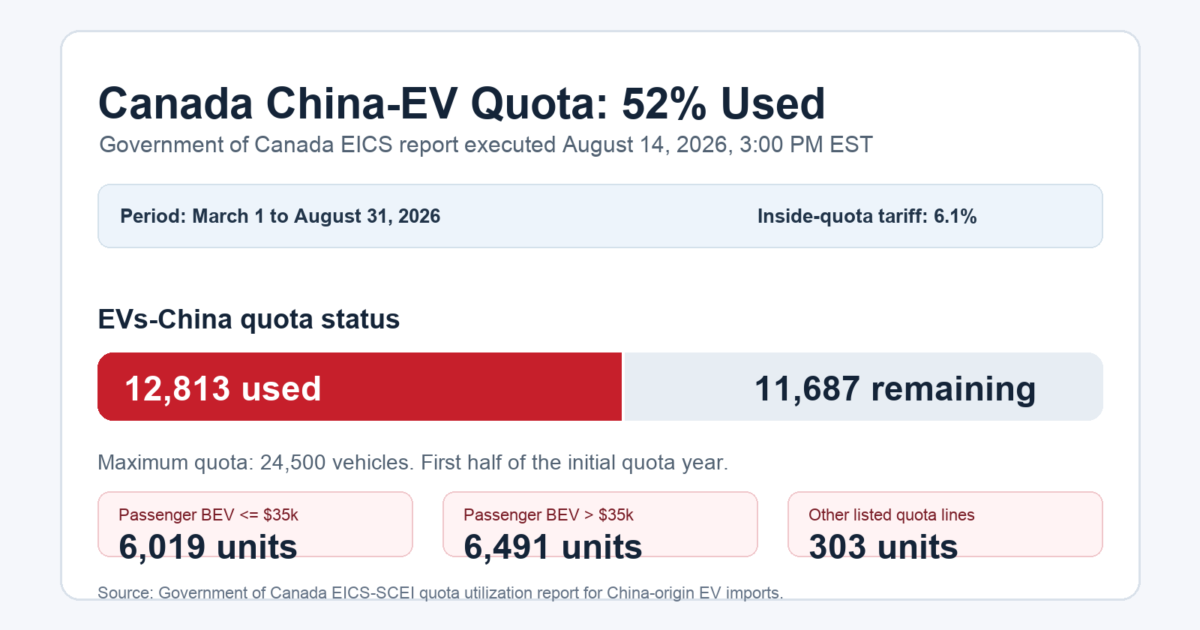
Quick answerCanada’s China-origin EV quota is now more than half used: the Government of Canada’s EICS-SCEI report executed on 14 August 2026 shows 12,813 vehicles used out of the first-period 24,500-vehicle access quantity, leaving 11,687 units before the 31 August period end. That is a quota-use signal, not a BYD launch confirmation. BYDToday still found no official Canadian BYD passenger-car price list, retail model line-up, dealer locator or confirmed consumer launch date.
Updated 19 August 2026This refresh adds the official EICS quota-utilization report executed on 14 August 2026, separates quota usage from BYD-specific retail availability, and updates the buyer checklist for the end of the first quota period on 31 August 2026. It preserves the original owner URL because the search intent remains BYD Canada availability, prices, tariffs and dealer status.
Claim key: CONFIRMED means a dated government or manufacturer source directly supports the statement; PENDING means the outcome has not been finalized; UNAVAILABLE means no current official figure or announcement was located and no number should be inferred.
BYD Canada status at a glance
| Question | Status | Current answer |
|---|---|---|
| Does Canada have a China-EV quota? | CONFIRMED | Yes. Canada announced an initial 49,000 EVs per year for China-origin EVs at a 6.1% most-favoured-nation tariff. |
| How much of the first period is used? | CONFIRMED | The 14 August 2026 EICS report shows 12,813 of 24,500 units used, leaving 11,687 before the 31 August period end. |
| Is the former 100% EV surtax still charged? | CONFIRMED | No. Global Affairs Canada says the 100% surtax was repealed when the quota framework took effect on 1 March 2026. |
| Can a covered shipment enter without a quota permit? | CONFIRMED | No. Notice 1162 says a shipment-specific Global Affairs Canada import permit is required for covered EVs. |
| Is BYD officially selling passenger cars in Canada? | UNAVAILABLE | No official Canadian passenger-car retail launch, price list, model list or dealer locator was located in the official sources reviewed. |
What the 14 August quota report shows
The EICS-SCEI report is the most useful new public signal because it shows that the China-origin EV quota is no longer a paper framework only. It reports utilization for the quota period from 1 March to 31 August 2026 and was executed at 3:00 PM EST on 14 August 2026.
| Quota line | Utilized units | What it does and does not prove |
|---|---|---|
| EVs-China total | 12,813 of 24,500 | Confirms aggregate China-origin EV quota use. It does not identify BYD as the importer. |
| Passenger BEV, electric-only, value at or below C$35,000 | 6,019 | Confirms a major low-price passenger BEV quota line is being used. It does not reveal the vehicle brand. |
| Passenger BEV, electric-only, value above C$35,000 | 6,491 | Confirms higher-value electric passenger-car quota activity. It does not confirm a Canadian retail model list. |
| Other listed quota lines | 303 combined | Includes 259 plug-in hybrid SUV/passenger-van units above C$35,000 and 44 electric SUV/passenger-van units above C$35,000. |
Evidence boundaryThe EICS report is about import quota utilization for China-origin EVs. It should not be reported as BYD sales, BYD deliveries, a BYD Canada launch, or evidence that a consumer can order a BYD from an authorized Canadian passenger-car dealer today.
What Canada’s 2026 quota actually changed
Global Affairs Canada implemented the quota on 1 March 2026. Notice to Importers No. 1162 says the quota year runs from 1 March to the end of February and that eligible imports inside the quota are assessed at the 6.1% most-favoured-nation tariff. The same notice says implementation of the quota repealed the 100% China EV surtax.
The first six-month period runs from 1 March to 31 August 2026 and has an access quantity of 24,500 vehicles. For the second half of the initial quota year, running 1 September 2026 to 28 February 2027, the available quantity is expected to be 24,500 vehicles plus any unused volume from the first period, but GAC says a new notice will be published before the second period starts.
The permit is only one gate. Notice 1162 leaves Canada Border Services Agency and Transport Canada requirements in place, so the quota is not a safety, registration, insurance or consumer warranty shortcut.
Can a Canadian buy or personally import a BYD today?
| Path | Current position | Main gate |
|---|---|---|
| Buy from an authorized Canadian BYD passenger-car dealer | PENDING | No official Canadian retail launch, price list or dealer locator was found. |
| Commercially import new Canadian-specification vehicles | Possible only through a compliant manufacturer or importer process | Canadian safety certification, Transport Canada requirements and a GAC shipment permit. |
| Personally import a new China-market BYD | Normally not a practical retail route | Foreign-market vehicles usually do not meet Canadian requirements, and the quota does not waive safety compliance. |
| Buy a Mexico- or U.S.-market vehicle and import it | Model-specific | RIV eligibility and original U.S./Canadian compliance. Being sold in Mexico alone is not enough. |
| Import a vehicle more than 15 years old | Age exemption may apply | CBSA entry, provincial registration and insurance still need checking. |
Transport Canada’s case-by-case pre-clearance process is for new Canadian-specification vehicles bought directly from a foreign manufacturer. It is not the same as buying a foreign-market vehicle from an overseas dealership and assuming it can be registered in Canada.
BYD Canada prices, models and dealer map: what is confirmed?
UNAVAILABLE: BYDToday did not locate an official BYD Canada passenger-car price list, confirmed launch model list, dealer count, dealership addresses, deposit portal or consumer warranty document as of 19 August 2026. Earlier versions of this owner removed precise Canadian prices and rollout numbers from secondary reports because they were not supported by a current BYD Canada primary source.
Overseas prices are not Canadian prices. Currency conversion does not account for specification, certification, shipping, duties, destination charges, sales tax, provincial fees, warranty support or importer margin. If BYD later publishes a Canadian price list, this owner page should be updated rather than replaced with a duplicate URL.
Would a future BYD qualify for Canadian EV incentives?
Transport Canada’s Electric Vehicle Affordability Program offers up to C$5,000 for an eligible battery-electric vehicle with a qualifying final transaction value, but the vehicle must be made in Canada or in a country that has a free-trade agreement with Canada. A China-built BYD would therefore not qualify under that current origin rule.
Quebec’s Roulez vert program offers up to C$2,000 for an eligible new battery-electric vehicle registered in 2026 and is scheduled to end on 31 December 2026. Eligibility is model-specific, so buyers should check the live Quebec list at registration rather than assume a future BYD will qualify.
Buyer checklist before paying a deposit
- Confirm that the seller appears in an official BYD Canadian dealer locator or is identified by BYD in writing.
- Request the exact VIN, Canadian compliance label and Transport Canada import pathway.
- Ask who holds the Global Affairs Canada shipment permit and who is the importer of record.
- Obtain the Canadian warranty, battery warranty, roadside assistance and parts terms in writing.
- Check provincial registration, insurance and incentive eligibility for the exact trim.
- Separate list price from a campaign price, finance example, deposit or currency-converted estimate.
- If a seller cites the quota, ask which quota line applies and whether the shipment is already permitted.
Who should wait?Most private buyers should wait for a normal Canadian retail channel with a published price, Canadian certification, warranty, parts support and insurer acceptance. Fleet or commercial importers can investigate the quota and pre-clearance processes, but that is not the same as a one-off consumer purchase.
Frequently asked questions
Is BYD officially on sale in Canada in August 2026?
No official Canadian BYD passenger-car retail launch, price list or dealer locator was found in BYD or Canadian government sources reviewed by BYDToday as of 19 August 2026.
How much of Canada’s China EV quota has been used?
The Government of Canada’s EICS-SCEI report executed on 14 August 2026 shows 12,813 of the first-period 24,500 China-origin EV quota units used, leaving 11,687.
Does the quota-use report prove BYD is importing cars to Canada?
No. The EICS report is aggregate quota data for China-origin EVs. It does not identify BYD as the importer, vehicle brand, retailer or seller.
Did Canada remove the 100% surtax on Chinese EVs?
Yes. Global Affairs Canada says the 100% surtax on China-origin EVs was repealed when the quota framework took effect on 1 March 2026.
Does the 49,000-vehicle quota let anyone import a BYD?
No. Covered shipments need a Global Affairs Canada import permit, and importers must still satisfy Canada Border Services Agency and Transport Canada requirements.
How much will a BYD cost in Canada?
No official Canadian BYD passenger-car price was located. Treat converted overseas prices and reported estimates as unavailable until BYD publishes a Canadian price list.
Would a China-built BYD receive the federal C$5,000 EV incentive?
Not under the current EVAP origin rule, which requires an eligible vehicle to be made in Canada or in a country that has a Canadian free-trade agreement.
Related coverage
- Why Chinese EVs are blocked in North America
- Can you buy a BYD in Mexico and bring it to the U.S.?
- 2026 BYD buying guide: which countries actually sell BYD cars?
- Chinese EVs in Australia: brands, policy and buyer risks
Primary sources
- Government of Canada EICS-SCEI: EVs quota utilization data, report executed 14 August 2026, 3:00 PM EST.
- Global Affairs Canada: Electric vehicle imports from China, modified 6 May 2026.
- Global Affairs Canada: Notice to Importers No. 1162, issued 25 February 2026 and modified 4 March 2026.
- Canada Border Services Agency: China Surtax Order customs notice, including repeal context.
- Transport Canada: Importing a vehicle.
- Transport Canada: Case-by-case pre-clearance for new vehicles.
- Transport Canada: Electric Vehicle Affordability Program, modified 13 July 2026.
Cover image: BYDToday non-AI editorial data graphic based on Government of Canada EICS-SCEI quota-utilization data. This consumer guide is informational and is not legal, customs, tax or insurance advice. Verify a specific VIN and transaction with the relevant agencies before paying.