Taiwanese solid-state battery specialist ProLogium Technology and French automotive supplier OPmobility (formerly Plastic Omnium) signed a Memorandum of Understanding on June 11, 2026, to jointly develop and integrate solid-state battery cells into production-ready modules for global electric vehicle platforms. The partnership bridges Asia’s most advanced solid-state cell technology with Europe’s premier battery pack engineering capabilities.
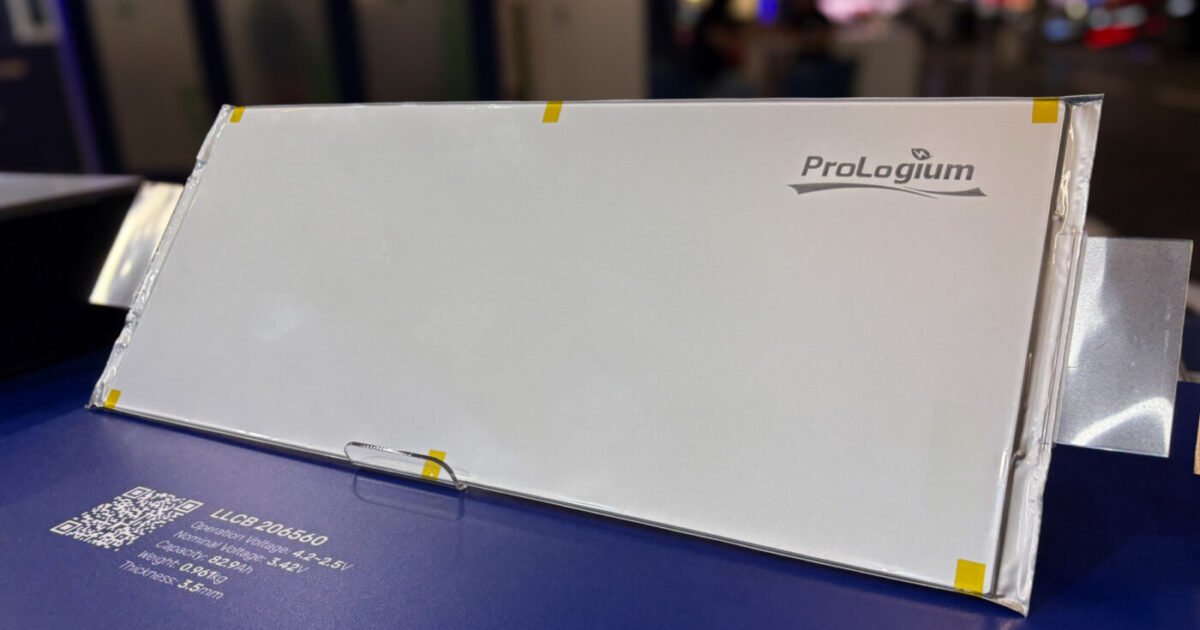
Under the agreement, electrive reported, ProLogium will supply its latest-generation lithium ceramic solid-state cells to OPmobility for electrical performance testing in Phase 1. Once validated, OPmobility will design, develop, and manufacture battery modules incorporating ProLogium cells, with the ultimate goal of delivering a standardized module solution that OEMs can directly adopt for their EV platforms.
ProLogium’s Technology Advantage
ProLogium’s current-generation “Superfluidized All Inorganic Solid-State Lithium Ceramic Battery” achieves industry-leading specifications: 900 Wh/L volumetric energy density, 380 Wh/kg gravimetric energy density, 5%-80% ultra-fast charging in approximately 6.4 minutes, over 1,200 cycle life, and more than 95% low-temperature (-20°C) discharge retention, according to ProLogium’s official announcement. These metrics place ProLogium at the forefront of commercially viable solid-state battery technology.
The company has demonstrated production capability at its Taoyuan, Taiwan facility, which has produced over 750,000 cells at a 3 GWh annual capacity. Its primary customer is Vietnamese EV maker VinFast, though the anchor customer for ProLogium’s planned Dunkirk, France gigafactory has not been publicly disclosed.
The Dunkirk Gigafactory Timeline
ProLogium’s European expansion is central to this partnership. The Dunkirk factory broke ground in February 2026 and follows an ambitious ramp-up schedule: Phase 1 production of 0.8 GWh begins in 2028 using fourth-generation lithium ceramic cells, scaling to 4 GWh by 2030, and reaching full capacity of 12 GWh (Fab 1) by 2032. At full capacity, Dunkirk could supply batteries for approximately 150,000-200,000 EVs annually.
OPmobility, headquartered near Paris, brings decades of experience in designing and manufacturing complex automotive modules at scale. The company has existing relationships with major European OEMs including Stellantis, Renault, and BMW, providing ProLogium with a direct channel to Europe’s largest automakers.
Industry Impact
This partnership represents a significant step toward solving the solid-state battery industry’s biggest challenge: translating lab-level cell performance into production-ready, vehicle-integrated modules. Many solid-state battery startups have demonstrated impressive cell-level metrics, but few have partnered with Tier-1 suppliers capable of packaging those cells into automotive-grade battery systems.
The timing is strategic. Chinese battery giant CATL has announced plans to begin small-scale solid-state battery production by 2027, while Toyota targets 2027-2028 for its first solid-state EV. ProLogium’s partnership with OPmobility positions a non-Chinese, non-Japanese supply chain alternative for European automakers seeking to diversify their battery sourcing.
Why It Matters Globally
The ProLogium-OPmobility partnership creates a viable non-Chinese solid-state battery supply chain at a time when global automakers are urgently seeking alternatives. With CATL commanding 46% of the global power battery market and BYD’s Blade Battery dominating the LFP segment, European and American automakers face significant supply chain concentration risk.
If ProLogium and OPmobility can deliver a competitive solid-state module by 2028-2029, European automakers would gain access to next-generation battery technology without relying entirely on Asian suppliers. This could reshape competitive dynamics in the premium EV segment, where solid-state batteries’ advantages in range, charging speed, and safety would be most impactful.
What’s Next
Phase 1 electrical performance testing between ProLogium and OPmobility is expected to commence immediately, with results guiding the design of the first integrated modules. The partnership operates under a framework that allows for further commercial agreements as technical milestones are achieved. ProLogium CEO Vincent Yang emphasized that “the real delivery of solid-state batteries lies in system integration and validation” — a process this partnership is designed to accelerate.
FAQ
How do solid-state batteries differ from conventional lithium-ion batteries?
Solid-state batteries replace the liquid or gel electrolyte in conventional lithium-ion batteries with a solid electrolyte (in ProLogium’s case, a lithium ceramic material). This enables higher energy density, faster charging, improved safety (no flammable liquid electrolyte), and better low-temperature performance.
When will solid-state battery EVs be available to consumers?
Several automakers are targeting 2027-2028 for initial solid-state EV launches. ProLogium’s Dunkirk factory begins production in 2028 at 0.8 GWh — enough for approximately 10,000 vehicles. Mass-market availability is expected between 2029-2032 as production scales to 12 GWh.
Who are ProLogium’s competitors in solid-state batteries?
Key competitors include Toyota (targeting 2027-2028), CATL (small-scale production by 2027), QuantumScape (partnered with Volkswagen), Solid Power (partnered with BMW and Ford), and Samsung SDI (mass production target 2027).