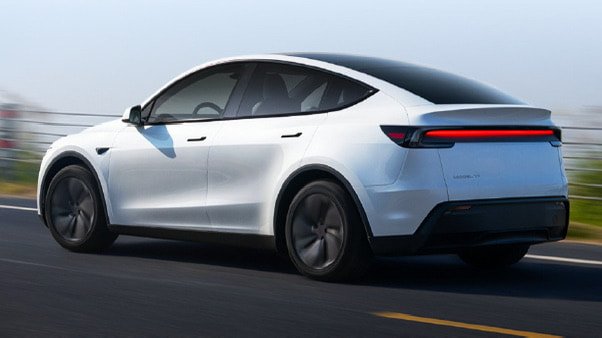
Since its August 2025 domestic launch in China, Tesla’s Model Y L — the long-wheelbase six-seat variant of the world’s best-selling vehicle — has executed one of the most aggressive Asia-Pacific export rollouts in automotive history. By April 2026, the Shanghai-built SUV had entered 11 markets across the region, from the mature auto industries of Japan and South Korea to the rapidly electrifying economies of Southeast Asia.
This deep dive examines how the Model Y L is performing market by market, why the six-seat configuration is proving decisive, and what the competitive landscape looks like as Chinese brands launch their own export offensives into the same territory.
South Korea: The Breakout Market
South Korea has emerged as the Model Y L’s most spectacular success story outside China. In April 2026, Tesla delivered 13,190 vehicles in the Korean market — a staggering 1,050% year-over-year increase and the highest monthly sales ever recorded by any imported auto brand in the country. The Model Y alone accounted for 10,086 units, becoming the first imported vehicle in Korean history to breach the 10,000-unit monthly threshold. The Model 3 contributed an additional 2,596 units, giving Tesla a clean sweep of the top two import positions.
Tesla’s 13,190-unit performance dwarfed BMW (6,658 units), Mercedes-Benz (4,796 units), and BYD (2,023 units), cementing a lead that has grown wider with each passing month. From a slow start of 1,966 units in January, Tesla’s Korean sales have climbed sequentially to 7,868 in February, 11,130 in March, and 13,190 in April — a trajectory that suggests the market is far from saturated.
Two structural factors are accelerating this growth. The South Korean government confirmed EV subsidies earlier in the year than previously, removing the policy uncertainty that historically depressed Q1 sales. Simultaneously, elevated global fuel prices driven by geopolitical tensions have pushed consumers toward electric alternatives. Imported EV sales across all brands hit 18,319 units in April, up 394% year-over-year — but Tesla captured 72% of that growth alone.
Japan: Subsidies Unlock Premium Demand
Japan’s famously import-resistant auto market is showing unexpected receptiveness to Tesla’s six-seat offering. The Model Y L launched in Japan on April 7, 2026, with deliveries beginning later that month. The vehicle is priced at 7.59 million yen (approximately $51,000) in a single Premium-grade AWD configuration, but aggressive government subsidies dramatically reshape the effective cost.
Japan’s national CEV clean-energy vehicle subsidy of 1.27 million yen brings the effective price to 6.32 million yen ($42,800). Tokyo residents qualify for an additional 400,000–800,000 yen in municipal incentives, potentially reducing the final purchase price below 5.52 million yen ($37,400). This layered subsidy structure effectively prices the Model Y L against well-equipped versions of the Toyota Harrier and Honda ZR-V — vehicles that occupy entirely different segments from Tesla’s traditional competitive set.
Tesla sold approximately 10,600 vehicles in Japan in 2025, up 90% year-over-year, and Q1 2026 volume reached roughly 5,000 units — nearly half the prior year’s total in a single quarter. Tesla’s Japanese country lead Richi Hashimoto has stated the brand’s goal of becoming Japan’s largest import brand by early 2027, supported by a service network expansion from 14 to approximately 30 centers. The Supercharger network currently counts 726 stalls across 146 stations nationwide.
Australia and New Zealand: The Early Movers
Australia and New Zealand were the first international markets to receive the Model Y L after China, with deliveries commencing in March 2026. Australia has been a particularly strong performer: Tesla registrations rose 145% year-over-year in the first quarter, with the Model Y ranking as the country’s top-selling EV. The RHD configuration produced in Shanghai gives Tesla a manufacturing advantage that left-hand-drive competitors — including many Chinese brands — cannot easily replicate for these Commonwealth markets.
New Zealand has followed a similar pattern, with the Model Y L quickly establishing itself as the best-selling electric vehicle in a market that has shown consistent preference for right-hand-drive EVs from global brands with established service networks.
Southeast Asia: The Next Frontier
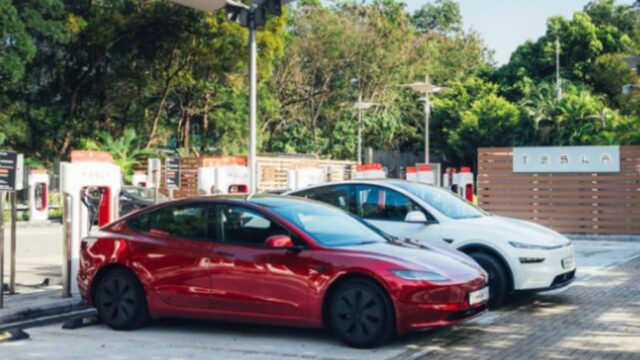
The Model Y L entered Thailand, Singapore, Malaysia, and the Philippines simultaneously in early April. At the 2026 Bangkok International Motor Show, the vehicle received the “Best Pure Electric SUV” award, signaling strong reception in a market where Chinese brands like BYD, MG, and GAC Aion have been aggressively building market share. Singapore’s combination of high vehicle taxes, limited space, and strong charging infrastructure makes the six-seat Model Y L an efficient proposition for affluent families who might otherwise consider a Mercedes-Benz EQB or BMW iX3.
The Philippines and Malaysia represent earlier-stage EV markets where Tesla’s first-mover advantage in the premium electric segment could prove durable as charging infrastructure develops. Macau and Hong Kong, the two Chinese special administrative regions included in the launch, benefit from Tesla’s existing Supercharger density in the Greater Bay Area.
Why the Six-Seat Configuration Matters
The Model Y L’s 2+2+2 layout addresses a specific gap in the Asia-Pacific premium market. Traditional three-row SUVs in this region — predominantly Japanese and Korean models — typically offer 2+3+2 configurations with cramped third rows. The Model Y L’s dual captain’s chairs in the second row, combined with 788 km of WLTC range, 2,539 liters of cargo space with seats folded, and adaptive air suspension, create a proposition that appeals to buyers who want genuine six-passenger capability without the fuel consumption penalty of a large combustion SUV.
The 5.0-second 0-100 km/h acceleration and 201 km/h top speed ensure the longer wheelbase hasn’t dulled Tesla’s performance credentials, while the Cosmic Silver exclusive paint and 18-speaker premium audio system with subwoofer reinforce the premium positioning.
Competitive Landscape: Tesla vs. the Field
The Model Y L’s APAC rollout is unfolding against intensifying competition. BYD is simultaneously expanding across the region with its Sealion 6 DM-i, Atto 3, and Seal models, leveraging a price-competitive strategy that has already made it the top EV brand in Thailand. Hyundai and Kia retain formidable home-market advantages in South Korea through their Ioniq and EV lineups, while Toyota’s bZ series and Honda’s e:N models are beginning to gain traction in Japan.
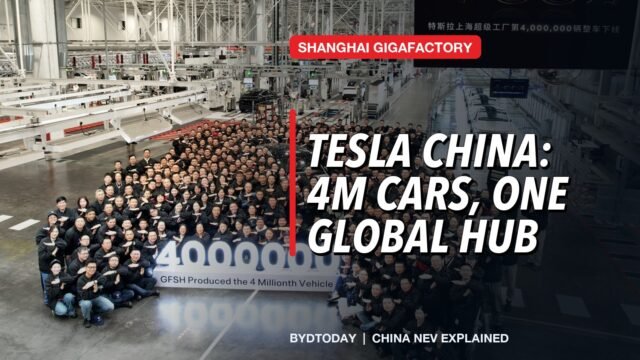
Tesla’s differentiation lies in three areas that competitors find difficult to replicate simultaneously: a dedicated Supercharger network that now exceeds 2,600 stations in China alone; over-the-air software update capability that continuously improves vehicles post-purchase; and the Shanghai Gigafactory’s unparalleled production scale, which enables competitive export pricing without sacrificing margins. As the factory delivered 79,000 vehicles in April 2026 alone, its role as Tesla’s global export hub has never been more central to the company’s strategy.
Related: Tesla Shanghai Gigafactory Delivers 79,000 Vehicles in April 2026 — Full Overview
Sources
- Drive Tesla Canada, Tesla sets another sales record in South Korea with over 13,000 deliveries
- Electrive, Tesla launches Model Y L in Japan, expanding availability to 11 markets
- Tesorb, Tesla Model Y L launches in eight Asian markets
- KAIDA — Korea Automobile Importers & Distributors Association, April 2026 data
- China Daily, Tesla Shanghai Gigafactory April delivery data