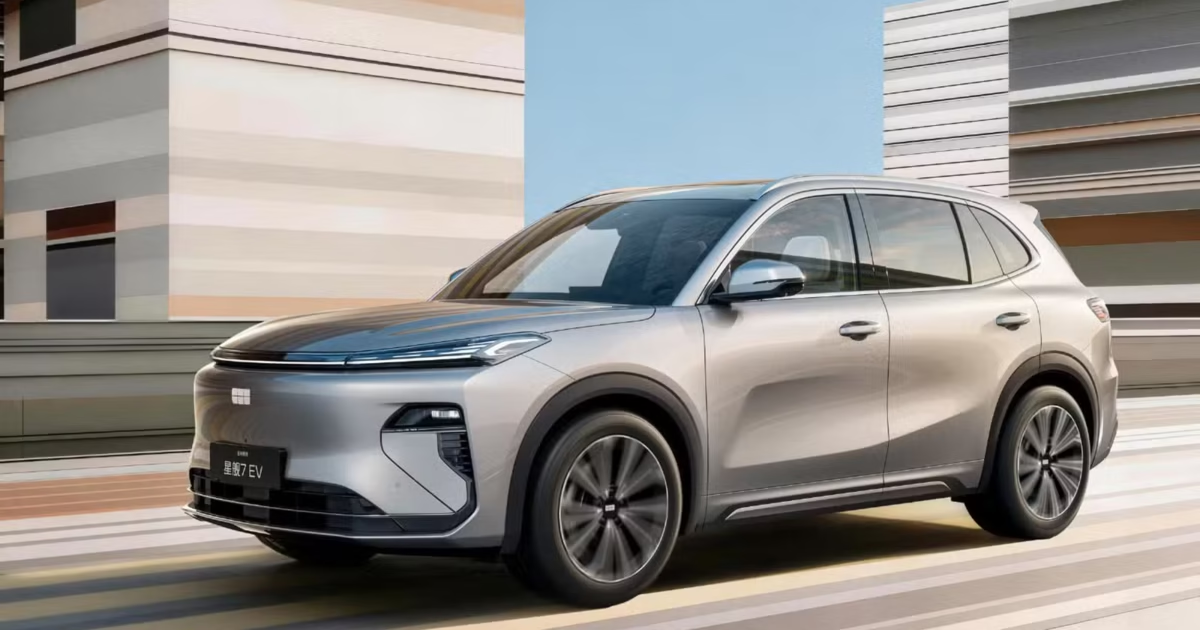
Geely’s Galaxy brand launched the Starship 7 electric SUV on June 11, 2026, with an aggressive starting price of 99,800 yuan (approximately $14,730) after incentives, bringing 800V fast-charging technology to the sub-$15,000 price segment for the first time. The launch is a strategic push to revive Galaxy’s flagging sales, which have declined year-on-year for five consecutive months.
The Starship 7 EV is the all-electric sibling of the Starship 7 EM-i plug-in hybrid already on sale, built on Geely’s Global Intelligent New Energy Architecture (GEA). Four variants are offered, with official guide prices ranging from 109,800 to 129,800 yuan, reduced to 99,800-119,800 yuan after a 6,000 yuan trade-in subsidy and 4,000 yuan insurance subsidy, according to CnEVPost’s launch report.
800V Platform at a Budget Price
The Starship 7’s standout feature is its 800V high-voltage platform — technology typically reserved for vehicles costing twice as much. This enables 30%-80% DC fast charging in just 20 minutes, effectively eliminating range anxiety for daily urban use. The SUV also supports 3.3 kW vehicle-to-load (V2L) discharging and a rare 6 kW vehicle-to-vehicle (V2V) charging capability, allowing it to serve as a mobile power bank for other EVs.
Powertrain specifications include a front-mounted single motor producing 160 kW (215 hp) and 320 Nm of torque, enabling 0-100 km/h acceleration in 7.3 seconds. Energy consumption is rated at just 12.4 kWh per 100 km — among the most efficient in its class. Two LFP battery options are available: a 60.22 kWh pack providing 525 km of CLTC range, and a 68.39 kWh pack delivering 605 km.
Market Context and Galaxy’s Challenges
The Starship 7 EV arrives at a critical moment for Geely’s Galaxy brand. Galaxy sold 81,727 units in May 2026, a 19.75% year-on-year decline and the fifth straight month of negative growth, per CnEVPost’s sales data compilation. While Geely Group’s overall May sales grew 1.03% to 237,637 units, the pure EV segment declined 19.37%, underscoring the urgency of the Starship 7 launch.
The compact SUV measures 4,750 mm long, 1,905 mm wide, and 1,680 mm tall with a 2,755 mm wheelbase — slightly larger than a Honda CR-V. The cabin features Geely’s Flyme Auto smart cockpit system with a 15.4-inch central touchscreen and 13.8-inch head-up display. Primary competitors include Changan’s Qiyuan Q05 and Deepal S05 in the fiercely competitive 100,000-yuan class.
Industry Impact
The Starship 7 EV represents a significant democratization of premium EV technology. By placing an 800V architecture and sub-20-minute fast charging in a $15,000 vehicle, Geely is erasing one of the last technical differentiators between budget and premium EVs. This accelerates the industry-wide trend toward 800V as the new baseline, rather than a premium feature.
For global automakers, the Starship 7 sets an uncomfortable benchmark. No non-Chinese manufacturer currently offers an 800V EV at this price point, and Geely’s ability to do so — even while absorbing brand-level sales pressure — demonstrates the scale advantages Chinese automakers now wield.
Why It Matters Globally
The Starship 7 EV is a preview of what global consumers can expect as Chinese automakers expand internationally. If Geely can sell an 800V compact SUV with 600 km range for under $15,000 in China, export versions priced at $20,000-$25,000 would still dramatically undercut European and American competitors. For budget-conscious markets like Southeast Asia, Latin America, and Africa, vehicles like the Starship 7 could accelerate EV adoption faster than any policy incentive.
What’s Next
The Starship 7 EV will compete head-to-head with BYD’s Yuan Plus (Atto 3) and upcoming budget EVs from Xiaomi and Leapmotor. Early sales data in July will indicate whether the aggressive pricing strategy can reverse Galaxy’s declining trajectory. Geely is also preparing the EX2 electric hatchback for local production in Brazil, signaling that the group’s budget EV push will be global, not domestic-only.
FAQ
What makes the Starship 7 EV’s 800V platform special at this price?
800V architecture enables significantly faster charging — 30-80% in 20 minutes — and better energy efficiency. Until now, 800V has been a feature of premium EVs priced above $30,000. The Starship 7 is among the first sub-$15,000 vehicles globally to offer this technology.
How does the Starship 7 compare to BYD Yuan Plus (Atto 3)?
The Starship 7 is larger (4,750 mm vs 4,455 mm), offers faster charging (800V vs 400V), and has a lower starting price after incentives (99,800 yuan vs 119,800 yuan). However, BYD’s Yuan Plus has stronger brand recognition and a more established global presence.
Will the Starship 7 EV be exported?
Geely has not announced export plans for the Starship 7 EV specifically, but the Galaxy brand is expanding internationally. The closely related Starship 7 EM-i PHEV is already sold in select overseas markets, suggesting an EV export version is likely.