A World Record for the Combustion Engine
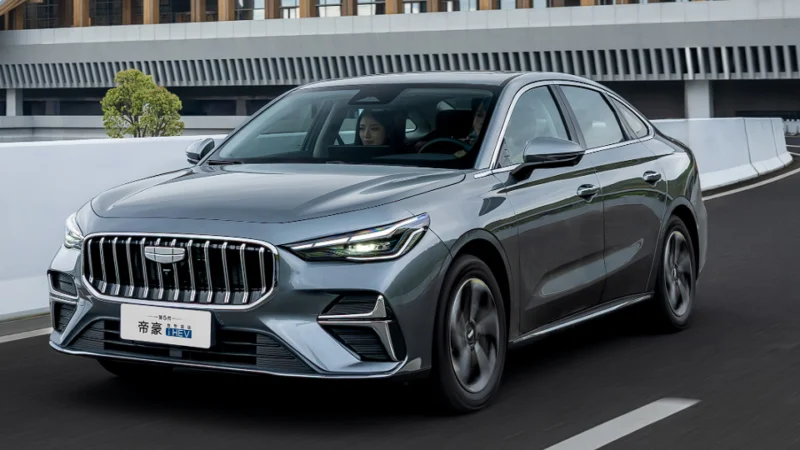
Geely has announced that its Emgrand i-HEV — a non-plug-in hybrid compact sedan — will officially launch in China on June 16, 2026. The headline figure is the vehicle’s dedicated hybrid engine, which achieves a certified thermal efficiency of 48.41% under the Chinese GB/T test cycle, setting a new world record for a production combustion engine, according to CarNewsChina. The previous record of 46% was held by BYD’s Xiaoyun engine used in the Qin L DM-i.
The 1.5-liter Atkinson-cycle four-cylinder engine operates almost exclusively in its most efficient RPM range, functioning primarily as a generator for the electric drive system. Combined with a dedicated hybrid transmission (DHT) and a small battery pack, the Emgrand i-HEV achieves a claimed fuel consumption of 2.9 L/100 km under CLTC — equivalent to approximately 81 mpg in US terms. With a 50-liter fuel tank, the theoretical range exceeds 1,700 km, per Geely’s official press release.
The Emgrand i-HEV is priced aggressively at 89,800-119,800 RMB ($12,400-$16,500 USD), targeting budget-conscious buyers who want hybrid efficiency without the need for plug-in charging. The Emgrand nameplate is one of China’s best-selling sedans with over 3.8 million units sold since its 2009 debut, and this i-HEV variant represents a significant upgrade to one of Geely’s most important models.
The achievement of 48.41% thermal efficiency is the result of extensive engineering work on multiple fronts: a high-compression-ratio Atkinson cycle design, cooled exhaust gas recirculation (EGR), low-friction coatings on piston rings and bearings, an electrically driven water pump and oil pump that reduce parasitic losses, and a high-energy ignition system that enables lean-burn operation under light loads. Geely claims that under ideal operating conditions, over 48% of the chemical energy in the fuel is converted to mechanical energy — a figure that was considered physically impossible for gasoline engines just a decade ago.
Why It Matters Globally
The 48.41% thermal efficiency milestone is globally significant because it challenges the assumption that combustion engines have reached their technological ceiling. For developing markets across Southeast Asia, Africa, and Latin America where charging infrastructure remains sparse, a $13,000 sedan that achieves 81 mpg represents a practical and immediate path to reducing transportation emissions without requiring massive infrastructure investment.
Geely has been expanding aggressively in emerging markets through its Proton (Malaysia), Geometry, and Geely-branded vehicles. The Emgrand i-HEV, with its record-breaking efficiency and sub-$15,000 price point, could become a global best-seller in markets where full electrification is still years away from being practical for the average consumer.
It also demonstrates that Chinese automakers can lead in combustion engine technology, not just electrification. The 48.41% thermal efficiency figure is the result of fundamental engineering innovation — advanced combustion chamber design, cooled EGR systems, low-friction materials, and sophisticated engine management algorithms — all areas where Geely has invested billions in R&D over the past decade. This technological capability gives Chinese automakers a credible path to compete in markets where hybrid vehicles will dominate for years to come.
FAQ
Q: What’s the difference between i-HEV and PHEV? An i-HEV (intelligent hybrid electric vehicle) is a non-plug-in hybrid — it cannot be charged from an external source and relies entirely on the engine and regenerative braking to charge its small battery. A PHEV can be plugged in and typically has a larger battery for 50-100 km of pure electric range.
Q: How does 48.41% thermal efficiency compare to typical engines? Most production gasoline engines achieve 35-40% thermal efficiency. Toyota’s best hybrid engines reach about 41%. Geely’s 48.41% means nearly half of the fuel’s energy is converted to useful work, dramatically reducing waste heat and fuel consumption. This is close to the theoretical maximum for spark-ignition gasoline engines.
Q: Will the Emgrand i-HEV be exported? Geely has confirmed plans to export the Emgrand i-HEV to Southeast Asian markets and potentially Latin America, where hybrid vehicles are increasingly popular as a practical bridge technology. The vehicle’s low price point and exceptional fuel economy make it particularly suitable for developing markets where fuel costs represent a significant portion of household transportation budgets.