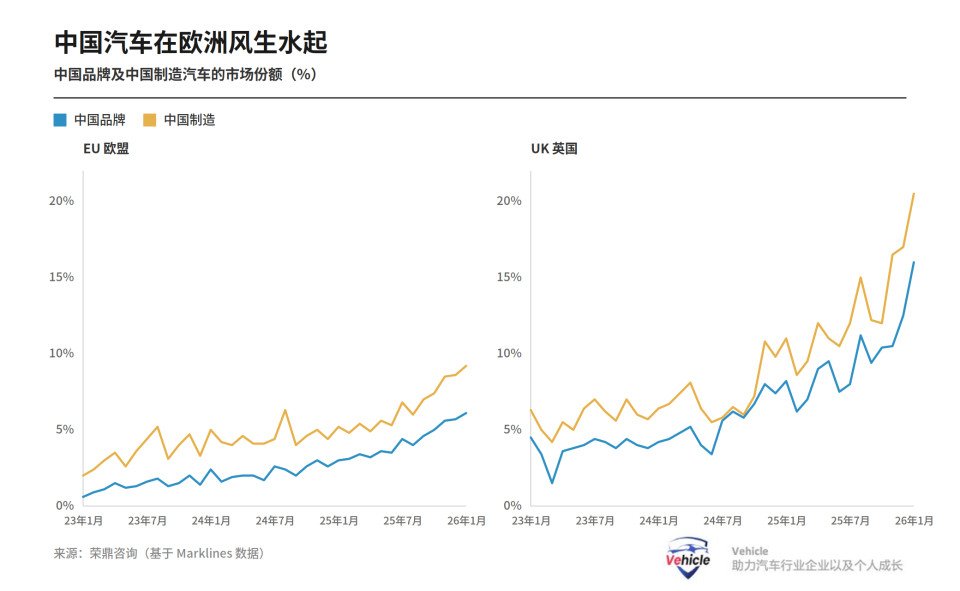
Eighteen months after the European Union imposed countervailing duties of up to 45.3% on Chinese electric vehicles, the data tells an uncomfortable story for Brussels: Chinese auto imports have not fallen — they have risen. Now the EU is drafting a new weapon: the Industrial Acceleration Act (IAA), a regulatory framework that ties public subsidies, corporate fleet incentives, and procurement rules to a “Made in Europe” (MiEU) standard that explicitly excludes China.
Introduced in March 2026 by EU Commissioner Stéphane Séjourné, the IAA represents the most ambitious attempt yet to reshape the competitive landscape for Chinese automakers in Europe — going well beyond tariffs to target the structural advantages that have allowed Chinese EVs to keep gaining market share despite trade barriers, as analyzed in depth by Tencent News.
Why Tariffs Aren’t Working
The numbers explain Brussels’ frustration. In December 2024 — two months after countervailing duties took effect — Chinese-made vehicles captured a record 9.3% of EU sales. By early 2026, Chinese passenger vehicle exports to the EU had surged 62% year-on-year to 214,000 units in just the first two months, per the Tencent News analysis.
The reason is structural: pure BEV shipments dipped briefly but have since returned to pre-tariff levels, while PHEV and ICE exports — which fall outside the current duty framework — have surged. Chinese automakers are also absorbing tariff costs through their estimated $10,000 per-vehicle cost advantage over European production, according to IEA estimates.
How the IAA Works: Five Measures, One Gatekeeper
The IAA’s core mechanism is the “Made in Europe” (MiEU) designation, which requires vehicles to meet three thresholds:
- Battery threshold: Cells must be produced within the EU.
- Local value-add: A minimum share of vehicle production must occur inside the bloc.
- Supply chain restriction: Components cannot come from non-“trusted partner” countries — a list that includes the US, UK, South Korea, and Japan, but explicitly excludes China.
Once designated MiEU, a vehicle unlocks five policy levers:
| Measure | Market Coverage | Impact on Chinese EVs |
|---|---|---|
| Government procurement mandate | ~2% of market | Minimal — easily bypassed |
| Private purchase subsidies tied to MiEU | ~7% of market | Moderate — follows France’s eco-bonus model |
| Corporate fleet incentives | ~60% of market | Severe — if fully enforced |
| CO₂ super-credit restriction | Small BEV segment | Limited |
| Low-carbon steel requirement | Legacy OEMs | Minimal |
The Corporate Fleet Battlefield
Article 4 of the IAA’s corporate fleet proposal is the measure with the greatest potential impact. From 2028, member states would only be allowed to provide fiscal support to corporate fleets if those fleets buy low-emission, EU-manufactured vehicles. With corporate fleets accounting for roughly 60% of new car sales in the EU — and fleet tax incentives averaging €1,500 annually in large member states, reaching €3,500 in Germany — this single provision could reshape the competitive dynamics of Europe’s largest auto sales channel.
However, the proposal faces fierce opposition. BMW chairman Oliver Zipse called it a “backdoor combustion-engine ban.” The German auto industry association VDA labeled it “unrealistic.” Italy and Germany’s CDU party are leading the resistance, according to the Tencent News report.
The 18-to-24-Month Window
Even on an optimistic timeline, the IAA would not take effect until mid-2027 at the earliest — and 2028 is more realistic. This gives Chinese automakers an 18-to-24-month window of relatively unrestricted access to the European market. During this period, BYD is preparing to begin Hungarian production, per CnEVPost, Leapmotor is leveraging its Stellantis joint venture for local assembly, and Geely is exploring Spanish production capacity with Ford.
Even if the IAA passes in full, roughly 30% of the European private market — buyers who do not receive government subsidies — would remain fully open to any competitor. Combined with the persistent cost advantage in Chinese battery production (estimated at 30% below European costs), this leaves Chinese automakers with meaningful room to maneuver.
Beyond the IAA: What Comes Next
The IAA is unlikely to be the EU’s final move. Additional measures under consideration include:
- PHEV tariffs: As PHEV imports approach the surge levels that triggered the original BEV investigation, Brussels is examining anti-circumvention measures and potential new anti-dumping cases.
- Cybersecurity rules: A proposed revision to the EU Cybersecurity Act would give the Commission authority to restrict high-risk suppliers — a “nuclear option” that could bar Chinese-connected vehicles outright.
- Resilience standards: The Net Zero Industry Act already requires member states to factor in supply-chain concentration when granting public support, specifically targeting technologies where over 50% of EU supply comes from a single non-EU country.
Why It Matters Globally
The IAA represents a new phase in the global EV trade war — moving from blunt tariff instruments to sophisticated regulatory frameworks that target supply chains, not just finished vehicles. For Chinese automakers, the message is clear: the window for pure export strategies into Europe is closing. Those who build production capacity inside the bloc — as BYD, Leapmotor, and potentially Geely are doing — will be positioned to qualify as MiEU. Those who don’t will face a shrinking addressable market.
The IAA also sets a precedent that other markets — particularly in North America and Southeast Asia — are watching closely. If the EU succeeds in using subsidy conditionality to reshape its auto supply chain, expect similar frameworks to emerge elsewhere.
FAQ
Q: Will the IAA block all Chinese EVs from Europe?
No. Even at full strength, roughly 30% of the market (unsubsidized private buyers) would remain open. Chinese automakers investing in EU production could also qualify for MiEU status over time.
Q: When does the IAA take effect?
Realistically not before 2028. The earliest optimistic scenario is mid-2027. This gives Chinese automakers an 18-to-24-month window to adapt.
Q: Which Chinese automaker is best positioned?
Leapmotor, through its Stellantis joint venture, has the clearest path to MiEU compliance using Stellantis production facilities. BYD’s Hungary plant will also qualify once operational, though battery cell production location remains a question.