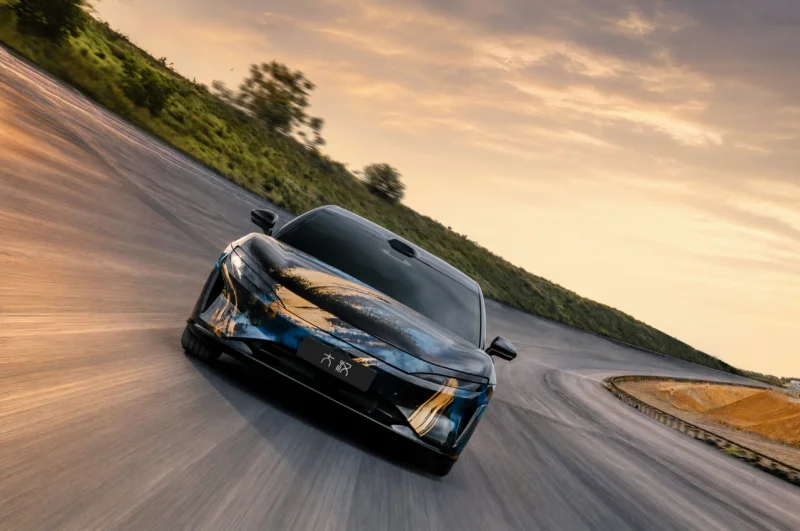
BYD has released official images of the Great Han (Da Han), its first D-class flagship sedan under the Dynasty series, confirming a 1,008 km range variant, second-generation Blade Battery technology, and a Q3 2026 launch window. The sedan joins the Da Tang flagship SUV as BYD’s twin assault on the premium large-vehicle segment.
According to regulatory filings and official images published on June 8, the Great Han will offer both plug-in hybrid (PHEV) and pure electric (EV) powertrains, with the top EV variant achieving 1,008 km of range on China’s CLTC cycle. An all-wheel-drive LiDAR-equipped version delivers 880 km.
Design and Positioning
The Great Han continues the design language established by the Han L, featuring a full-width front light bar connecting the headlamps, a long flowing roofline that drops from the B-pillar, and a full-width taillight assembly. The body carries a noticeable “Han 9” badge. BYD has not released full dimensions but confirmed both body and wheelbase have been stretched compared to the Han L.
The interior borrows elements from the Da Tang SUV, with an emphasis on premium materials and rear-seat comfort. The Great Han is expected to be the production version of the D-class sedan BYD previously teased in a public naming campaign.
Powertrain and Battery Technology
The Great Han debuts BYD’s second-generation Blade Battery in a sedan form factor, with the Gen-2 Blade improving energy density approximately 15% over the first generation while maintaining LFP thermal safety. Combined with a 1,000V platform, the Great Han supports flash charging speeds competitive with the recently launched BYD Da Tang SUV.
Two variants filed with regulators show a rear-wheel-drive model at 1,008 km and an all-wheel-drive LiDAR flagship at 880 km, both using CLTC standard. Real-world highway range is estimated in the 700-850 km bracket.
Market Context
The Great Han arrives as BYD accelerates its premium push. The existing Han L saw domestic sales of just over 1,000 units in April 2026, a 69.5% year-over-year decline per industry data. BYD recently confirmed humanoid robot development, signaling a long-term technology ecosystem strategy.
Why It Matters Globally
The Great Han represents BYD’s most ambitious push into the D-segment premium sedan space—a category historically dominated by the Mercedes E-Class, BMW 5 Series, and Audi A6. With 1,008 km of range from a sedan form factor, BYD is not just competing on price anymore; it is staking a claim on range leadership. For global markets, the Great Han previews what BYD’s next-generation products will offer when they reach Europe, Southeast Asia, and Latin America: luxury-level range, advanced driver assistance, and a price point that undercuts European competitors by 30–50%.
The 1,008 km model also serves as a technology statement. Achieving this range in a sedan—which has less physical space for batteries than an SUV—requires the second-generation Blade Battery’s improved energy density and a highly efficient powertrain. This sets a new benchmark that rivals including Tesla (Model S: 652 km EPA), NIO (ET7: 1,000 km CLTC with semi-solid-state), and Mercedes (EQS: 785 km WLTP) will need to respond to.
FAQ
What’s the difference between the BYD Han L and the Great Han?
The Han L is BYD’s current mid-to-large sedan, positioned as a premium executive car competing with the BMW 3 Series and Mercedes C-Class at 190,000–280,000 RMB. The Great Han (Da Han) is a larger, more luxurious D-class flagship above it, targeting the E-Class/5 Series/A6 segment above 300,000 RMB. The Great Han offers significantly more range (1,008 km vs ~750 km for the Han L EV) and debuts the second-generation Blade Battery, whereas the Han L uses first-generation Blade technology.
Will the Great Han be exported outside China?
BYD has not confirmed export plans for the Great Han, but the company’s pattern with the Han and Seal sedans suggests a 6–12 month lag between China launch and key export markets. Europe and Southeast Asia are the most likely first destinations. BYD’s Hungary factory (starting production in late 2026) could serve as the European production base for the Great Han, avoiding EU tariffs on Chinese-made vehicles. Australia, Thailand, and Brazil are also strong candidates for early export availability.
Update
Update (June 10, 2026): The Great Han has now appeared in MIIT regulatory filings revealing a 5.26-meter body length and 570 kW dual-motor AWD powertrain. Read our latest coverage: BYD Da Han Flagship Sedan Filed: 5.26-Meter D-Class EV With 570 kW AWD Powertrain.