The Electric Vehicle Sustainability Alliance (EVSA), backed by BYD, Geely, NIO, XPeng, and CATL, was launched on May 22 to establish ESG standards for Chinese EV makers expanding globally.
The EVSA launch details are based on 21st Century Business Herald coverage and related CAAM/Geely ESG reporting.
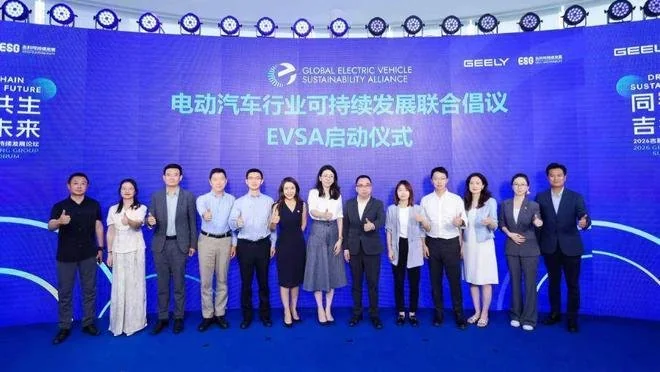
The EVSA launch ceremony took place in Hangzhou on May 22, 2026.
On May 22, 2026, the China Association of Automobile Manufacturers (CAAM) and Geely Holding Group launched the Electric Vehicle Sustainability Alliance (EVSA) in Hangzhou, with 12 founding members spanning the entire automotive value chain — from BYD and NIO to CATL and Bosch China. The initiative marks China’s EV industry’s coordinated response to tightening global ESG requirements.
Who Signed: 12 Founding Members
The founding membership includes seven automakers — Geely, BYD, Changan, Chery, SAIC, NIO, and XPeng — and five Tier-1 suppliers — CATL, Bosch China, Autoliv, Lizhong Group, and Yanfeng International. Together, these companies represent the majority of China’s EV production and export volume.
CAAM Deputy Secretary-General Li Shaohua framed the initiative as a response to “new green trade barriers.” The EU Battery Regulation, for example, now requires full carbon footprint accounting from mining to recycling. Vehicles with non-compliant battery carbon footprints cannot enter the EU market. “These regulations are less about production requirements and more about new forms of trade barriers,” Li stated.
Peng Huagang, President of the China Enterprise Reform and Development Research Association, described the context bluntly: “The era of industrial scale dividends is nearing its end. Competition has shifted from products to ecosystems, from price wars to value wars.” He argued that future competitiveness depends on carbon management, governance, supply chain integration, and global rule adaptability — not just range and compute power.
Geely’s ESG Commitment
Geely Holdings Vice President Chen Yimin announced that the company has established a Sustainable Development Advisory Committee to navigate increasingly stringent ESG regulations. Geely’s 2030 targets include: 100% green electricity coverage across all manufacturing bases, an 80% reduction in per-vehicle manufacturing carbon intensity versus 2022, and capping total operational emissions at 2022 levels without relying on carbon offsets — even as production volumes grow.
These are ambitious targets that go beyond compliance. Achieving them while scaling production will require breakthroughs in green steel, low-carbon aluminum, and renewable energy procurement — challenges that the EVSA aims to address collectively rather than forcing each company to solve alone.
ESG Maturity Becomes an Export Issue
Li Shaohua categorized corporate ESG capability into four stages: passive compliance → systematic management → strategic embedding → long-term value creation and rule-setting. He assessed that most Chinese automakers and suppliers are currently transitioning from systematic management to strategic embedding — a critical inflection point.
The gap between Chinese and European automakers in ESG maturity is narrowing but remains significant. European OEMs have decades of experience with sustainability reporting, supply chain due diligence, and circular economy principles. The EVSA is designed to accelerate China’s catch-up by sharing best practices, standardizing data platforms, and building collective negotiating power with international regulators.
From Learners to Rule-Makers
Peng Huagang’s closing vision was ambitious: China’s EV industry should move from being a “learner and participant” in global sustainability to becoming a “definer and contributor.” The EVSA’s first deliverable — a joint ESG report on Chinese EV overseas expansion — signals this intent.
For overseas readers, the EVSA represents both a competitive threat and a collaborative opportunity. A unified Chinese ESG framework could simplify compliance for international partners while also raising the bar for market entry. European and Southeast Asian regulators will be watching closely to see whether the EVSA produces substantive standards or remains a branding exercise.
Given that over 90% of automotive emissions occur in the supply chain, the inclusion of CATL, Bosch China, and other Tier-1 suppliers is particularly significant. Effective supply chain decarbonization requires upstream coordination — and the EVSA provides the institutional mechanism for it.
Sources
- 21st Century Business Herald, EV industry sustainability joint initiative launched
- Sina Finance, CAAM launches EVSA initiative with Geely
- Tencent News, China EV overseas ESG report released in Hangzhou
- China News, Geely and CAAM release China EV overseas ESG report