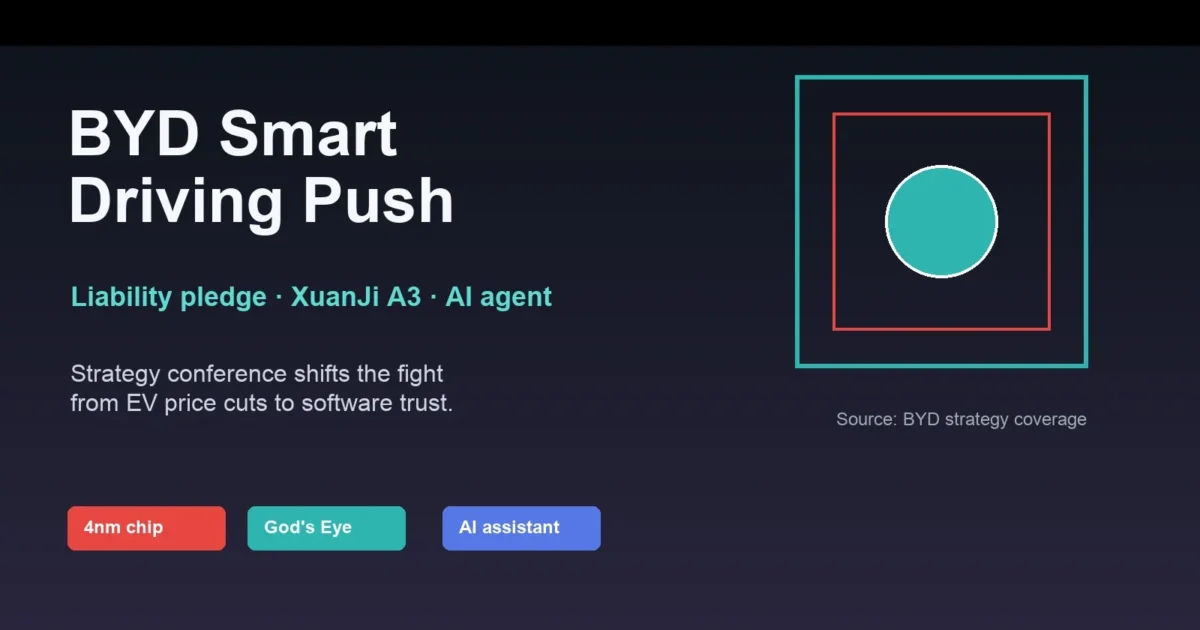
BYD’s latest intelligent-driving push is broader than one chip launch: it pairs a liability pledge for city navigation, the XuanJi A3 chip, and an AI assistant roadmap into a trust-focused software strategy.
Key details are based on CnEVPost coverage of BYD’s liability pledge and related strategy reporting.
From Feature Race to Trust Race
The headline change is BYD’s willingness to underwrite parts of the city-navigation experience, a move that shifts the conversation from raw feature lists to accountability. In China’s increasingly crowded smart-driving market, that is a meaningful positioning change.
For overseas readers, the strategic point is simple: BYD is trying to make assisted driving feel less like an expensive experiment and more like a standard vehicle capability.
XuanJi A3 Becomes the Hardware Anchor
The XuanJi A3 chip gives BYD an in-house silicon story to match Tesla, Huawei, and other vertically integrated competitors. BYD says the chip supports high-end smart-driving workloads and is already tied to its God’s Eye ecosystem.
That matters because BYD’s scale can turn a chip program into a fleet learning platform. If deployed across mass-market models, the chip could lower per-vehicle smart-driving costs while expanding data coverage.
AI Agent Expands the Software Ambition
BYD also framed the strategy around an AI assistant or ‘super secretary’ concept, suggesting that the company wants the cockpit experience to move beyond navigation and voice control toward broader task handling.
This is the area where BYD still has to prove execution. Chinese rivals already compete aggressively on cockpit software, city NOA coverage, and OTA cadence, while BYD’s historic strength has been cost-efficient hardware.
Why It Matters for Global EV Competition
BYD’s strategy conference signals a new phase of competition: price cuts remain important, but smart-driving credibility, liability language, and software experience are becoming export-market differentiators.