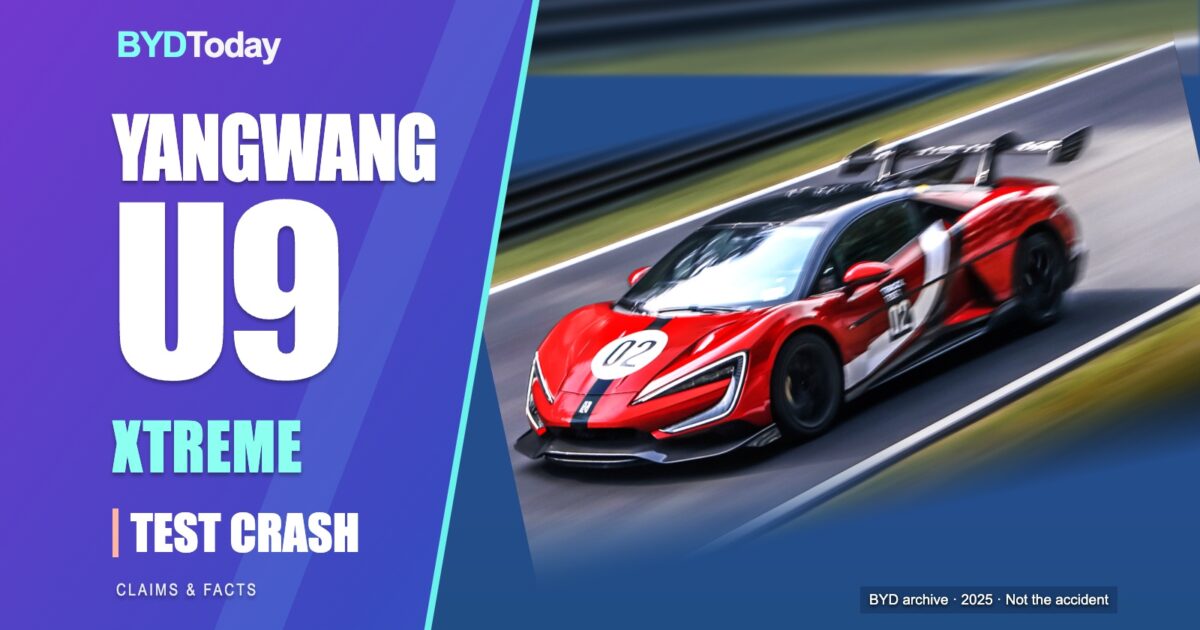
Yangwang has shared disclosures about a domestic U9 Xtreme test incident. The FIA subsequently recognised a separate 503.17 km/h speed run in Abu Dhabi. The story warrants attention, but the reported crash-speed figures are not an independently certified crash-test result. The driver interview, collision-testing footage and historical speed record need to be read as separate pieces of evidence.
Hu Xiaoqing, head of Yangwang’s sales business, announced the Abu Dhabi plan on November 1, shared an interview with BYD test driver Jiang Wen on November 2, and posted further U9 collision-testing material on November 3. These are company disclosures. They give an account of the programme; they do not provide a complete independent accident investigation.
Sources checked November 4, 2026. Disclosure dates are not the accident date. We have not independently established the date, full test configuration or exact impact conditions of the reported domestic incident.
What Yangwang has disclosed
The November 2 post introduces Jiang Wen as a BYD test driver with 23 years at the company and invites viewers to hear about the domestic high-speed testing programme. Fast Technology’s November 3 report describes his account of the car becoming unsettled, contact with the left guardrail and a subsequent movement toward the opposite side. The outlet reports about 360 km/h at first contact.
That is an attributed account of a test incident. It should not be rewritten as a laboratory finding that any U9 can survive a collision at a specified speed. The published source material also does not justify reconstructing a precise accident date or claiming that the same wrecked vehicle was repaired and then set another record.

The distinction between a test crash and crash testing matters here. A crash during development and a planned assessment of passive safety can both produce damaged-car footage, while answering different questions. The posts and clips should therefore be identified and dated before their images are used to support a speed or safety claim.
420–450, 360 and 496.22 km/h describe different claims
A single dramatic number can conceal the difference between the test’s operating window, a driver-reported speed near contact, and a separately timed maximum-speed run.
On a small screen, swipe the table horizontally.
| Figure | What it refers to | Evidence boundary |
|---|---|---|
| 420–450 km/h | Test-speed window described in media reporting | Not proof of barrier-contact speed |
| About 360 km/h | Reported recollection of first contact in the driver’s account | Not independently verified here with synchronized telemetry |
| 496.22 km/h | BYD’s September 2025 ATP Papenburg maximum-speed result | A separate speed-run result, not a collision test |
Vehicle speed alone cannot describe the severity of a collision. Contact angle, the barrier, changes in speed, restraints and the sequence of impacts affect what happens to the occupant and vehicle. Without the underlying measurements, neither a spectacular headline nor a visual estimate from a short clip resolves those variables.
A visible outcome is not a production safety rating
News coverage has emphasized the cabin and battery outcome. A visibly surviving occupant compartment, a driver leaving a vehicle, or no visible fire during a filmed segment would each be an observation about that incident and that time window. None establishes the outcome of a different collision or the condition of a battery over a longer monitoring period.
ANCAP’s explanation of vehicle safety testing describes a programme of physical crash and collision-avoidance assessments under controlled conditions. It is a different evidence base from a manufacturer’s development story or a single incident video. We are not assigning the U9 or U9 Xtreme an ANCAP rating through this comparison.
The useful follow-up evidence would include the exact test vehicle and restraints, synchronized speed data, impact geometry, an engineering account of the failure sequence, and post-incident battery monitoring. Until those details are published, the story should not be used to promise occupants that the carbon structure or a particular battery chemistry makes extreme-speed impacts safe.
The U9 Xtreme is a limited production derivative
BYD’s September 2025 manufacturer release describes an extensively revised U9 derivative with a 1,200 V electrical architecture and a limited customer run of no more than 30 examples. Calling the entire Xtreme model “only a prototype” loses that distinction. Equally, a production programme does not make every development test vehicle identical to a delivered customer car.
The company’s record recap identifies Marc Basseng as the driver of the 496.22 km/h run at ATP Papenburg on September 14, 2025. That result should remain attached to its date, driver and venue. The Papenburg figure measures peak speed on a separate run. It does not establish the impact speed in the domestic incident.
For another distinct use case, our U9 owner track-upgrade report concerns a customer programme, while the DiSus explainer covers the chassis-system family. Neither should be treated as a substitute for the incident’s own evidence.
The Abu Dhabi challenge reached 503.17 km/h
Update, November 6, 2026. The FIA recognised the U9 Xtreme’s 503.17 km/h single-direction result, achieved on November 1. BYD identifies Marc Basseng as the driver and the E11 in Abu Dhabi’s Al Dhafra region as the venue. The timed run measures top speed. The domestic test incident still needs its own evidence about impact conditions and occupant protection. FIA announcement · Full report on the 503.17 km/h Abu Dhabi run
Frequently asked questions
Did the Yangwang U9 Xtreme crash at 450 km/h?
The 420–450 km/h figure describes the test-speed window in media accounts, not an independently verified barrier-impact measurement. Reports of the driver’s account refer to about 360 km/h at first contact. BYDToday has not obtained synchronized telemetry establishing the exact impact speed.
What has Yangwang itself published?
Hu Xiaoqing announced an Abu Dhabi road-speed challenge on November 1, shared a domestic-test interview with driver Jiang Wen on November 2, and posted U9 collision-testing material on November 3. Those disclosures should be identified separately rather than treated as one instrumented crash-test report.
Does the incident prove the battery or cabin is safe at 360 km/h?
No. A reported outcome in one incident cannot establish a general survival guarantee or a production crash rating. The public material reviewed does not supply a full injury-assessment, barrier, restraint and post-crash battery-monitoring dataset.
Is the U9 Xtreme only a prototype?
BYD announced the U9 Xtreme as a limited production derivative of the U9, with no more than 30 customer examples. That does not establish the exact specification of every development vehicle appearing in test footage.
What was the previous top-speed result?
BYD’s manufacturer releases report 496.22 km/h at ATP Papenburg in Germany on September 14, 2025, with Marc Basseng driving. That historical speed-run result is separate from the domestic test incident and does not certify crash protection.
What happened in the Abu Dhabi speed challenge?
On November 1, 2026, the U9 Xtreme reached 503.17 km/h in Abu Dhabi in a single-direction run. The FIA recognised the speed on November 6. The result concerns maximum speed on the E11, while the domestic test incident has separate evidence.
Sources and image credits
By BYDToday Editorial. Company statements, attributed reporting and our assessment of their limits are distinguished throughout; no independent collision certification is claimed.
- Hu Xiaoqing: Abu Dhabi announcement, November 1, 2026, public Sina mirror of the official post.
- Hu Xiaoqing: Jiang Wen domestic-test interview, November 2, 2026, public Sina mirror.
- Hu Xiaoqing: U9 collision-testing video, November 3, 2026.
- Fast Technology report of the driver’s account, November 3, 2026. Used as attributed reporting, not independent telemetry.
- BYD Japan U9 Xtreme press release, September 26, 2025, and BYD’s 2025 record recap.
- ANCAP: how vehicles are tested for safety, assessment-method context.
Cover vehicle photograph: BYD/Yangwang’s 2025 record-announcement artwork, cropped for an editorial layout by BYDToday. It is archive manufacturer photography, not a photograph of the domestic crash. The original image’s award and speed-result annotations are not evidence of the crash conditions. Video-reference image: Yangwang/Hu Xiaoqing, linked beside the figure. Copyright remains with the respective rights holders.