Quick Answer
BYD sits between two very different valuation models. Toyota represents what public markets typically pay for a mature, highly profitable global automaker. Tesla represents a much larger premium for future artificial-intelligence, software, Robotaxi, energy and robotics earnings. BYD already has technology-company assets: RMB 63.4 billion of 2025 R&D spending, 71,094 cumulative patent applications, 120,000 R&D employees, in-house batteries and power semiconductors, and China’s first automaker-developed 4nm intelligent-driving chip. What it does not yet have is equally clear: separately disclosed software revenue, a proven recurring-services model, or the global investor narrative that supports Tesla’s multiple.
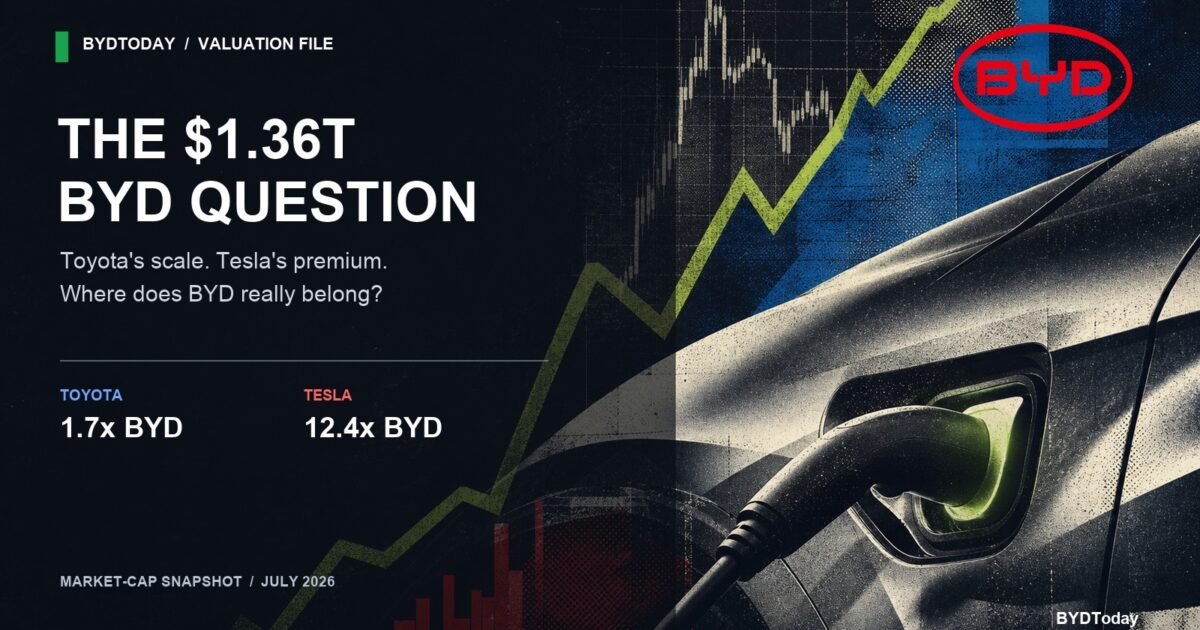
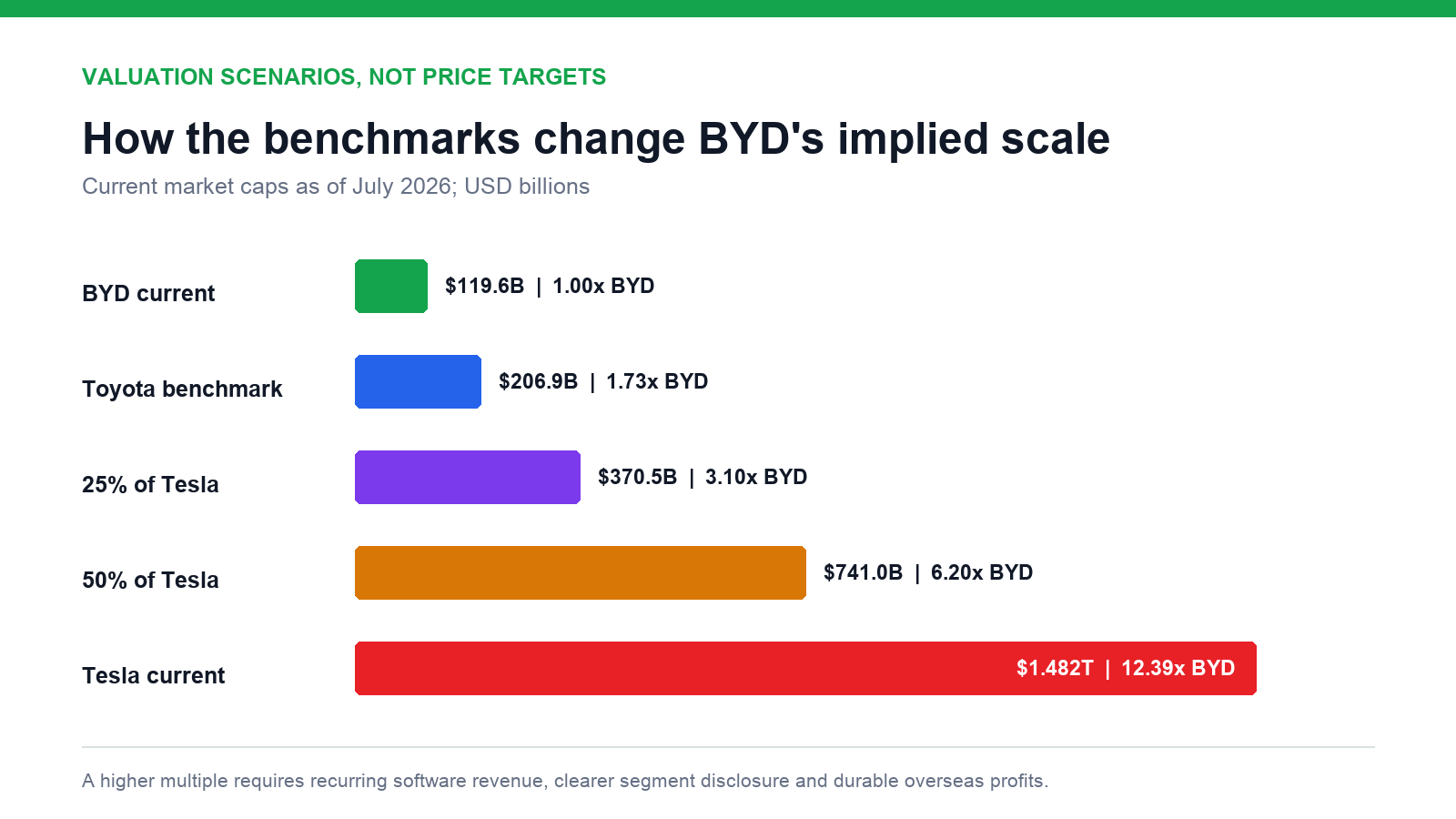
As of July 2026, CompaniesMarketCap valued BYD at about $119.6 billion, Toyota at $206.9 billion and Tesla at $1.482 trillion. Reaching Toyota’s current market value would equal about 1.73 times BYD’s present value; reaching one-quarter of Tesla would equal about 3.10 times. Those are comparison scenarios, not price targets. The gap can close through BYD earning a higher multiple, through Tesla’s premium shrinking, or through both.
Three Companies, Three Valuation Stories
The most useful way to understand BYD’s valuation is not to ask whether it is “the next Tesla.” It is to ask which parts of BYD investors currently value like Toyota and which parts could eventually be valued more like a technology platform.
| Company | What the market mainly prices | July 2026 market cap |
|---|---|---|
| BYD | EV manufacturing scale, vertical integration and China exposure | About $119.6B |
| Toyota | Global volume, durable profits, brand strength and manufacturing discipline | About $206.9B |
| Tesla | Vehicles plus AI, software, Robotaxi, energy and robotics option value | About $1.482T |
The figures are a dated snapshot and will move with share prices and exchange rates. Their value is in showing the size of the classification gap: Toyota was worth roughly 1.7 BYDs, while Tesla was worth about 12.4 BYDs.
Why Toyota Is the First Benchmark
Toyota is the more defensible starting point because it shows how the market values a proven global car manufacturer without assuming a large AI premium. For the fiscal year ended March 2026, Toyota reported JPY 50.685 trillion in sales revenue, JPY 3.766 trillion in operating income and JPY 3.848 trillion in net income attributable to Toyota. Consolidated vehicle sales were 9.595 million units.
BYD’s calendar-year 2025 profile was smaller but increasingly comparable in industrial scale. It sold 4,602,436 new-energy vehicles, reported about RMB 804 billion in revenue and spent RMB 63.4 billion on R&D. Its 2025 net profit was about RMB 32.6 billion.
That does not make Toyota’s market capitalization a floor for BYD. Toyota has a much larger global installed base, deeper brand recognition, a mature dealer and service network, and decades of demonstrated profitability across economic cycles. BYD also faces heavier China-market competition and geopolitical restrictions. Toyota is best treated as a benchmark for what BYD must prove globally, not as an automatic destination.
Why Tesla Is Worth So Much More
Tesla’s 2025 accounts still looked predominantly automotive. It reported $94.827 billion in total revenue, including $69.526 billion of automotive revenue. GAAP operating income was $4.355 billion and GAAP net income attributable to common shareholders was $3.794 billion. Tesla delivered 1,636,129 vehicles during the year.
Yet investors do not value Tesla only on those results. The premium includes expectations for supervised and unsupervised driving software, Robotaxi economics, energy storage, AI infrastructure and Optimus robotics. Those future businesses may become material, but much of their value is still anticipatory rather than visible in current revenue.
Tesla’s accounts also show why the comparison needs balance. It earned $1.993 billion from automotive regulatory credits in 2025, equivalent to about 52.5% of GAAP net income, although credit revenue and net income are not directly interchangeable measures. Its R&D spending totaled approximately $6.4 billion. The market is therefore paying a premium for Tesla’s future platform potential while its present profits still rely heavily on vehicle operations, energy and regulatory credits.
Where BYD Already Looks Like a Technology Company
R&D intensity and engineering scale
BYD’s 2025 sustainability disclosure put R&D spending at RMB 63.4 billion, or 7.89% of revenue, with 120,000 R&D employees. At a simple RMB 7.2 per dollar conversion, that is approximately $8.8 billion, versus Tesla’s reported $6.4 billion. Exchange rates and accounting definitions differ, so this is directional rather than a perfect like-for-like comparison.
Patents and vertical integration
BYD reported 71,094 cumulative patent applications worldwide by the end of 2025. Patent counts alone do not measure quality or commercial value, and they should not be compared with another company unless the same database and methodology are used. What matters more is where BYD’s intellectual property sits: batteries, electric powertrains, power electronics, vehicle control, charging and manufacturing.
This vertical integration allows BYD to coordinate battery chemistry, semiconductors, motors, electronic controls and vehicle architecture. The same engineering base also supports businesses beyond passenger cars, including energy storage and electronics. Our analysis of Ford’s warning about BYD’s structural cost advantage explains why this system is difficult for legacy automakers to reproduce quickly.
A 4nm intelligent-driving chip
In May 2026, BYD announced China’s first 4nm intelligent-driving chip developed by an automaker. That is a more concrete technology-company signal than simply installing third-party ADAS hardware. It gives BYD greater control over computing cost, vehicle integration and future software deployment. BYD’s DiSus active-suspension family offers another example of a reusable technology platform rather than a feature tied to one model.
The Valuation Scenarios
| Scenario | Implied market value | Multiple of current BYD | What would need to change |
|---|---|---|---|
| Current BYD | $119.6B | 1.00x | Present market classification |
| Toyota benchmark | $206.9B | 1.73x | More durable overseas profits and global brand strength |
| 25% of Tesla | $370.5B | 3.10x | Technology businesses receive a visible platform premium |
| 50% of Tesla | $741.0B | 6.20x | Meaningful recurring software and services economics |
| Tesla benchmark | $1.482T | 12.39x | Not a reasonable base case; shown only to define the current gap |
The Toyota scenario is mainly an execution test. The quarter-Tesla scenario is a business-model test. It would require investors to see BYD’s chips, batteries, ADAS, energy storage and control systems as monetizable platforms rather than as internal tools that improve vehicle margins.
What Could Trigger a BYD Re-Rating?
- Software revenue disclosure: investors need to see subscriptions, ADAS services or licensing revenue separately from vehicle sales.
- Clearer segment reporting: batteries, energy storage, semiconductors and intelligent-driving technology need measurable economics.
- Overseas profitability: factories and distribution networks outside China must produce durable margins, not only higher delivery volumes.
- Technology monetization beyond BYD cars: supplying external automakers or licensing platforms would make BYD’s technology assets easier to value independently.
- Capital-market communication: BYD needs a consistent, evidence-based explanation of how R&D becomes future cash flow.
BYD’s investment and partnership activity, including its relationship with ADAS supplier Momenta, also shows that its strategy does not depend on doing every layer alone.
Why the Gap Might Not Close
- Tesla’s premium could contract: the comparison can narrow because Tesla falls, not because BYD rises.
- Manufacturing remains capital intensive: large R&D and factory budgets do not automatically produce software-like returns.
- China’s price competition pressures profit: BYD’s 2025 net profit declined even as revenue reached a record.
- Geopolitical barriers matter: tariffs, connected-vehicle rules and investment restrictions can limit the value of BYD’s overseas opportunity.
- Patent quantity is not patent value: only technologies that improve cash flow or create external revenue deserve a separate valuation premium.
Verdict
BYD should not be valued as “Tesla with a Chinese discount,” and Toyota should not be treated as a guaranteed floor. The more useful conclusion is that BYD combines a Toyota-like manufacturing challenge with technology assets that Toyota is not usually credited for and that Tesla investors prize heavily.
At today’s market values, moving toward Toyota would represent a substantial re-rating, while even one-quarter of Tesla would imply a much larger shift. The size of that gap is real. Whether it is opportunity or justified discount depends on BYD proving that its R&D, patents, chips and vertical integration can create recurring, separately measurable profits beyond selling more cars.
This article is an industry and valuation-framework analysis, not investment advice. Market capitalizations and exchange rates change continuously.
FAQ
Is BYD currently worth less than Toyota?
Yes. In the July 2026 snapshot used here, BYD’s market capitalization was about $119.6 billion versus Toyota’s $206.9 billion.
How much larger is Tesla’s market value than BYD’s?
About 12.4 times in the same snapshot. That does not mean BYD should receive Tesla’s multiple; much of Tesla’s value reflects expectations for AI, software, Robotaxi, energy and robotics.
Does BYD spend more on R&D than Tesla?
BYD reported RMB 63.4 billion of 2025 R&D spending, approximately $8.8 billion at RMB 7.2 per dollar. Tesla reported about $6.4 billion. Currency conversion and accounting definitions make the comparison approximate.
Why not value BYD only as a car company?
BYD develops batteries, power electronics, vehicle-control systems, energy-storage technology and intelligent-driving chips in-house. Those assets extend beyond assembly, but BYD still needs clearer disclosure showing how they create independent earnings.
Are the Toyota and Tesla scenarios price targets?
No. They are benchmarks used to show how different market classifications change implied company value. They are not forecasts or recommendations.
Sources
- Huxiu / Eastland: “BYD Is Not a Car Company” — original Chinese valuation thesis.
- BYD: 2025 sales of 4,602,436 vehicles.
- BYD: 2025 sustainability report highlights — R&D, personnel and patent applications.
- BYD: first automaker-developed 4nm intelligent-driving chip in China.
- Tesla 2025 Form 10-K — revenue, profit, R&D and regulatory credits.
- Tesla: full-year 2025 production and deliveries.
- Toyota FY2026 Financial Summary — revenue, profit and consolidated vehicle sales.
- CompaniesMarketCap: BYD market capitalization.
- CompaniesMarketCap: Toyota market capitalization.
- CompaniesMarketCap: Tesla market capitalization.