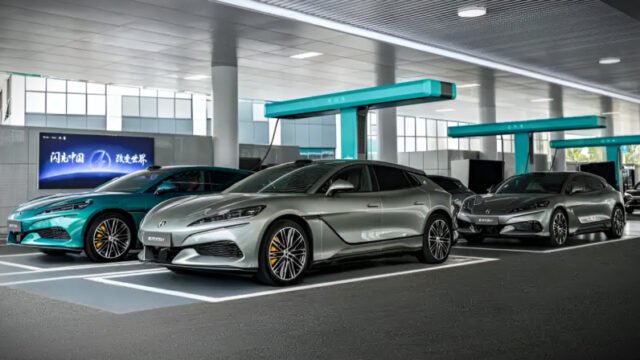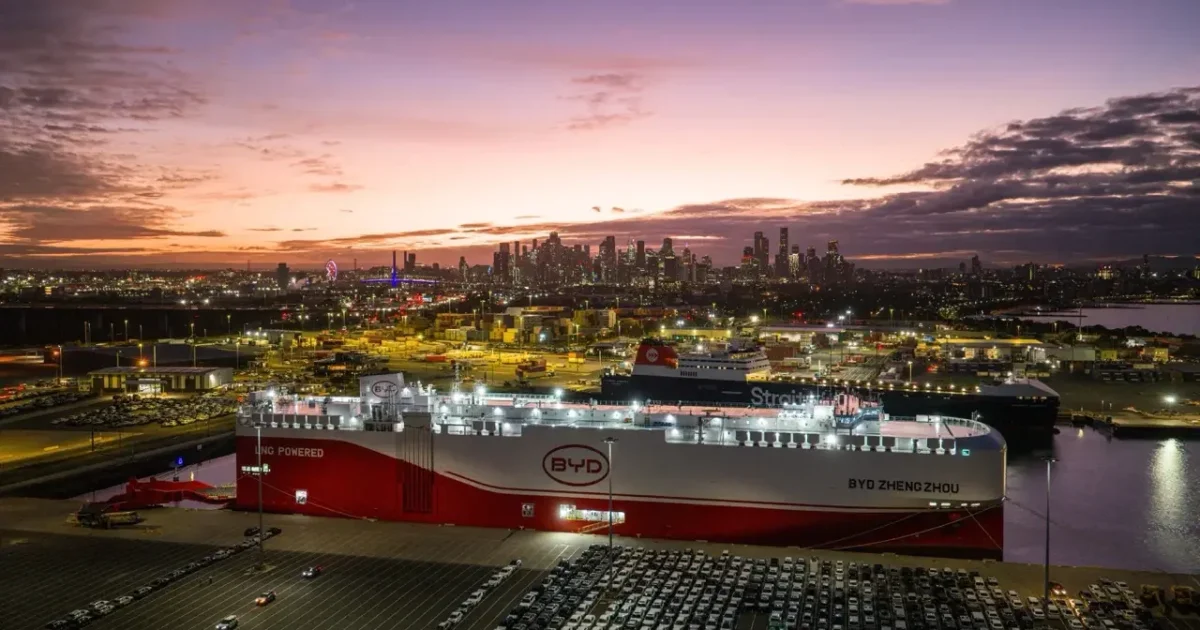
China has surpassed Japan to become Australia’s largest source of imported vehicles, with nearly 36,000 passenger vehicles arriving from China in April 2026 compared with approximately 29,000 from Japan, according to data released by the Australian Bureau of Statistics on June 5. Over the first four months of 2026, Chinese auto imports to Australia exceeded 100,000 units, a 51% year-over-year increase.
Of those 100,000-plus vehicles, more than 40,000 were electric vehicles, reflecting the surging demand for affordable EVs and plug-in hybrids in the Australian market. The Federal Chamber of Automotive Industries reported that electric and hybrid vehicles accounted for nearly half of all Australian new-car sales in May 2026.
BYD’s Leading Role
BYD has become the second-best-selling automotive brand in Australia, with its market share more than doubling over the past year. Toyota remains the top-selling brand, but the gap is narrowing rapidly as Chinese manufacturers — including BYD, MG (SAIC), GWM, and emerging brands — expand their Australian portfolios. Australia’s EV boom has made it a key test market for Chinese brands, with consumers increasingly cross-shopping Chinese EVs against established players.
The automotive import surge helped push Australia’s total April imports to a record A$45.4 billion (approximately $32.3 billion). China’s rise as an automotive exporter to developed Western markets represents a structural shift: three years ago, Chinese-brand vehicles were virtually absent from Australian roads; today one in four imported vehicles comes from China, holding an estimated 25% import market share, per The Auto Executive.
Broader Export Context
Australia is not an isolated case. China’s auto exports have been surging globally: in the first four months of 2026, total vehicle exports exceeded 3 million units amid strong demand across Southeast Asia, Europe, and Latin America. Geely reported a record 85,144 export units in May, up 184% year-over-year, while BYD’s overseas shipments exceeded 160,000 units per month.
The Australia milestone is particularly symbolic because it involves displacing Japan — historically the dominant auto exporter to the Australian market for decades — in a developed, right-hand-drive market with strict safety and emissions standards. Chinese automakers are now competing in markets once considered impenetrable by adapting global platforms to local requirements, investing in service networks, and leveraging cost advantages in EV and hybrid powertrains that legacy Japanese brands have been slower to deploy at scale.
Why It Matters Globally
Australia is not just any export market—it is an open, high-income, right-hand-drive country with no domestic auto industry to protect. This makes it the purest test case for Chinese automakers’ global competitiveness. If Chinese brands can succeed in Australia without tariff protection or policy favoritism, they can succeed anywhere. The milestone carries symbolic weight because Japan has been Australia’s largest vehicle import source for decades, built on a reputation for reliability and value. China’s overtaking of Japan signals a fundamental shift in the global automotive hierarchy.
The data also challenges the narrative that Chinese EVs are cheap, low-quality products. Models like the BYD Atto 3, Seal, and Shark 6 are competing in the AUD 40,000–60,000 segment against established Japanese and Korean rivals. With BYD launching its Shark 6 plug-in hybrid ute—a segment Australian buyers are fiercely loyal to—and SAIC’s MG brand already a top-10 seller, the Chinese share is likely to continue growing through 2027.
FAQ
Which Chinese brands are leading in Australia?
BYD leads with over 36,000 vehicles exported to Australia in January–April 2026 across models including the Atto 3, Seal, Dolphin, Sealion 6, and Shark 6. MG (SAIC) is the second-largest Chinese brand by volume, with a longer-established dealer network. GWM (Great Wall Motors) has also grown significantly with its Cannon ute and Haval SUVs. Zeekr and XPeng are newer entrants focusing on the premium segment.
Is Australia imposing tariffs on Chinese EVs?
Unlike the EU and United States, Australia has not imposed additional tariffs on Chinese-made vehicles. Australia’s free trade agreement with China (ChAFTA) eliminated tariffs on Chinese vehicle imports in 2019. However, Australia’s Luxury Car Tax (LCT) applies to vehicles above AUD 89,332 for 2026–27, which affects some premium Chinese models. The lack of protectionist barriers makes Australia uniquely valuable as a market-proving ground for Chinese automakers.
Sources
- ECNS, China overtakes Japan as Australia’s largest vehicle supplier
- Gasgoo, China surpasses Japan as Australia’s top auto import source
- Australian Bureau of Statistics, April 2026 international trade data: vehicle import breakdown by country