This article was originally published on June 8, 2026, as a pre-launch preview based on filing data and pre-order information. For full launch-day analysis, buyer/investor impact, and updated specifications, see BYD Great Tang Launches June 17: 100K+ Pre-Orders, 950 km Range and Flash Charging.
BYD will officially launch the Great Tang, its flagship D-segment electric SUV, on June 17, 2026. The three-row family hauler, which opened pre-sales on April 24 at 250,000–320,000 yuan (approximately $36,950–$47,300), has already amassed over 100,000 pre-orders in just 13 days — demand so strong it reportedly pressured Blade Battery 2.0 supply and delayed the original launch timeline.
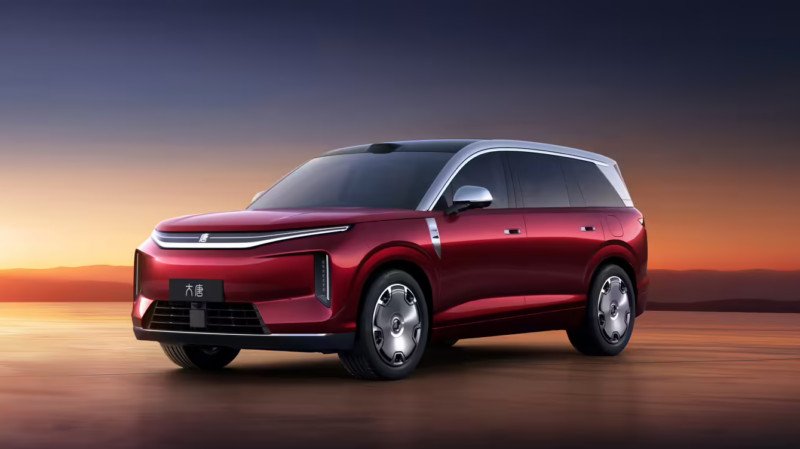
Measuring 5,263 mm long with a 3,130 mm wheelbase, the Great Tang is the largest and longest-range member of BYD’s Tang family. It combines family practicality with genuine performance credentials, making it one of the most anticipated Chinese EVs of 2026.
Range and Powertrain
Three powertrain configurations are offered. The entry-level rear-wheel-drive version uses a 105.79 kWh battery with a 300 kW motor delivering 800 km of CLTC range. The long-range RWD variant steps up to a 130.15 kWh pack and a 370 kW motor for 950 km of range — among the highest in any production electric SUV. The flagship dual-motor AWD version combines the 130.15 kWh battery with 585 kW of combined output, enough to launch the 2.5-tonne-plus SUV from 0 to 100 km/h in 3.9 seconds.
All versions feature BYD’s Flash Charging technology, though specific charging power figures have not been officially confirmed. The 130.15 kWh battery, shared by the long-range and AWD variants, is among the largest in any production passenger EV.
Chassis and Smart Driving
The Great Tang rides on BYD’s DiSus-A intelligent air suspension with dual-chamber air springs and road-preview capability. The system continuously adjusts ride height and damping based on forward road surface detection — a sophisticated feature that places the Tang’s chassis hardware among the segment’s most advanced.
God’s Eye 5.0 (DiPilot) is standard, providing highway and urban driver assistance. A roof-mounted LiDAR unit, integrated into a contrast-color roof design, feeds environmental data to the system. The semi-hidden door handles and full-width front and rear light bars complete the modern exterior.
Interior and Market Position
Inside, a 2+2+3 seven-seat layout features wood-grain trim, a digital instrument cluster, a large floating central touchscreen, and a head-up display. Rear-seat entertainment screens and an onboard refrigerator cater to family buyers. A wireless charging pad and physical shortcut buttons on the center console improve everyday usability.
Tang family sales have been modest — the Tang EV sold 1,829 units in April 2026, and the Tang L managed 791 — but the Great Tang’s overwhelming pre-order numbers suggest BYD has finally unlocked the formula for a mass-market flagship electric SUV. The competitive 250,000–320,000 yuan price range positions it directly against Li Auto’s L-series EREVs and premium offerings from NIO and XPeng.
Related Articles
- BYD Great Tang Launches June 17: 100K+ Pre-Orders, 950 km Range and Flash Charging — Full launch-day analysis with updated specs, buyer/investor impact, and global implications