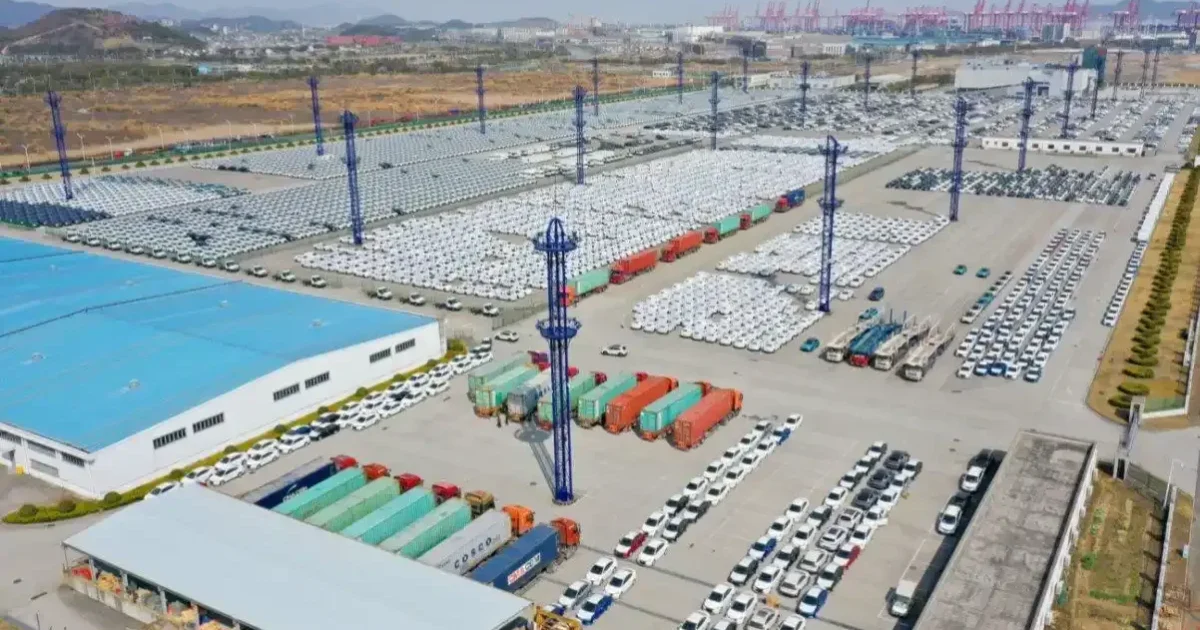
China’s new energy vehicle exports reached 954,000 units in Q1 2026, jumping 116.3% year-over-year to claim 41.2% of total automotive exports, as domestic brands from BYD to Leapmotor accelerate their global manufacturing and distribution networks. Chinese-made EVs await export at Ningbo port. NEV exports hit 954,000 units in Q1 2026. Source: 新华网 (Xinhua)
Q1 export figures are based on Internet Info Agency coverage of CAAM export data, with market context checked against CnEVPost and Gasgoo export-destination reporting.
Q1 2026 Export Data Breakdown
According to the China Association of Automobile Manufacturers (CAAM), compiled from General Administration of Customs data, China’s total vehicle exports reached 2.312 million units in Q1 2026, up 40.9% year-over-year. Within that total, NEV exports accounted for 954,000 units – a 116.3% surge that brought NEV’s share of total exports to 41.2%, up from approximately 26% a year earlier. In April 2026 alone, cumulative NEV exports for the first four months reached 1.384 million units, representing a 120% increase. This figure already exceeds the full-year NEV export total for 2024, underscoring the acceleration of China’s EV export machine. Passenger NEV exports led the growth, with brands like BYD, MG (SAIC), Chery, Geely, and Changan driving volume across Southeast Asia, Europe, Latin America, and the Middle East.
Key Markets and Brand Performance
BYD has emerged as the single largest NEV exporter. In Germany, BYD’s monthly sales surged 1,550% year-over-year to breach 10,000 units, while MG (backed by SAIC) posted a 564% increase in Italy. In Australia, Chinese brands collectively captured 25% market share, ending a 28-year Japanese brand monopoly and becoming the top choice for family buyers. In Latin America, BYD’s Dolphin mini topped Brazil’s retail sales chart, with Chinese brands accounting for 77.6% of all pure electric vehicle sales across the region. In Southeast Asia, BYD, GWM, and Chery dominate Thailand and Indonesia’s EV markets. Multiple markets reported order backlogs stretching months, creating what trade analysts describe as a “supply gap” that local manufacturing must eventually fill.
The Localization Shift
While export volumes are surging, the strategic focus is shifting from shipping complete vehicles to building local production capacity. Stellantis’ partnerships with Leapmotor and Dongfeng for European manufacturing, BYD’s factories in Hungary, Thailand, Brazil, and Indonesia, and Chery’s planned European plant all point to a transition from “Made in China, exported” to “Chinese technology, locally built.” This localization is partly driven by tariff barriers – the EU’s 20.7% duty on Chinese EVs, potential US tariff escalation, and similar measures being considered in Turkey and India. But it also reflects a maturation strategy: Chinese brands want to be seen as local manufacturers with local workforces, not just exporters. The CAAM data shows total vehicle imports rose just 2.6% to 97,000 units in Q1, confirming that China’s automotive trade relationship with the world is overwhelmingly export-driven.