The “Smart Driving for All 2.0” strategy and God’s Eye 5.0 system promise to put LiDAR, city NOA, and full-scene autonomous parking into China’s most affordable vehicles — permanently free, with no subscription.
BYD’s lower-price smart-driving push is based on Carscoops coverage of God’s Eye ADAS moving into lower-priced BYD models, with 2026 XuanJi A3 context from BYD technology reporting.
A Paradigm Shift: Democratizing High-End Autonomous Driving
In May 2026, BYD unveiled what may be the most consequential smart driving announcement in automotive history. The company’s “Smart Driving for All 2.0” strategy, paired with the God’s Eye 5.0 (Tian Shen Zhi Yan 5.0) intelligent driving system, promises to bring features historically reserved for $41,000+ luxury vehicles — LiDAR sensors, city Navigate on Autopilot (NOA), and full-scene automated parking — to vehicles priced as low as about $9,600 (approximately $9,600 USD). The implications are staggering. BYD sold over 4 million vehicles in 2025, the vast majority in the about $9,600 to $27,500 mass-market segment. Equipping these affordable vehicles with advanced driver assistance systems (ADAS) represents a democratization of automotive intelligence at an unprecedented scale. BYD explicitly frames this as “ending the premium premium on intelligence” — a deliberate challenge to competitors who charge $3,000 to $8,000 for comparable systems or lock features behind monthly subscriptions.
God’s Eye 5.0: Full-Stack Self-Developed Intelligence
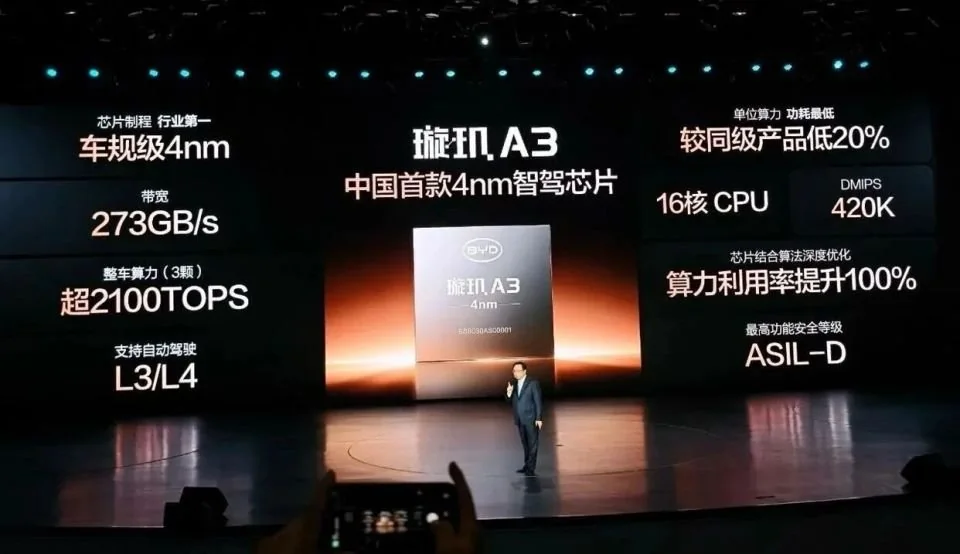
The God’s Eye 5.0 system represents a technological tour de force built on three pillars of in-house development. First, the Xuanji ASIC chip delivers a 40% computing power improvement while reducing energy consumption by 30%, crucial for cost-sensitive mass-market vehicles. Second, BYD’s self-developed LiDAR sensor achieves 1,080 to 2,160 scan lines — “thousand-line class” — at a cost pushed down to the thousand-RMB level, a fraction of what competitors pay for third-party units. Third, the end-to-end neural network driving model, continuously trained on 180 million kilometers of real-world driving data per day from BYD’s 4-million-plus connected vehicle fleet, creates a data moat that competitors cannot replicate. In real-world testing, God’s Eye 5.0 demonstrates capabilities that rival or exceed premium ADAS systems. It can navigate chaotic Chinese urban environments — crowded village alleys, unprotected left turns, roundabouts with aggressive drivers, construction zones with ambiguous lane markings, and rural roads without clear markings. The AEB (Automatic Emergency Braking) system can detect and stop for a stationary vehicle in a tunnel at 135 km/h during daylight, execute emergency evasive steering at 130 km/h, and identify a child darting from a blind corner.
A Three-Tier Architecture for Every Price Point
BYD has designed a flexible A/B/C three-tier hardware architecture that allows God’s Eye 5.0 to scale across its entire product range. Entry-level models like the Seagull and Dolphin (from about $9,600) receive a high-sensor-count perception package covering basic ADAS and highway pilot functions. The mid-range A, Song, and Yuan families (100,000-200,000 RMB) step up to more capable hardware with broader sensor coverage. Flagship models like the Tang and Han (200,000-300,000 RMB) get the full suite with maximum compute power. Critically, LiDAR sensors cascade down to the 150,000 RMB price point, a segment where no competitor offers the technology. Perhaps the most disruptive element of BYD’s strategy is pricing: all software features are permanently free. There are no optional packages, no subscription fees, and lifetime over-the-air (OTA) updates are included. This contrasts sharply with the industry norm, where Tesla charges $8,000 for FSD, XPeng offers XNGP as a paid upgrade, and NIO has experimented with subscription-based NOP+. BYD is betting that absorbing the software cost into the vehicle’s MSRP — and leveraging its enormous scale to drive down hardware costs — will accelerate adoption and cement its market leadership. Source: Sina Finance/Caifuhao (cj.sina.com.cn), May 6, 2026.