Gotion High-Tech unveils a 400+ Wh/kg all-solid-state battery and charts a clear cost roadmap to bring solid-state cells below about $0.14/Wh, as China’s battery industry races toward the holy grail of energy storage.
The cost-roadmap claim is based on Gasgoo coverage of Gotion’s solid-state battery cost target, with SMM and CarNewsChina used for production-timeline checks.
Gotion’s 400 Wh/kg Breakthrough and the Sulfide Electrolyte Cost Equation
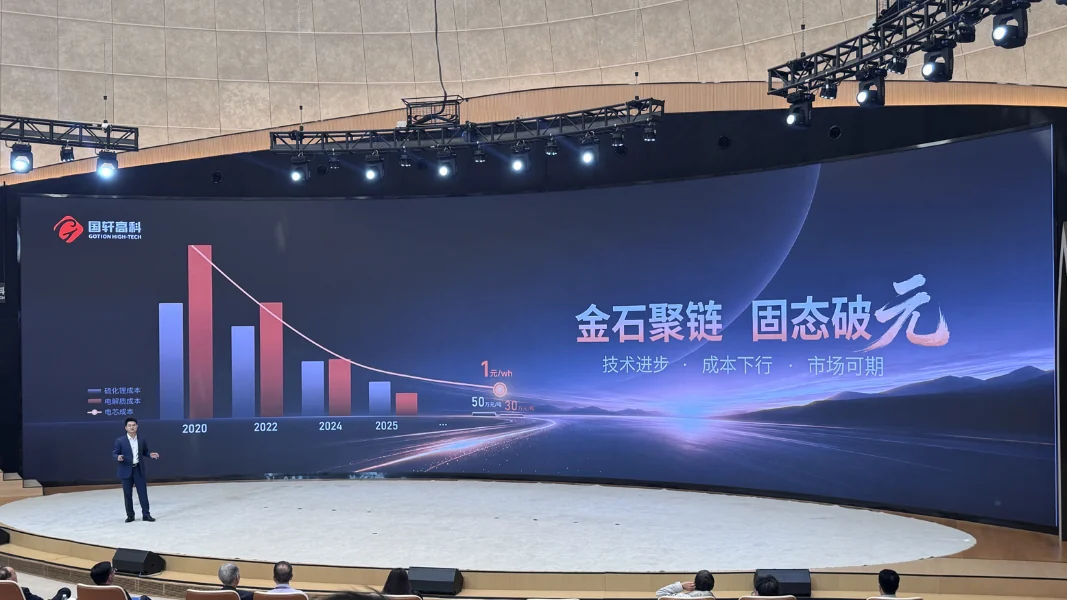
At the 2026 Global Technology Conference, Gotion High-Tech (Gotion) delivered a landmark presentation that mapped the final mile of solid-state battery commercialization. The company’s Jinshi (Gold Stone) all-solid-state battery has achieved an energy density exceeding 400 Wh/kg, up from 300 Wh/kg just one year earlier. A dedicated 2 GWh Jinshi production line is currently under construction, marking the transition from laboratory achievement to industrial-scale manufacturing. The presentation revealed a surprisingly transparent cost roadmap. Gotion engineers explained that 70-80% of sulfide-based solid-state battery costs come from the sulfide electrolyte material itself, and 70-80% of that electrolyte cost derives from lithium sulfide (Li2S). This cascading cost structure means that solving lithium sulfide production economics is the single most important lever for bringing solid-state batteries to commercial viability. Gotion laid out specific targets: when lithium sulfide costs fall to 500,000 RMB per ton (about $69,000) and solid electrolyte costs reach 300,000 RMB per ton (about $41,400), solid-state batteries will enter “their own era of about $0.14 per watt-hour.”
The Industry-Wide Race: Production Capacity Timelines
The solid-state battery industry is coalescing around a shared production timeline. Gotion’s roadmap calls for lithium sulfide capacity to ramp from 300 tons per year in 2026 to 20,000 tons in 2027 and 50,000 tons by 2030 — sufficient to supply 150 GWh of solid-state battery production. Solid electrolyte capacity follows a parallel trajectory: 2,000 tons per year in 2026, expanding to 10,000 tons in 2027 and 100,000 tons by 2030. At these volumes, the cost curve bends sharply downward. Other major players are advancing on parallel tracks. CATL has secured a landmark 3-year, 60 GWh order with HyperStrong, signaling confidence in next-generation battery technologies. BYD, whose 400 Wh/kg sulfide solid-state battery is already undergoing testing according to earlier reports, remains a formidable competitor. A wave of automakers — including FAW Hongqi, GAC, Geely, and Chery — are initiating vehicle-level validation of all-solid-state battery packs in 2026, targeting small-scale production and vehicle integration by 2027. The semi-solid-state battery, based on oxide electrolyte technology, has already entered small-scale mass production and is finding initial applications in data centers and commercial energy storage.
Why This Matters for the Global EV Industry
The march toward about $0.14/Wh solid-state batteries carries transformative implications for the global electric vehicle industry. At current LFP battery pack costs of approximately 0.5-0.6 RMB/Wh at the cell level, the premium for solid-state technology is narrowing rapidly. When solid-state cells reach price parity — or near-parity — with today’s liquid-electrolyte LFP cells, the advantages become overwhelming: 400+ Wh/kg energy density (versus ~200 Wh/kg for LFP), inherent thermal safety without flammable liquid electrolytes, and the potential for ultra-fast charging. The value chain extends far beyond automotive. Solid-state batteries are the enabling technology for electric vertical take-off and landing (eVTOL) aircraft, where weight and safety requirements make current lithium-ion batteries impractical. Humanoid robots, commercial aerospace, and premium consumer electronics all stand to benefit. Meanwhile, the parallel sodium-ion battery revolution is picking up speed, with global Q1 2026 shipments reaching 3.6 GWh (up 150% year-over-year) and full-year forecasts targeting 26.8 GWh. China’s battery industry is executing a three-pronged strategy: LFP for mass market, sodium-ion for cost-sensitive applications, and solid-state for premium and next-generation use cases. Source: Eastmoney/Securities Times (fund.eastmoney.com), May 18, 2026.