Huawei-powered AITO M6 achieves the fastest 10,000-unit delivery in its segment, with 100,000 pre-orders in 20 days and a 760 km CLTC range at a starting price of 259,800 RMB (about $35,800).
The 10,000-unit delivery milestone is based on Gasgoo coverage of AITO M6 deliveries, with later delivery updates and Chinese-market reporting used for context.
A Delivery Pace That Rewrites the Record Books
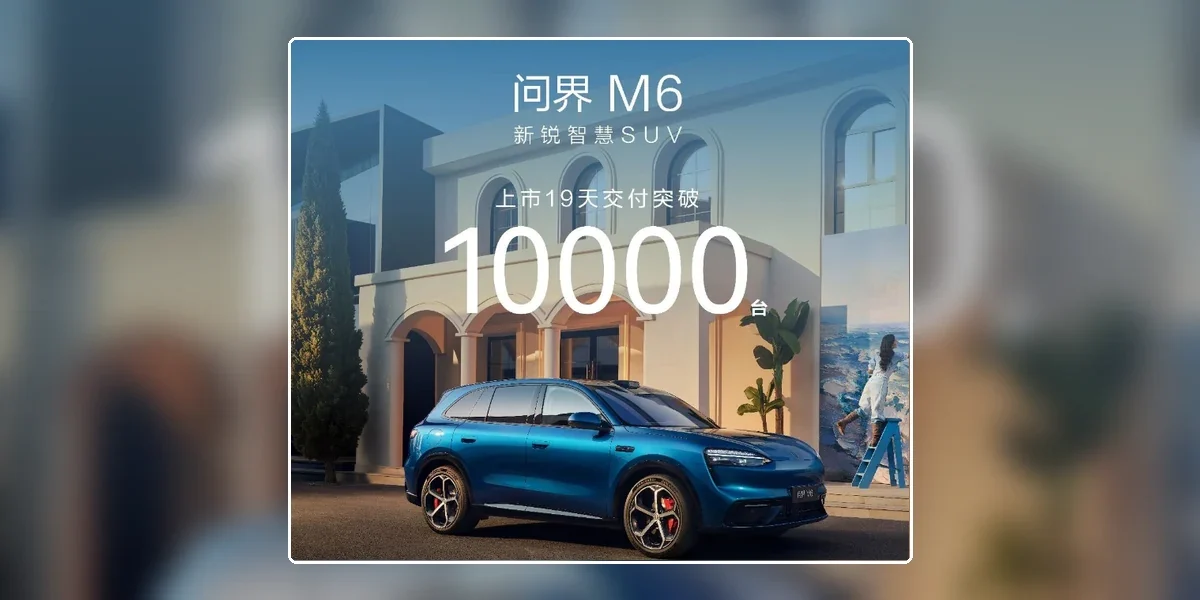
The AITO M6, launched in early May 2026, has achieved what no other vehicle in the 250,000-300,000 RMB (about $34,500-$41,400) SUV segment has accomplished. Within 15 minutes of opening orders, the model secured over 10,000 firm bookings. After 7 days, cumulative deliveries crossed 5,000 units. By May 11 — just 19 days after launch — cumulative deliveries exceeded 10,000 units. Pre-sale orders over a 20-day period surpassed an astonishing 100,000 units. To put these numbers in perspective: the Li Auto L6, a direct competitor, took 72 hours to reach 10,000 pre-orders; the Xiaomi YU7 required half a year to reach a 70,000 monthly sales run rate. The M6’s trajectory is unprecedented. The model’s popularity has overwhelmed Huawei’s retail network. Foot traffic at Huawei stores and AITO experience centers surged 200%, with pop-up delivery events at shopping districts drawing crowds that spilled into parking lots. Related social media topics accumulated over 5 billion views, with organic user reviews flooding Douyin and Xiaohongshu. The Pure Electric Max+ Long Range variant, with its 100 kWh battery and 760 km CLTC range accounting for over 90% of orders, has become the de facto choice for buyers in this segment.
How the M6 Redefines the about $34,500 Segment
The AITO M6’s product formula is simple but devastatingly effective: deliver 500,000 RMB-class (about $69,000) specifications at a about $34,500 price point, with the full weight of Huawei’s technology ecosystem behind it. The vehicle is the only model in its class to offer a standard 896-line dual-channel image-grade LiDAR sensor paired with Huawei’s Qiankun ADS 4.1 advanced driver assistance system — hardware that can detect small objects from 120 meters away and handle high-speed nighttime driving and sudden pedestrian scenarios with confidence. Beyond the sensor suite, the M6 comes standard with Huawei’s Tuling intelligent chassis with closed-air suspension, a front double-wishbone and rear multi-link suspension layout, and ride comfort that reviewers have compared to million-RMB luxury SUVs (about $138,000). The cabin features a 17.3-inch central display, zero-gravity seats, and the full HarmonyOS cockpit ecosystem. Safety equipment includes 9 airbags and the Full-Dimensional Collision Prevention 4.0 system. The cumulative effect is what industry observers describe as “entry-level pricing with flagship-level content” — a value proposition that makes competitor models appear under-equipped by comparison.
Huawei’s Automotive Ascendancy and the Competitive Landscape
The M6’s success is not an isolated event but the latest chapter in Huawei’s accelerating automotive dominance. In April 2026, AITO topped the new energy vehicle residual value rankings with an 82.7% retention rate, surpassing Xiaomi and Li Auto. The brand’s cumulative deliveries across the R7 and S7 models reached 160,000 units by mid-May, and the recently launched M9 flagship continues to command strong demand. Huawei’s automotive strategy — providing deep technology integration without manufacturing vehicles itself — is proving to be the most disruptive force in China’s EV industry. The competitive implications are stark. The Li Auto L6, once the benchmark in this segment, now appears disadvantaged in both intelligent driving capability and chassis configuration. The Tesla Model Y offers Spartan interior appointments and an ADAS hardware suite that lags significantly behind the M6’s sensor array. The Xiaomi YU7, despite strong initial enthusiasm, has been constrained by production capacity shortfalls. As AITO’s manufacturing partner Seres ramps production toward a target of 20,000+ M6 units in May, the model is on track to become the best-selling SUV in its segment for 2026.