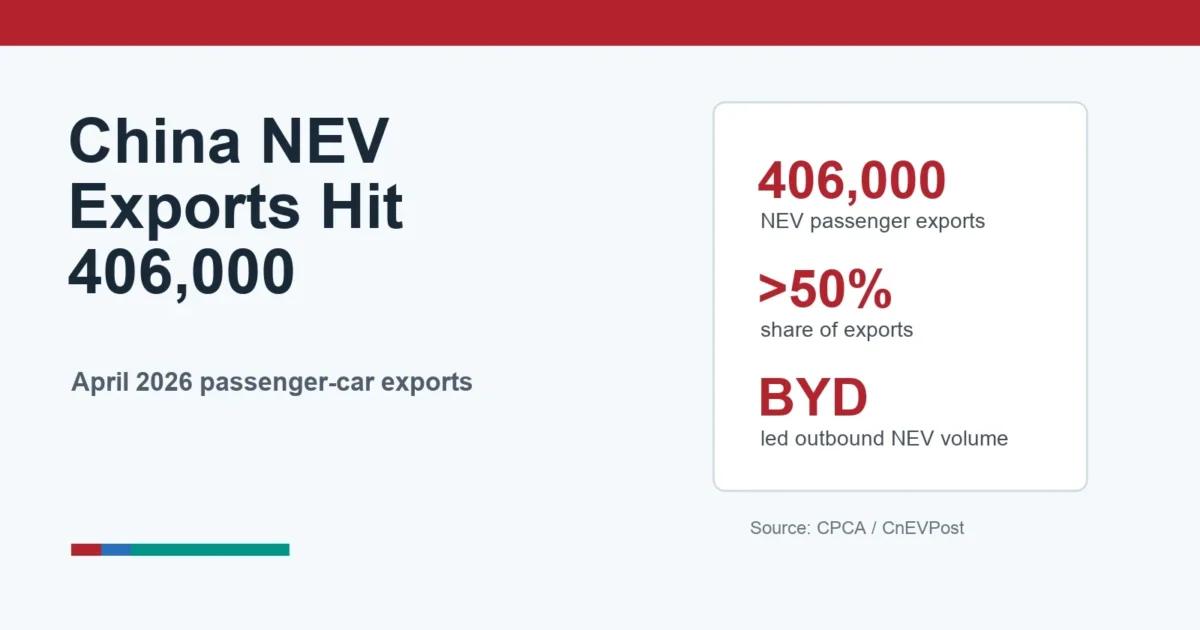
New energy vehicles now account for more than half of all Chinese passenger car exports, driven by surging demand in Europe, Southeast Asia, and Latin America.
Export volume and ranking context are based on CnEVPost coverage of April 2026 China NEV exports and related retail-sales reporting.
April 2026: A Watershed Month for Chinese EV Exports
In April 2026, China exported 406,000 new energy passenger vehicles, representing a 111.8% increase year-on-year, according to data from the China Passenger Car Association (CPCA). More significantly, NEVs accounted for 52.7% of total passenger car exports in April, the first time the share has exceeded 50%. CPCA Secretary-General Cui Dongshu described the performance as “exceptional,” noting that the growth momentum has consistently exceeded market expectations throughout 2026.
The first four months of 2026 have been equally impressive. China’s total auto exports reached 2.34 million vehicles in Q1 alone, up 53% year-on-year. Electric vehicle exports specifically grew 68.1% in the January-April period according to China Customs data. The shift from internal combustion engine vehicles to NEVs as the primary export product marks a structural transformation in China’s automotive industry that has been accelerating since 2023.
UBS China auto research head Gong Min attributed the outperformance to favourable external conditions. The expiry of the US $7,500 EV tax credit in September 2025 prompted Western automakers to scale back EV investments and refocus on ICE vehicles, creating competitive space for Chinese manufacturers. Additionally, sustained high global oil prices since March 2026 have increased the total cost of ownership advantage of EVs, accelerating consumer adoption worldwide.
Automaker Export Strategies Diversify
Chinese automakers are deploying diverse strategies to capitalise on global demand. Changan Automobile exported 637,000 vehicles in 2025, up 19%, with exports exceeding 20% of total sales. The company has established 76 factories globally and began production at its Brazil plant in March 2026. GAC Group reported strong April growth across Hong Kong, Malaysia, Indonesia, Uruguay, and Colombia, and has set a 2026 overseas sales target of 250,000 vehicles, scaling to one million by 2030.
The most significant strategic shift is from “selling globally” to “manufacturing globally.” BYD is in active negotiations with Stellantis and other European automakers to acquire or lease idle factory capacity for localised production. CATL is co-investing in a LFP battery factory in Spain with Stellantis, addressing the supply chain localisation requirements that European regulations increasingly demand.
Leapmotor has pioneered a new model through its joint venture with Stellantis, Leapmotor International. The partnership is integrating Stellantis’s Villaverde plant in Madrid, Spain, and exploring a potential full transfer of the facility to the joint venture. Dongfeng Motor is also in discussions to use Stellantis’s Rennes-La Janais plant in France for contract manufacturing of Dongfeng-branded NEVs for the European market. These arrangements allow Chinese brands to avoid the 45.3% EU tariffs on Chinese-built EVs while leveraging existing manufacturing expertise and workforce.
Challenges Ahead Despite Record Numbers
Despite the impressive headline numbers, Chinese EV exporters face significant headwinds. The European Union’s 45.3% tariffs on Chinese-built electric vehicles remain in place, forcing manufacturers to accelerate localisation plans. In the United States, additional 100% tariffs effectively block direct exports. Regulatory scrutiny of Chinese technology, particularly around connected vehicle data security, is increasing in multiple markets.
The quality and brand perception gap also persists. While Chinese EVs have made enormous strides in technology and build quality, consumer awareness and trust in markets like Europe and North America remain works in progress. Building dealer networks, after-sales service infrastructure, and brand equity in new markets requires sustained investment measured in years, not months.
Nevertheless, the trajectory is clear. China’s NEV exports have evolved from a niche activity to the dominant force in the country’s automotive trade. With domestic penetration exceeding 60% and production capacity continuing to expand, exports are not merely an option but a necessity for Chinese automakers seeking growth. The question is no longer whether Chinese EVs will dominate global markets, but how quickly and through what combination of direct exports, local manufacturing, and technology licensing.
Sources
- CnEVPost, Top automakers in China NEV exports in Apr 2026
- CnEVPost, China Apr 2026 NEV retail sales data
- CarNewsChina, China’s NEV penetration hits historic 61.4% in April


