Quick answer
An LFP battery works by moving lithium ions between a graphite anode and a lithium iron phosphate cathode while electrons travel through the external circuit. At the cathode, iron switches mainly between Fe2+ and Fe3+ as lithium leaves and returns. LFP’s phosphate framework holds oxygen tightly and changes relatively little during cycling, which helps thermal stability and durability.
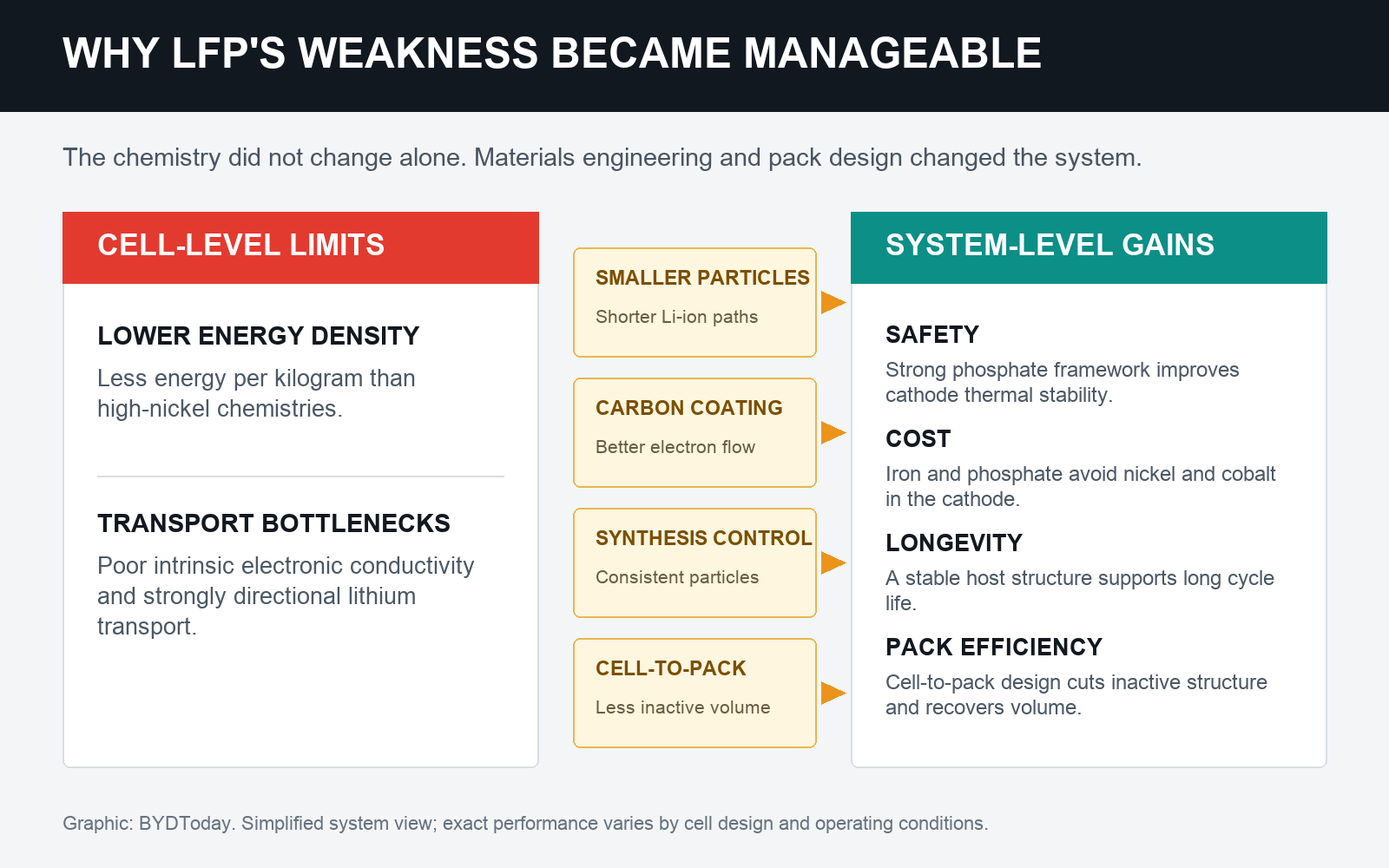
Those strengths come with real limits. Pristine LiFePO4 conducts electrons poorly, lithium transport is strongly directional in the ideal olivine crystal, and LFP stores less energy per kilogram and liter than leading nickel-rich cathodes. Commercial cells became practical because engineers added conductive carbon, controlled particle size and defects, refined synthesis and used more space-efficient packs such as BYD’s Blade Battery.
What LFP means inside a lithium-ion cell
LFP is the cathode material, not a separate class outside lithium-ion batteries. A typical LFP cell still contains a negative electrode, usually graphite; a liquid electrolyte that carries lithium ions; a separator that keeps the electrodes from touching; current collectors; and a casing. A battery pack then adds cooling, electrical connections, sensors, a battery-management system and crash protection.
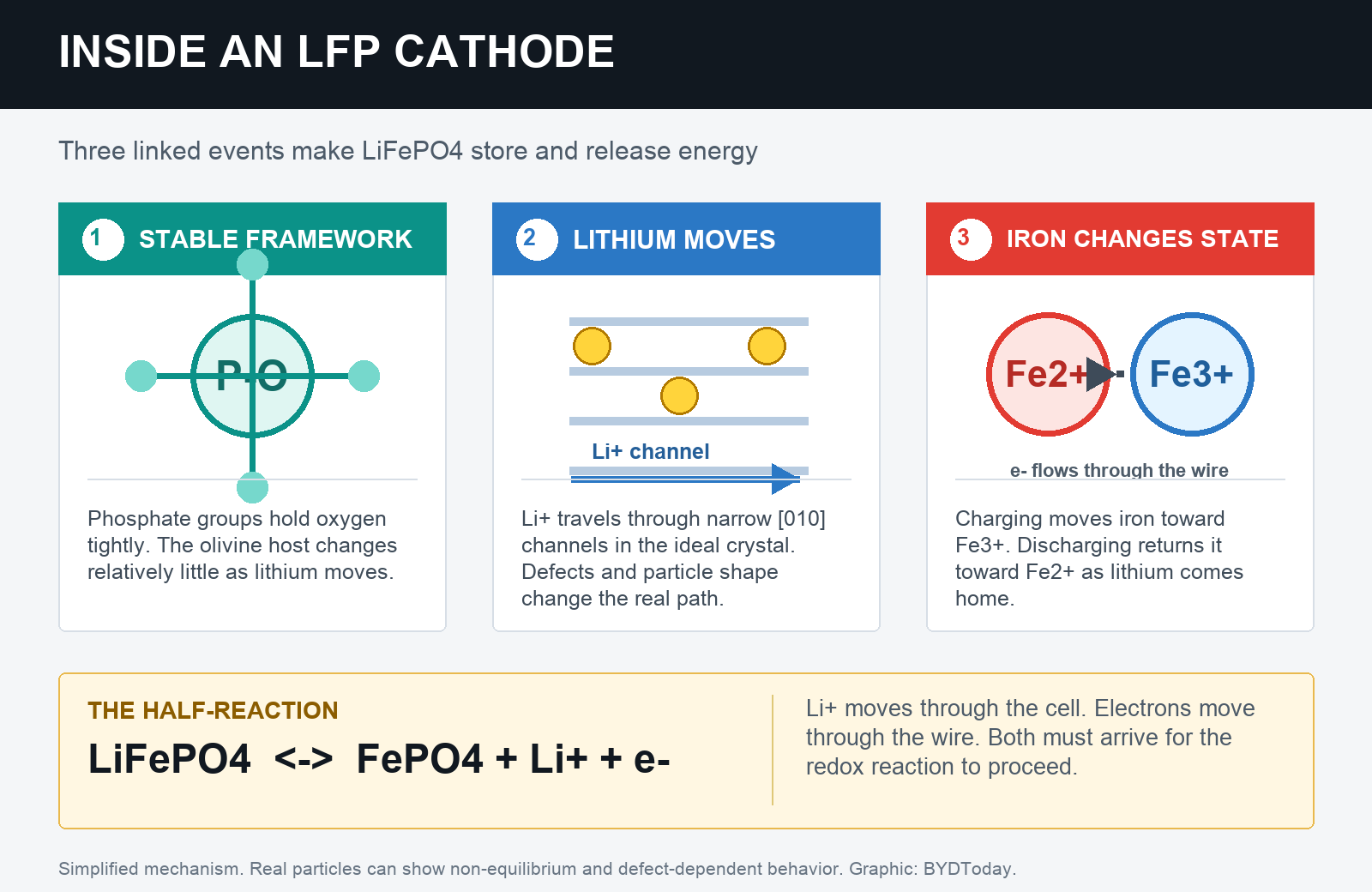
During charging, an external power source pulls electrons away from the positive electrode and pushes them toward the negative electrode. Lithium ions leave the LFP cathode, cross the electrolyte and enter the graphite anode. During discharge, the process reverses: lithium ions return to the cathode while electrons flow through the vehicle’s inverter and motor before reaching the positive side.
The cathode half-reaction is often simplified as:
LiFePO4 ↔ FePO4 + Li+ + e–
This equation explains why lithium and electrons must move together through different paths. Lithium ions travel inside the cell through the electrolyte and solids. Electrons cannot pass through the separator, so they travel through the external circuit, where they can do useful work.
The olivine framework is LFP’s central tradeoff
LiFePO4 crystallizes in an orthorhombic olivine structure commonly described by the Pnma space group. Oxygen atoms form a framework around iron-oxygen octahedra, lithium-oxygen octahedra and phosphate tetrahedra. The phosphate groups are linked by strong phosphorus-oxygen bonds.
That polyanion framework is a major reason LFP behaves differently from layered nickel-manganese-cobalt oxides. Under rising temperature and high state of charge, a cathode that releases reactive oxygen can accelerate electrolyte combustion. LFP’s strong phosphate framework is more resistant to oxygen release and structural collapse, giving the cathode greater thermal stability.
The same ordered framework restricts transport. Lithium sites connect through narrow pathways, and iron and phosphate groups do not rearrange to create broad two-dimensional layers. LFP therefore began with a frustrating combination: a chemically stable host that did not move charge quickly enough in its untreated form.

Are LFP’s lithium channels one-dimensional or two-dimensional?
The short answer is: the ideal crystal is conventionally described as strongly one-dimensional, but real particles can behave more complexly. First-principles and structural studies identify open lithium channels along the [010] direction. A defect that blocks one of these narrow channels can therefore have an outsized effect.
Operando research has also observed apparent two-dimensional lithium diffusion and inter-channel hopping in some particles. Antisite defects, particle shape, strain, surfaces and phase boundaries can alter the path. That does not make the one-dimensional model wrong; it means a perfect-crystal diagram is not a complete prediction of a manufactured electrode.
For buyers, the practical conclusion is more useful than the dimensional label. LFP power and fast-charge performance depend heavily on particle orientation, defect population, conductive networks, electrode thickness, temperature and cell design. Two cells with the same broad “LFP” label can perform very differently.
Iron stores and releases the electron
When lithium leaves LiFePO4 during charging, iron is oxidized mainly from Fe2+ to Fe3+. When lithium returns during discharge, iron gains an electron and returns toward Fe2+. Phosphate provides the stable structural and chemical framework; the iron redox couple provides the electrochemical switch.
This is why manufacturing must control iron’s oxidation state before the cell ever operates. Unwanted oxidation or secondary iron-containing phases can consume active material, raise resistance and disturb lithium transport. Carbon introduced during synthesis may help in two ways: it can create a conductive network and, depending on the process, help maintain a reducing local environment that limits Fe3+-rich impurities.
LFP often reacts through two coexisting phases
The classic description of LFP charging and discharging is a two-phase reaction between lithium-rich LiFePO4 and lithium-poor FePO4. Rather than every point in a particle changing composition uniformly, regions of the two phases coexist and an interface moves as lithium is removed or inserted.
That phase behavior helps produce LFP’s flat voltage plateau. A flat voltage is useful for delivering stable power, but it makes state-of-charge estimation harder because voltage changes only slightly through a large part of the usable range. The battery-management system must rely more on current integration, calibrated models, temperature and periodic voltage references.
Modern studies show that the reaction pathway can depart from the simplest moving-boundary picture at high rate, in small particles or under non-equilibrium conditions. Solid-solution and metastable states can appear. The two-phase model remains a useful foundation, but commercial fast charging involves kinetics that are more complicated than a static textbook diagram.
Why LFP can support long cycle life
LiFePO4 and FePO4 have closely related frameworks. A frequently cited room-temperature volume difference is about 6.8%. That relatively modest and repeatable structural change can reduce mechanical damage compared with cathodes that undergo larger or less uniform rearrangements.
Stable cathode structure is only one part of cell ageing. LFP cells can still lose lithium inventory, grow resistive interphases, dry out electrolyte, develop current-collector problems or suffer lithium plating during aggressive cold charging. Pack temperature and operating window matter as much as the chemistry label.
That is why a universal claim such as “LFP lasts 2,000 cycles and NMC lasts 500” is misleading. Cycle counts depend on depth of discharge, charge rate, temperature, state-of-charge window, cell format and the chosen end-of-life threshold. LFP generally has strong cycle-life potential, but the number belongs to a tested cell under stated conditions, not to the four letters alone.
The electronic-conductivity problem was severe
Academic work has placed pristine LFP’s electronic conductivity around 10-9 S/cm, with values varying by sample and measurement method. At that level, electrons cannot reach active sites quickly enough for a practical high-power electrode.
Conductive carbon changed the commercial outlook. A thin carbon layer around particles and a connected conductive network through the electrode give electrons a lower-resistance route to the current collector. One Nature Communications study notes that carbon treatment can raise measured conductivity by five to eight orders of magnitude.
More carbon is not automatically better. Carbon occupies mass and volume that do not store lithium in the LFP reaction, can reduce tap density and must be distributed without blocking ion access. Manufacturers therefore optimize carbon source, graphitization, thickness, coverage and the broader conductive-additive network.
Why nanosizing helped – and created another tradeoff
Reducing particle size shortens the distance lithium must travel through the solid. It can also expose more channel openings and reduce the chance that one defect blocks an entire transport path. This was central to early high-power LFP approaches associated with companies such as A123 Systems.
But nanoparticles have more surface area. That can increase side reactions with the electrolyte, demand more binder and conductive material, lower packing density and complicate slurry processing. Very small particles may improve rate capability while hurting volumetric energy density and production efficiency.
Commercial materials therefore do not simply chase the smallest possible particle. They combine primary particles, secondary agglomerates, controlled porosity, coatings and electrode design to balance ion transport, electron transport, surface stability and how densely the powder can pack.
How LFP cathode material is manufactured
The source video spends several minutes on a solid-state route. In simplified form, lithium, iron and phosphate precursors are mixed with a carbon source, heated to remove volatile components and then calcined at higher temperature so atoms diffuse into the olivine phase. The furnace atmosphere is controlled to limit unwanted oxidation and secondary phases.
The description captures real process principles but should not be copied as a universal recipe. Commercial routes use different starting materials, milling techniques, heating profiles, atmospheres and post-processing. Exact temperatures and oxygen limits are manufacturer-specific.
Solid-state synthesis
Solid-state routes are attractive because the equipment and unit operations can be relatively direct. Their challenge is mixing and diffusion: if precursors are not uniform at small scales, the final powder can show broad particle distributions, incomplete reaction or local impurities. Milling, precursor quality, furnace uniformity and residence time become critical.
Solution-based and hydrothermal routes
Liquid-phase methods can mix elements more uniformly before calcination and offer more control over particle size and morphology. Dynanonic’s filings, for example, describe a self-heating evaporation liquid-phase route for nano-LFP. These processes may add drying, solvent, pressure, energy or equipment complexity, so they are not automatically cheaper.
Whichever route is used, the production target is not the highest number from one sample. It is a powder that repeatedly meets capacity, moisture, impurity, particle-size, tap-density and coating specifications at high yield.
Why practical capacity is below the 170 mAh/g theory
The theoretical capacity assumes that one lithium ion per LiFePO4 formula unit participates reversibly. Real electrodes contain conductive carbon, binder, pores and current collectors, none of which contribute the same cathode capacity. Not every active-material region is reached equally at high rate, and voltage limits leave part of the theoretical reaction unused.
Capacity also declines as the measurement expands from active material to electrode, cell, module and pack. This distinction prevents a common comparison error: a cathode-material number cannot be placed beside a pack-level number without accounting for the inactive mass and volume between them.
Why LFP is safer – but not fireproof
LFP’s cathode is less prone to oxygen release and exothermic structural breakdown than common nickel-rich layered oxides. That gives engineers more time and a lower heat-release tendency under some abuse conditions. It is a meaningful safety advantage.
A complete cell still contains flammable electrolyte and stored electrical energy. Internal shorts, contamination, lithium plating, external heating, overcharge, mechanical crush or poor pack design can still initiate thermal runaway. Once neighboring cells and vehicle materials become involved, pack architecture and thermal propagation controls are decisive.
BYD’s nail-penetration demonstration showed a Blade cell remaining without smoke or flame under the company’s test conditions. It supports a comparative thermal-stability claim; it does not prove that every Blade-equipped vehicle is incapable of fire. Test method, cell state of charge, pack context and failure cause must always be stated.
What Blade Battery changes – and what it does not
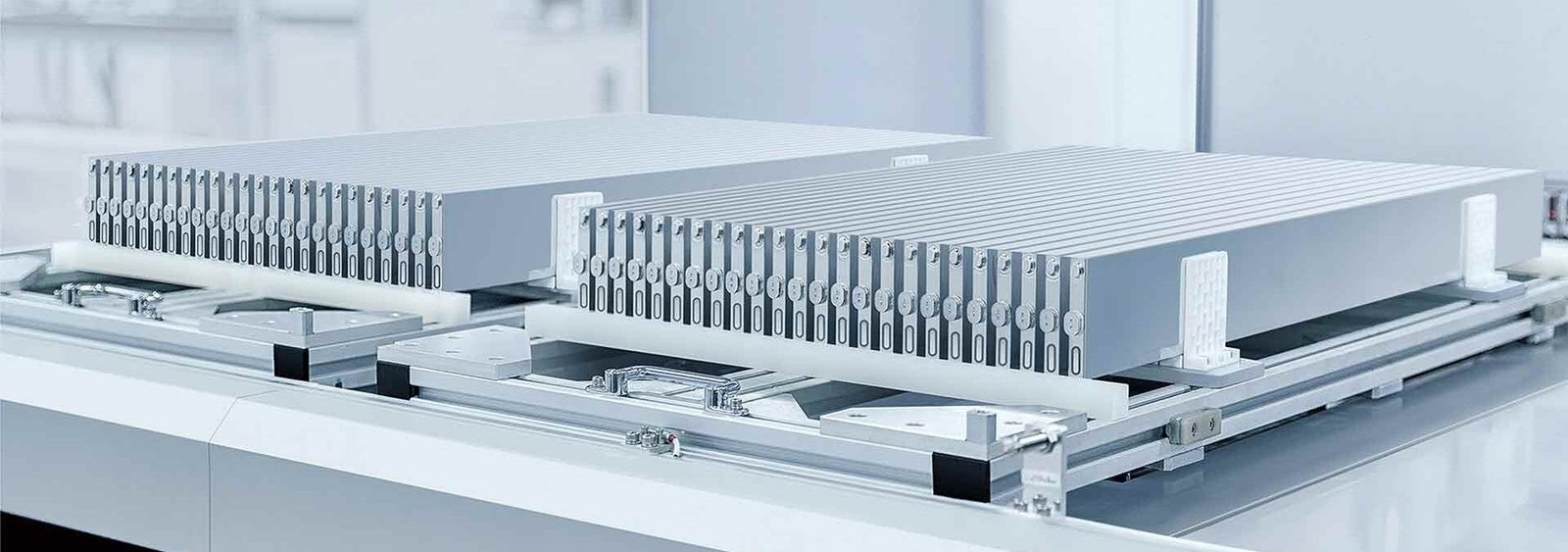
BYD’s Blade Battery is an LFP cell and pack architecture, not a new cathode chemistry. Long, thin prismatic cells are placed directly in the pack with less intermediate module structure and also contribute to mechanical rigidity. BYD says the design increased space utilization by more than 50% compared with its earlier conventional packs.
That is a company comparison, not a law that every LFP pack beats every NMC pack. Cell-to-pack design recovers inactive volume and improves system efficiency. It cannot change LFP’s theoretical voltage or cathode capacity.
LFP vs NMC: the engineering tradeoffs
Energy density
NMC generally stores more energy for a given mass and volume. The IEA’s 2025 analysis estimated average LFP pack energy density at about one-fifth lower by mass and one-third lower by volume than NMC. Better pack integration narrows the vehicle-level penalty but does not erase it.
Cost and materials
LFP avoids nickel and cobalt in the cathode and has structurally lower cathode-material costs. Market prices still depend on lithium, factory utilization, energy, yield and competition. In 2025, the IEA found average LFP pack prices more than 40% below NMC, while noting that application mix and producer losses affected the comparison.
Thermal behavior
LFP has stronger cathode thermal stability. NMC packs can still be safe when cells, cooling, software and propagation barriers are well engineered. Chemistry is one layer of safety, not the entire result.
Cold weather
LFP commonly loses more usable power and charging acceptance at low temperature. Preconditioning, thermal management, electrolyte formulation and charging controls can reduce the penalty, but they cannot be assumed identical across vehicles.
Life and charging
LFP often supports long cycle life and regular full-charge use. Vehicle owners should still follow the manufacturer’s instructions. Fast charging at low temperature or keeping any lithium-ion battery at extreme state of charge for long periods can accelerate ageing.
The correct question is therefore not “Which chemistry is best?” It is “Which chemistry and pack design best meet this vehicle’s range, mass, climate, cost, charging and lifetime targets?”
Five common LFP myths
- “LFP cannot catch fire.” False. Its cathode is more thermally stable, but complete cells and packs can still enter thermal runaway.
- “Blade Battery is a different chemistry.” False. It is a highly integrated long-format LFP design.
- “Lithium moves only in one perfect tunnel.” Incomplete. The ideal structure is strongly one-dimensional, while real defects and particles can enable more complex paths.
- “Smaller particles always make a better battery.” False. Nanosizing improves kinetics but can increase side reactions and reduce packing density.
- “LFP has already made NMC obsolete.” False. LFP leads global deployed EV capacity, while NMC retains advantages in energy-dense, weight-sensitive and cold-climate applications.
Why the chemistry matters for BYD
BYD’s advantage is not that it found a way around electrochemistry. It paired an LFP cathode with particle and electrode engineering, large-cell manufacturing, structural packs, thermal management, vehicle platforms and software. The result is a system in which LFP’s safety and cost strengths can matter more than its cell-level energy-density deficit.
The industrial history behind that system is covered separately in How China Built the LFP Battery Supply Chain in 23 Years.
Frequently asked questions
What does LFP stand for?
LFP stands for lithium iron phosphate, LiFePO4. It is the active cathode material in an LFP lithium-ion cell.
How does an LFP battery produce electricity?
During discharge, lithium ions move from the graphite anode to the LFP cathode while electrons travel through the external circuit. Iron in the cathode is reduced toward Fe2+ as lithium returns.
Why is LFP more thermally stable?
Strong phosphorus-oxygen bonding helps stabilize the cathode framework and makes oxygen release less favorable than in common nickel-rich layered oxides.
What is LFP’s biggest weakness?
Lower energy density is the main system-level disadvantage. Poor intrinsic electronic conductivity and directional lithium transport also require careful material and electrode engineering.
Can an LFP battery be charged to 100%?
Many automakers permit or recommend periodic full charging for LFP packs, partly for state-of-charge calibration. Owners should follow the vehicle maker’s guidance because charging strategy and buffer design vary.
Is LFP always better than NMC?
No. LFP often favors cost, life and thermal stability; NMC generally favors lower pack mass and higher energy density. Climate, vehicle size, range and charging targets determine the better fit.
Source video and editorial method
This technical explainer was prompted by Professor Meow’s 17-minute Bilibili video Century of Chemistry: China No.111 – Lithium Iron Phosphate. The public page did not provide a separate subtitle track, so BYDToday transcribed the complete public audio and checked its chemistry sections against the original 1997 paper and later peer-reviewed research. The wording, structure, comparisons and corrections here are original; this is not a transcript or line-by-line translation.
Sources reviewed
- Padhi, Nanjundaswamy and Goodenough: original 1997 LFP cathode paper
- Nature Communications: LFP conductivity and carbon-coating effects
- Nature Communications: lithium diffusion and phase behavior in olivine LFP
- Nature Communications: particle-size and conductive-coating tradeoffs
- Journal of Power Sources: LiFePO4/FePO4 structure and volume change
- MIT: A123 Systems and nanostructured iron phosphate
- BYD: Blade Battery architecture and company test claims
- IEA Global EV Outlook 2025: LFP and NMC pack comparison
- IEA Global EV Outlook 2026: LFP deployment, cost and pack design