That makes the video a strong third-party observation of BYD’s Flash Charging demonstration — and a useful reminder to separate a 10–70% claim from a full-charge claim.
We traced the viral video to two YouTube originals
The Bilibili upload, published on April 13, 2026, combines two separate English-language videos:
| Bilibili segment | Original source | Published | What it contributes |
|---|---|---|---|
| 00:00–04:24 | “Chinese electric vehicles pull into the lead”, CBS Sunday Morning | April 12, 2026 | Seth Doane’s report on Chinese EVs in Europe, including a UK BYD buyer |
| 04:24–19:48 | “First BYD Flash Charging In Europe! 10-97% In 9 Minutes”, Out of Spec Roaming | April 10, 2026 | Site tour, charging session and creator-estimated charging curve |
There is no single YouTube original for the full 19:48 edit. The source split explains why the tone changes abruptly after the CBS segment: the first part is a television report; the second is a specialist EV charging walkthrough.
What the CBS segment actually shows
CBS follows UK customer Justin Watson at a BYD dealership as he prepares to trade a Lexus for a BYD Sealion 7. Watson praises the ride, suspension, comfort and technology, and compares the seating experience to a throne. The dealership also tells CBS that sales are strong.

That is a real consumer story, but it is still one buyer and one dealer. It supports the claim that BYD is winning interest in the UK; it does not, by itself, prove the viral headline’s broader suggestion that “Europeans are buying like crazy.” For market context, see BYDToday’s separate analysis of BYD’s UK milestones and market share.
CBS’s written report also makes a wider point: BYD’s vertical integration, battery expertise and cost structure are changing how Western buyers and automakers assess Chinese EVs.
What the European Flash Charging video records
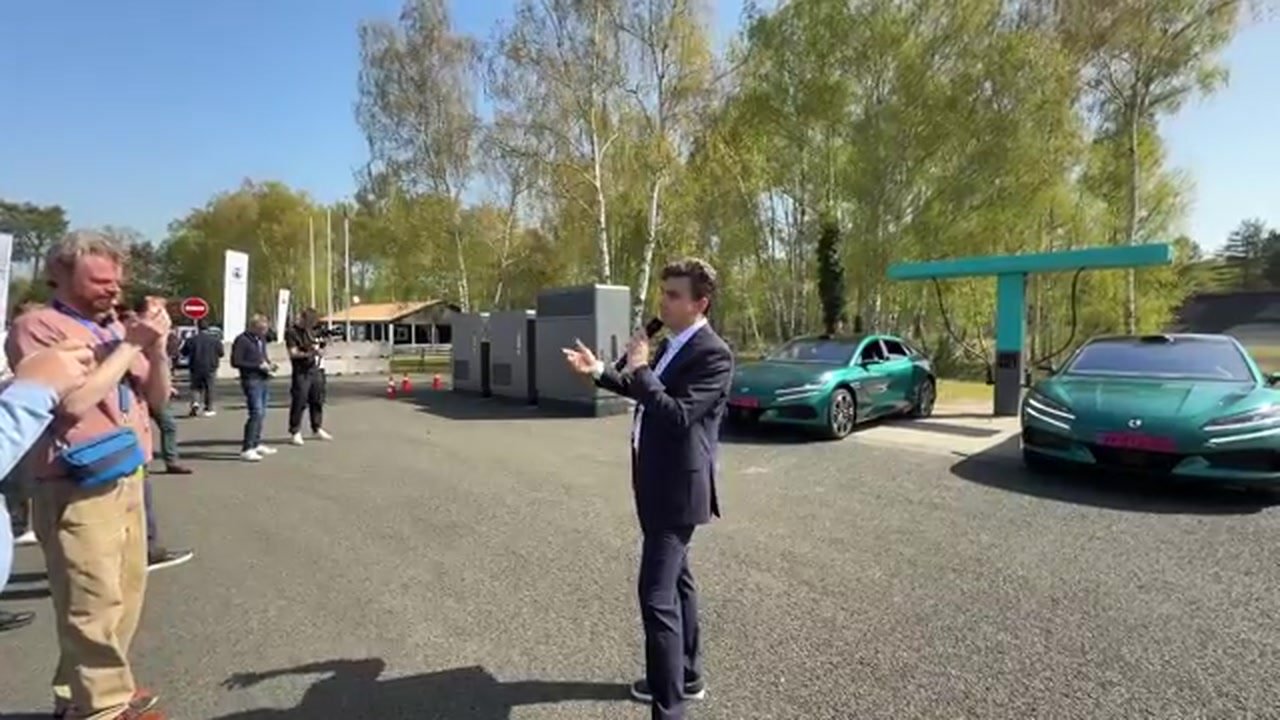
The second source shows a Denza Z9 GT connected to BYD’s temporary European Flash Charging installation. The presenter tours the charger, the supporting battery-storage cabinets and the Blade Battery 2.0 display before filming the in-car charging screen.
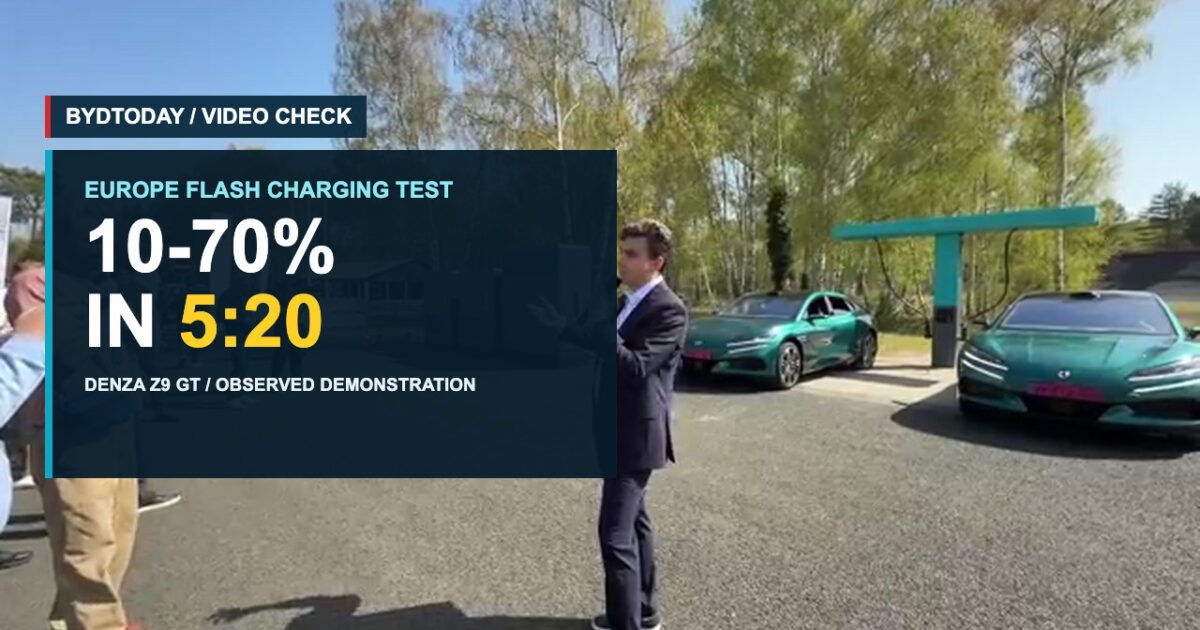
The result is close to BYD’s official “Ready in 5, Full in 9” claim:
| Charging interval | BYD official claim | Recorded in this video | Approx. gap |
|---|---|---|---|
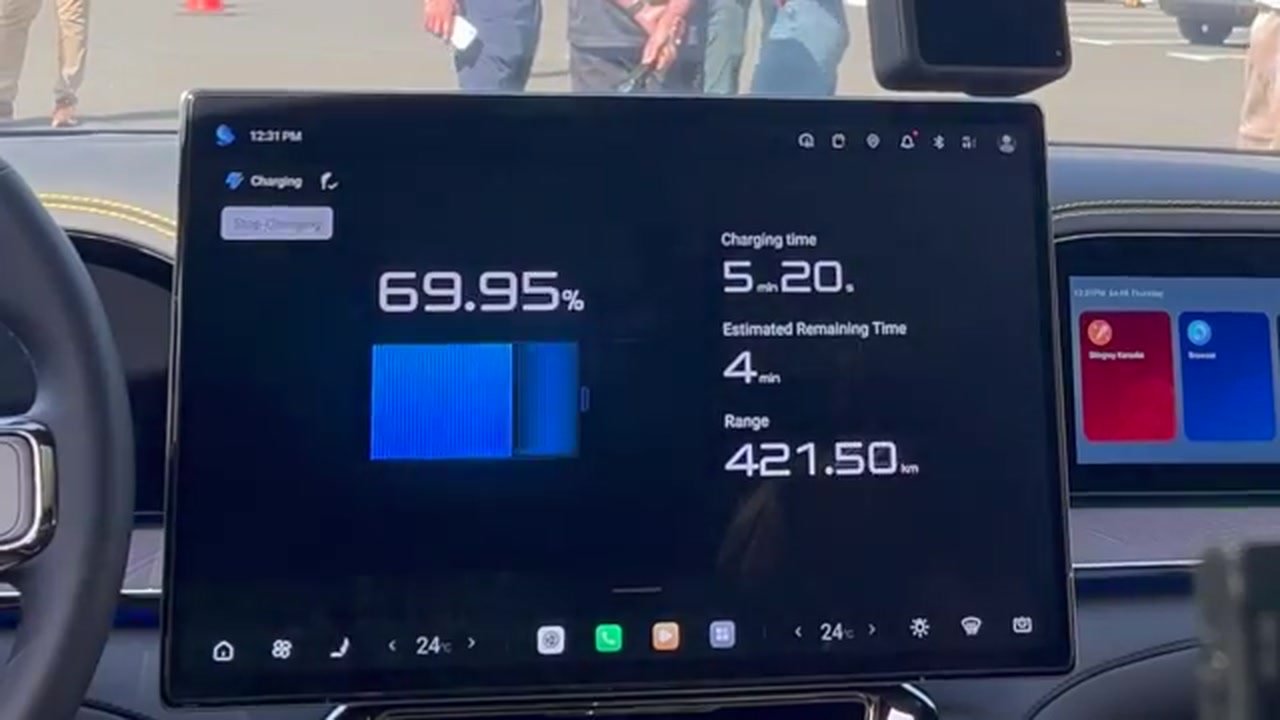
| About 10% to 70% | As little as 5:00 | 5:20 | About +0:20 |
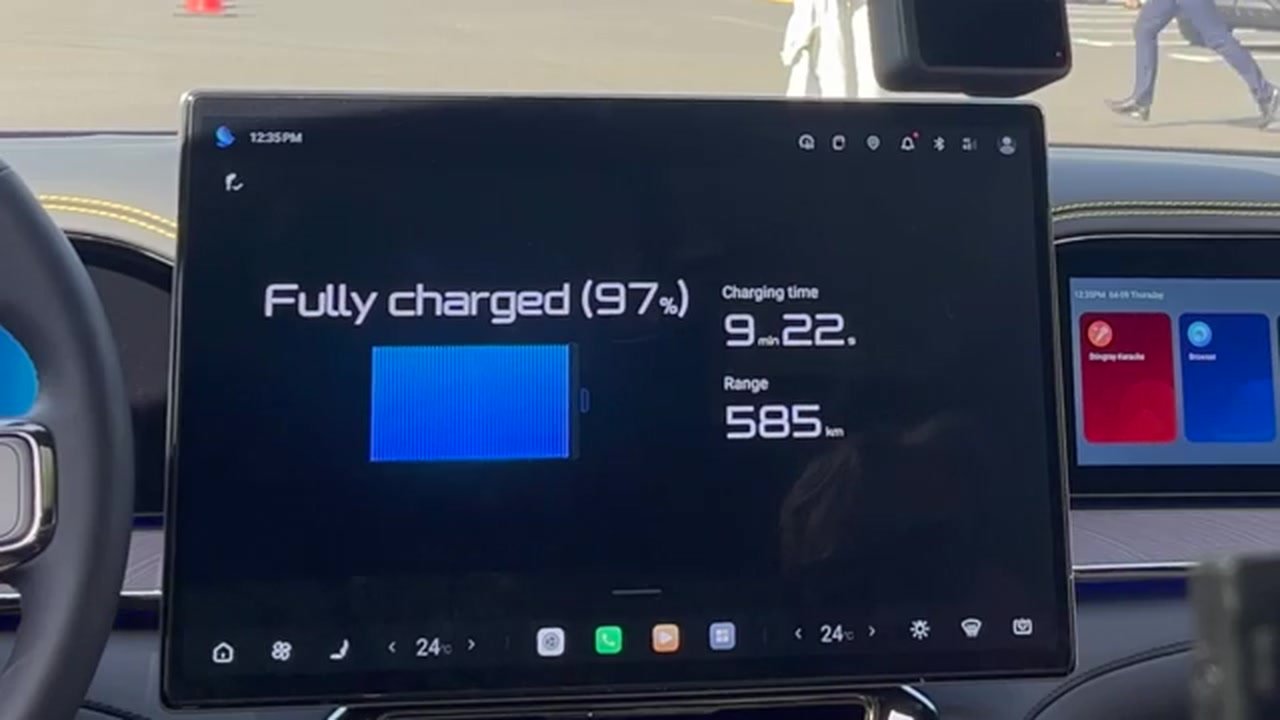
| About 10% to 97% | 9:00 | 9:22 | About +0:22 |
At 5:20, the display reads 69.95%, effectively the 70% threshold at the screen’s refresh precision. The presenter later summarizes the 10–70% run as 5:20 and estimates an average of about 810 kW over that interval.
The car then continues to 97%. Its display labels that endpoint “Fully charged (97%)” and records a total time of 9:22.
So, did BYD charge an EV fully in five minutes?
This distinction matters because charging power normally tapers as a battery approaches full. A vehicle can add a large amount of usable range quickly while still needing several additional minutes for the final portion of the pack.
The viral title compresses two separate claims into one misleading phrase. A more accurate summary is: BYD demonstrated near-70% state of charge in roughly five minutes and reached 97% in just over nine minutes.
How BYD reaches megawatt-class charging speeds
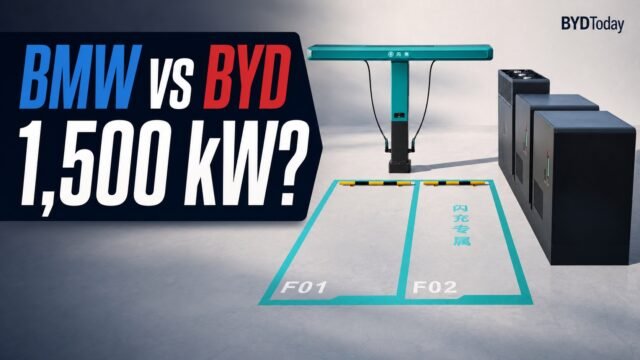
BYD attributes the result to a combination of its second-generation Blade Battery and Flash Charging hardware. In its March 2026 technology announcement, the company says the charger can deliver up to 1,500 kW through one connector and that Blade Battery 2.0 reduces internal resistance while improving ion transport.

The charging site also uses battery energy storage. Instead of asking the local grid to supply the full megawatt-class burst instantly, storage cabinets can recharge at a lower rate and then discharge rapidly into the vehicle. BYD describes this system as both an energy reservoir and a power amplifier that can reduce grid constraints.
There is an important specification caveat. BYD’s 1,500 kW single-connector headline is explicitly described as a Chinese-market specification in its European materials. The European demonstration used a compatible Denza Z9 GT and European charging hardware, but peak charger capacity is not the same as sustained power into the battery. The video’s 810 kW average is the creator’s calculation, not a certified charger-meter result.
For a deeper technical explainer, see BYD Flash Charging: 1,000V, 1.5 MW and 5 Minutes.
What the video proves — and what it does not
The video provides unusually useful evidence because it shows the charging screen continuously and reports both major endpoints. Still, it should be read as an observed demonstration, not a complete validation program.
It shows
- A compatible Denza Z9 GT starting at about 10%
- Roughly 70% at 5:20
- The vehicle’s 97% endpoint at 9:22
- A temporary European setup with battery storage
- A third-party creator’s estimated charging curve
It does not establish
- 0–100% charging in five minutes
- Repeatability across vehicles, temperatures or battery ages
- The same result on today’s ordinary BYD models
- Public-network uptime, pricing or queues
- A sustained 1,500 kW vehicle input
The presenter’s final chart is clearly marked as estimated. The session is compelling, but a robust real-world verdict will require repeated public-site tests with logged charger output, battery temperature and environmental conditions.
What this means for Europe
The first European model announced with Blade Battery 2.0 and Flash Charging is the Denza Z9 GT. BYD’s European launch material says the car is intended to introduce the technology to European customers, while an initial wave of Flash Chargers will support the rollout.
The practical impact will depend on three things: compatible vehicles, enough charging sites and reliable operation outside demonstrations. Existing EVs cannot automatically accept megawatt-class power simply because the dispenser can provide it.
BYDToday tracks the infrastructure side separately in BYD Launches Flash Charging Network in Europe, 3,000 Stations Planned.
Frequently asked questions
What are the original YouTube videos behind the viral BYD clip?
The first source is CBS Sunday Morning’s “Chinese electric vehicles pull into the lead”. The charging portion is Out of Spec Roaming’s “First BYD Flash Charging In Europe! 10-97% In 9 Minutes”.
Which vehicle was used in the charging test?
The filmed vehicle was a Denza Z9 GT equipped for BYD’s second-generation Blade Battery and Flash Charging system.
Was the five-minute claim verified?
The demonstration closely approached BYD’s “as little as five minutes” claim. The filmed result was about 10–70% in 5:20, but the starting state of charge and test conditions were not independently instrumented by BYDToday.
Did the battery reach 100%?
No. The vehicle stopped at its configured “Fully charged” endpoint of 97%, reached in 9:22.
Is this a normal public charging session?
No. It was a controlled European demonstration using a temporary installation. It is stronger evidence than a promotional animation, but it is not the same as an unsupervised public-network test.
Sources
- Bilibili viral edit, published April 13, 2026
- CBS Sunday Morning: “Chinese electric vehicles pull into the lead”
- Out of Spec Roaming: European Flash Charging demonstration
- BYD: Blade Battery 2.0 and Flash Charging technical announcement
- BYD: Denza Z9 GT European launch material