Quick answer: As of July 27, 2026, China has not finalized a 30,000 km NEV reliability-test standard. The National Technical Committee of Auto Standardization (NTCAS) is consulting on three draft amendments for battery-electric, hybrid and fuel-cell vehicles. Comments close on August 12, 2026. The drafts propose minimum test mileage within China’s type-approval procedures; they do not require every production vehicle or customer car to accumulate 30,000 km.
What is already final: MIIT’s separate 2026 vehicle-admission review requirements have been issued and take effect on January 1, 2027. That final MIIT document is not proof that the three GB/T amendments have been approved or put into force.
What Changed in This Update?
Updated July 27, 2026: BYDToday rechecked the NTCAS consultation page, all three draft amendments and MIIT Announcement No. 1 of 2026. This update separates four questions that are often mixed together: what has been proposed, what has been formally approved, when a document takes effect, and what applies to vehicles in production.
What Is Proposed, Approved, Effective or in Production?
The documents have different legal and technical statuses. Completing one stage does not automatically complete the next.
| Status question | Confirmed as of July 27, 2026 | Not confirmed |
|---|---|---|
| Proposal | NTCAS published three draft GB/T amendments for public comment on July 13, 2026. | The consultation text is not final wording. |
| Formal approval | MIIT Announcement No. 1 of 2026 has been issued as a separate admission document. | The three GB/T amendments have not been shown as formally approved or published standards. |
| Effective date | MIIT’s revised admission-review requirements take effect on January 1, 2027. | The draft GB/T amendments contain no confirmed implementation date. |
| Production vehicles | The drafts describe reliability test mileage in vehicle type-approval procedures. | They do not say every vehicle leaving a factory must be driven 30,000 km, or that completing the mileage alone authorizes mass production. |
What Exactly Is China Proposing?
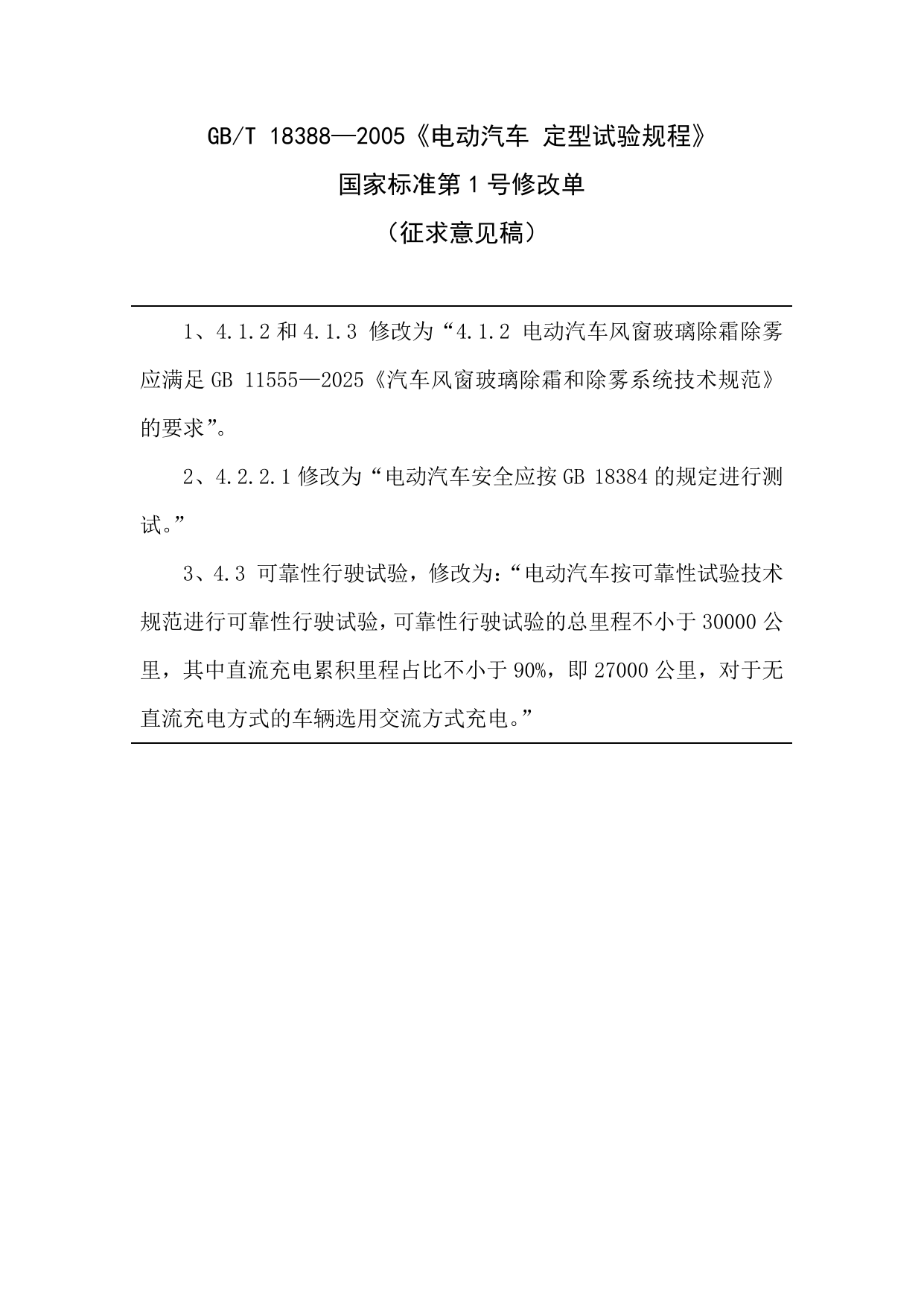
The consultation covers three existing vehicle type-approval test procedures. Each draft proposes at least 30,000 km of reliability road testing, with different operating conditions for each powertrain.
| Draft amendment | Vehicles covered | Proposed reliability test |
|---|---|---|
| GB/T 18388-2005, Amendment 1 | Battery-electric vehicles | At least 30,000 km; at least 27,000 km accumulated using DC charging where the vehicle supports it |
| GB/T 19750-2005, Amendment 1 | Hybrid electric vehicles | At least 30,000 km; qualifying plug-in hybrids would complete at least 10,000 km in pure-electric operation |
| GB/T 39132-2020, Amendment 1 | Fuel-cell electric vehicles | At least 30,000 km in hybrid-drive mode |
The drafts also update references to safety, defrosting and range-test standards. The 30,000 km figure is the headline proposal, but it is not the only technical amendment.
Does Every Production NEV Need to Drive 30,000 km?
No. The proposed 30,000 km figure is test mileage within reliability procedures for vehicle type approval. The drafts do not state that every retail vehicle must show 30,000 km on its odometer before sale. They also do not state that a manufacturer receives production approval merely by completing this mileage.
Type approval, manufacturer admission, product admission and routine factory production are related parts of regulation, but they are not interchangeable claims. A reliability-test proposal should not be reported as proof that a vehicle model has been approved, that mass production has begun, or that an enacted standard already applies.
Is the 30,000 km Requirement Already in Force?
No. As of July 27, 2026, the three amendments remain drafts for public comment. The consultation page lists an August 12, 2026 deadline. The draft documents still show placeholder approval and effective dates, so no start date can be treated as confirmed.
The GB/T prefix identifies recommended national standards. Their practical role in type approval depends on the final amendments and the separate vehicle-admission framework. Reporting the drafts as an enacted mandatory rule would go beyond the documents now available.
How Does the Final MIIT Admission Document Relate to the Drafts?
MIIT published revised vehicle-manufacturer and product-admission review requirements in January 2026. Those requirements take effect on January 1, 2027 and strengthen product-reliability oversight. The explanatory notes for the three GB/T drafts cite MIIT’s 2026 Announcement No. 1 as the policy basis for aligning NEV reliability testing with the 30,000 km requirement applied to conventional vehicles.
The relationship is relevant, but the documents should not be collapsed into one rule. MIIT’s admission requirements are issued and have a confirmed effective date. The three GB/T amendments remain under consultation and require separate approval, publication and implementation dates.
Does the Draft Apply to Chinese EV Exports?
The consultation concerns China’s type-approval and market-admission system. It does not create a separate universal 30,000 km test for every exported vehicle, and it does not replace the homologation rules of the destination country.
A vehicle approved and produced for China’s domestic market may share engineering and validation work with an export derivative. That can influence a manufacturer’s common quality baseline. However, an export model’s legal requirements still depend on its destination, configuration and relationship to China’s domestic approval system. It is therefore inaccurate to say that every China-built NEV shipped to Europe, Southeast Asia or Latin America must pass the proposed test solely because it is exported.
What Would the Draft Change, and What Would It Not Prove?
- Longer validation: A 30,000 km minimum would add defined test mileage to the relevant approval procedures.
- DC-charging exposure: The BEV draft proposes at least 27,000 km accumulated using DC charging where the vehicle supports it.
- PHEV electric-mode durability: The hybrid draft proposes at least 10,000 km in pure-electric operation for qualifying plug-in hybrids.
- Cross-powertrain alignment: The drafting notes say the proposal is intended to bring NEV reliability requirements closer to those for conventional vehicles.
The drafts do not establish a battery-life guarantee, a failure-rate target, a resale-value improvement or a specific industry-consolidation outcome. Those may be debated as possible effects, but they are not provisions in the draft amendments.
What Happens Before the Drafts Can Take Effect?
- NTCAS collects public comments through August 12, 2026.
- The drafting groups may revise the technical text.
- The amendments require formal approval and publication.
- The final documents must specify wording, transition arrangements and effective dates.
Readers following China’s broader shift from incentives toward mature-market regulation can also see our explainer on changes to NEV tax treatment from 2027. Tax policy and reliability testing are separate measures, so neither proves the final scope of the other.
Source Method
BYDToday compared the NTCAS consultation notice with all three amendment drafts and MIIT Announcement No. 1 of 2026. Dates and mileage figures are reported only when they appear in those official documents. Placeholder dates in the drafts are treated as unconfirmed. The article also separates the draft GB/T test procedures from the already-issued MIIT admission requirements.
Official Sources
- NTCAS/CATARC public consultation page, published July 13, 2026; comments close August 12, 2026.
- Official GB/T 18388-2005 Amendment 1 draft for battery-electric vehicles.
- Official GB/T 19750-2005 Amendment 1 draft for hybrid electric vehicles.
- Official GB/T 39132-2020 Amendment 1 draft for fuel-cell electric vehicles.
- MIIT Announcement No. 1 of 2026, which publishes the revised admission-review requirements effective January 1, 2027.
FAQ
Has China finalized a 30,000 km NEV reliability test?
No. NTCAS is consulting on three draft GB/T amendments through August 12, 2026. Final wording, approval dates and effective dates have not been published.
Does every new NEV have to be driven 30,000 km before sale?
No. The proposal describes reliability test mileage in type-approval procedures. It does not require every production or customer vehicle to accumulate 30,000 km.
Does completing 30,000 km authorize mass production?
No such claim appears in the drafts. Reliability testing, manufacturer admission, product admission and the start of production are separate questions.
Is the proposed standard mandatory?
The draft documents amend GB/T recommended national standards. Their practical application depends on the final amendments and the separate MIIT admission framework. The current consultation text should not be described as an enacted mandatory rule.
Would every Chinese EV exported overseas have to pass it?
No blanket export requirement appears in the drafts. They address China’s domestic type-approval framework, while export vehicles must also meet destination-market rules.
Which vehicles are covered?
The consultation covers battery-electric vehicles, hybrid electric vehicles including qualifying plug-in hybrids, and fuel-cell electric vehicles.
Does the proposal guarantee longer battery life?
No. The drafts specify proposed reliability-test mileage and operating conditions. They do not set a battery-life guarantee or a consumer warranty threshold.
When could the 30,000 km requirement start?
No effective date is confirmed for the draft amendments. MIIT’s separate admission-review requirements start on January 1, 2027, but that date must not be assigned automatically to the GB/T drafts.