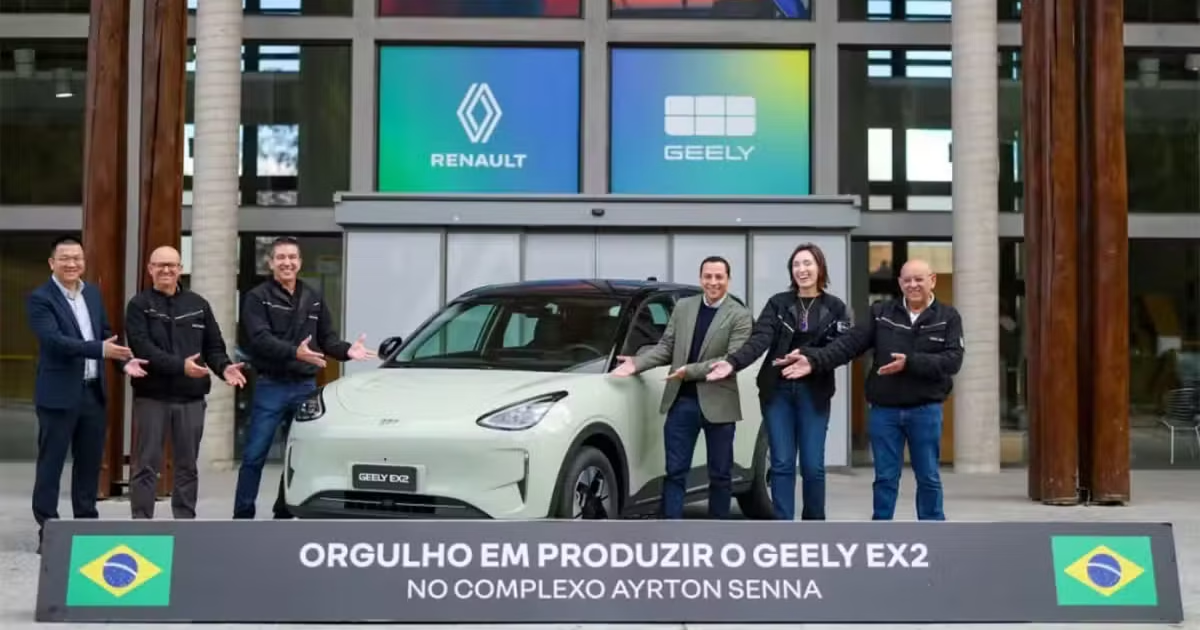
Geely officially commenced local production of its best-selling EX2 electric hatchback at the Renault Geely do Brasil joint venture plant in Paraná state, Brazil, on June 11, 2026, according to CnEVPost. The EX2 — known in China as the Geely Xingyuan and the country’s best-selling small EV — becomes the second model produced locally in Latin America’s largest automotive market, following the EX5 EM-i hybrid SUV.
The local production milestone comes just seven months after the EX2 entered the Brazilian market in November 2025. Strong initial demand prompted the rapid shift from fully imported to locally assembled production. The EX2 is built on Geely’s Global Intelligent New Energy Architecture (GEA) platform at the Ayrton Senna Complex plant, leveraging the Renault Geely joint venture in which Geely holds a 26.4% stake.
The EX2: China’s Hatchback Champion
The Geely Xingyuan (marketed as EX2 in Brazil) has been a remarkable success story in China. The model achieved 465,775 retail sales in 2025, making it the best-selling small pure electric vehicle in the Chinese market. In May 2026, the Xingyuan topped China’s overall passenger vehicle retail sales chart with 38,751 units — surpassing even the Tesla Model Y, per CnEVPost data.
Geely refreshed the Xingyuan in China on May 28, 2026, with a promotional starting price of 61,800 yuan (approximately $9,120) — a 6% reduction from the previous generation. The aggressive pricing strategy has solidified the model’s position in the entry-level EV segment, and similar competitive pricing is expected for the Brazilian market.
Geely’s Brazilian Strategy
Brazil represents a cornerstone of Geely’s Latin American expansion strategy. The Renault Geely joint venture provides immediate access to established manufacturing infrastructure, supply chains, and dealer networks — advantages that pure greenfield investments cannot match. Geely has already demonstrated marketing sophistication in Brazil, becoming the first Chinese brand to sponsor Big Brother Brasil, the country’s most-watched reality show, in April 2026.
The strategy mirrors approaches taken by other Chinese automakers in the region. BYD is building a major manufacturing complex in Camaçari, Bahia, while Great Wall Motor acquired a Daimler plant in São Paulo state. Brazil’s large domestic market (2.5+ million annual vehicle sales), growing EV adoption, and Mercosur trade bloc access make it the most attractive manufacturing hub in South America.
Industry Impact
Geely’s EX2 local production highlights the accelerating localization of Chinese EV manufacturing in emerging markets. Rather than simply exporting finished vehicles, Chinese automakers are increasingly establishing CKD (completely knocked down) and full manufacturing operations in target markets. This approach offers multiple advantages: tariff avoidance, logistics cost reduction, local content compliance, and political goodwill through job creation.
For traditional automakers in Brazil — particularly Fiat, Volkswagen, and Chevrolet, which have dominated the market for decades — the arrival of locally-produced Chinese EVs represents a direct threat to their volume segments. The EX2’s target demographic — urban first-time car buyers seeking affordable electric mobility — has historically been served by entry-level combustion engine models like the Fiat Mobi and Renault Kwid.
Why It Matters Globally
The EX2’s Brazil production demonstrates that Chinese EV manufacturing localization is no longer limited to developed markets in Europe and North America. Emerging economies, where price sensitivity is highest and charging infrastructure is nascent, are becoming battlegrounds for Chinese brands deploying their full competitive arsenal: locally-assembled, aggressively-priced EVs backed by marketing campaigns tailored to local culture.
This model — joint venture manufacturing + localized marketing + competitive pricing — is likely to be replicated across Southeast Asia, Africa, and the Middle East. For legacy automakers, the challenge is existential: they must match Chinese competitors on all three fronts simultaneously, while Chinese brands only need to execute a formula they’ve already perfected domestically.
What’s Next
Geely Brazil has indicated plans to expand its local lineup beyond the EX2 and EX5, with additional models expected as the Ayrton Senna Complex ramps up. The company is also evaluating expansion into neighboring Mercosur markets (Argentina, Uruguay, Paraguay) using Brazil as an export base, which would further improve the economics of local manufacturing.
FAQ
What is the difference between Geely EX2 and Geely Xingyuan?
They are the same vehicle. The Geely Xingyuan is the domestic Chinese market name, while EX2 is the export market name used in Brazil and potentially other international markets. Both share the same GEA platform, specifications, and styling.
How does Geely’s Brazil strategy compare to BYD’s?
BYD is building a greenfield factory in Camaçari, Bahia with larger capacity but a longer timeline. Geely’s approach leverages an existing joint venture with Renault, enabling faster market entry with lower upfront investment. Both strategies have merits: BYD gains full control and larger scale, while Geely achieves speed and capital efficiency.
Will the EX2 be produced in other markets?
While Brazil is the first confirmed overseas production location, Geely is likely to replicate this model in other markets. The EX2/Xingyuan’s platform flexibility and proven market appeal make it a natural candidate for localized production in Southeast Asian and African markets.
Sources
- CnEVPost, Geely begins local production of hot-selling EX2 electric hatchback in Brazil
- Geely Global Newsroom, Geely EX2 local production launch in Brazil — official press release
- Renault Group Press Release, Renault-Geely do Brasil joint venture expands EV lineup with local EX2 production