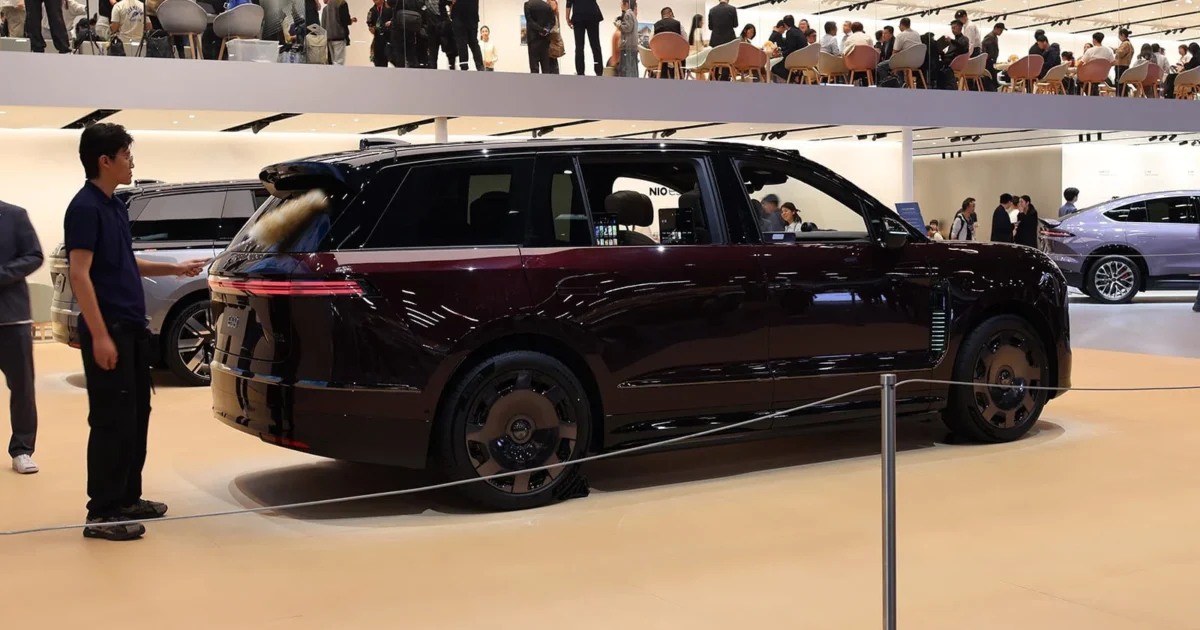
NIO’s newly launched ES9 flagship SUV delivered 3,108 units in the final four days of May following its May 27 market debut and May 28 delivery start, putting the model on track for approximately 10,000 deliveries in June per company and analyst estimates. Deutsche Bank analysts estimate the ES9 has accumulated over 25,000 non-cancellable orders, with delivery wait times of 8-9 weeks for the base version and 16-17 weeks for the high-spec variant equipped with an advanced suspension system.
The strong ES9 launch contributed to NIO’s record May deliveries of 37,705 units, the highest monthly total in the company’s history and a 62.3% year-over-year increase. Deutsche Bank expects NIO to sustain non-GAAP profitability in Q2 2026, forecasting approximately 180 million yuan (about $26.5 million) in net profit, driven by high-margin SUV deliveries including the ES9.
Premium Pricing Power
The ES9 starts at 498,000 yuan with battery (approximately $73,407) or 390,000 yuan (approximately $57,476) under NIO’s BaaS battery rental scheme. NIO brand and communications vice president Ma Lin disclosed that the main NIO brand’s average transaction price exceeded 450,000 yuan (about $66,330) last week, surpassing traditional premium competitors including Mercedes-Benz, BMW, and Huawei-backed AITO.
This pricing achievement is significant for a Chinese automaker operating in a market where foreign luxury brands historically commanded premium margins. NIO’s ability to sustain prices above 450,000 yuan while growing volume suggests the brand’s service ecosystem — including its 2,700-plus battery swap stations — is translating into genuine pricing power.
Q2 and Full-Year Outlook
Deutsche Bank has raised its ES9 full-year 2026 delivery forecast to 56,000 units and NIO’s total 2026 delivery forecast to 450,000 units. Q2 total deliveries are expected to reach 110,000-115,000 units, with June alone projected at 43,000-48,000 units. These figures would represent substantial growth from Q1 2026 levels, placing NIO among the fastest-growing premium EV brands globally in percentage terms.
The ES9’s early momentum also validates NIO’s multi-brand strategy. While the main NIO brand anchors the premium segment, the sub-brand ONVO targets the mass-premium market, and the recently launched NIO family posted record May figures. Separately, NIO partnered with Chinese chipmaker GigaDevice to co-develop automotive chips, furthering vertical integration that supports margin expansion.
Why It Matters Globally
The ES9’s strong initial delivery numbers validate NIO’s strategy of targeting the premium family SUV segment—the same space occupied by the BMW X5, Mercedes GLE, and Porsche Cayenne globally. With 3,108 units delivered in just four days, NIO has demonstrated that its brand equity, battery-swap ecosystem, and premium service model can drive rapid adoption even in China’s hyper-competitive market. For international observers, the ES9’s trajectory offers a preview of the competitive threat Chinese premium EVs pose as NIO expands into Europe, the Middle East, and other overseas markets.
Analysts at CICC and Citic Securities have raised their Q2 2026 delivery forecasts for NIO, with some projecting the ES9 alone could contribute 20,000–25,000 units per quarter once production fully ramps. NIO’s share price rose over 5% in Hong Kong trading following the delivery announcement, reflecting broader market confidence in the company’s turnaround narrative after a challenging 2025.
FAQ
How does the NIO ES9 compare to the Li Auto L8 and XPeng G9?
The ES9 is a pure battery-electric large SUV with NIO’s signature battery-swap capability, while the Li Auto L8 is an EREV (extended-range EV) with a gasoline range extender. The ES9 targets buyers who want full electrification with swap convenience; the L8 appeals to those with range anxiety who still want electric driving characteristics. The XPeng G9 is similarly positioned as a pure EV but lacks the battery-swap ecosystem that differentiates NIO’s offering.
Can NIO sustain 3,000+ weekly deliveries?
Sustaining this rate depends on NIO’s F2 factory in Hefei ramping without quality issues and the company’s ability to manage battery supply for its swap stations. NIO’s second-generation swap stations (Power Swap 4.0) can complete a swap in under 3 minutes, but scaling the station network to support a growing fleet remains a capital-intensive challenge. NIO management has guided for break-even on a quarterly basis by Q4 2026.