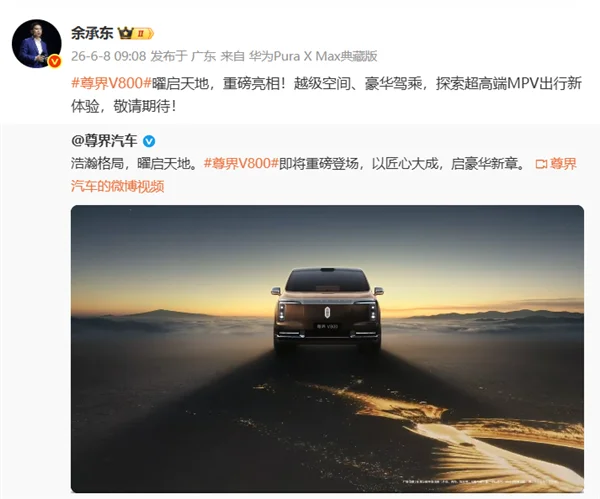
Huawei executive director Richard Yu officially announced the MAEXTRO V800 on June 8, positioning the ultra-premium 7-seat MPV as the second model under Huawei’s flagship MAEXTRO brand within the Harmony Intelligent Mobility Alliance (HIMA). The vehicle, which completed MIIT regulatory filing in May, carries a presale price range of 1.6 million to 2 million yuan (approximately $236,000 to $295,000).
Yu shared an official promotional video with the caption “Explore new ultra-premium MPV travel experiences,” signaling Huawei’s ambition to compete directly with luxury MPVs from Lexus, Toyota Alphard, and Mercedes-Benz in a segment where Chinese brands have historically been absent above the 500,000-yuan threshold.
Specifications and Powertrain
Per MIIT filings, the MAEXTRO V800 measures 5,495 mm long, 2,006 mm wide, and 1,850 mm tall, with a 3,430 mm wheelbase. Curb weight ranges from 3,120 to 3,190 kg. The extended-range electric powertrain combines a 1.5-liter turbocharged engine delivering 127 kW (173 hp) as a generator with dual electric motors: 160 kW at the front axle and 230 kW at the rear, producing a combined system output of 530 horsepower.
A 63.262 kWh battery pack provides 276 km of WLTC pure-electric range — sufficient for daily urban chauffeuring without engaging the range extender. The exterior features a champagne-gold and brown two-tone paint scheme, a long hood profile unusual for MPVs, vertical taillights, and a large chrome-accented front grille centered on the MAEXTRO logo.
HIMA Portfolio Expansion
The V800 joins the S800 sedan as MAEXTRO’s second model, filling an ultra-premium MPV slot that no other HIMA brand currently occupies. HIMA’s five-brand portfolio — AITO (mass-premium SUVs), LUXEED (tech-focused), STELATO (premium sedans), MAEXTRO (ultra-luxury), and Zhijie — now covers every major premium segment in China. Zhijie’s V9 sedan, launched 21 days ago, has accumulated over 18,000 firm orders per Gasgoo reporting, while HIMA delivered 46,122 vehicles in May, up 41% month-over-month with a lineup-wide average transaction price of 390,000 yuan (about $57,500).
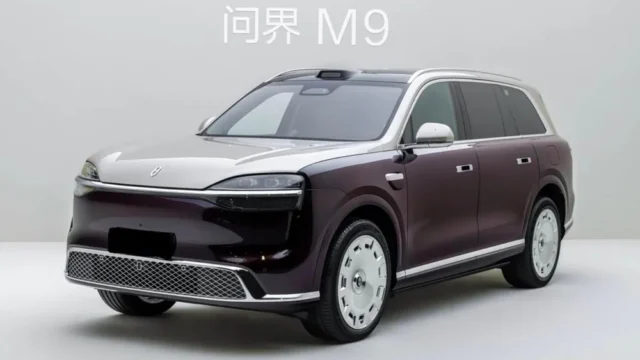
The MAEXTRO V800 is expected to launch in the second half of 2026. Its price positioning — roughly double that of the most expensive AITO M9 — creates a clear brand hierarchy within HIMA and directly challenges the narrative that Chinese EV brands cannot command six-figure dollar prices.
Why It Matters Globally
The MAEXTRO V800 demonstrates how Huawei’s HIMA (Harmony Intelligent Mobility Alliance) business model enables Chinese automakers to leapfrog into ultra-premium segments that were previously monopolized by European and Japanese luxury brands. By providing the intelligent driving stack, cockpit OS, brand halo, and retail channel, Huawei allows manufacturing partners like JAC to focus on vehicle engineering while Huawei handles the technology differentiation that premium buyers increasingly value.
At $236,000, the V800 is priced above the Mercedes-Maybach S-Class and approaches Bentley Flying Spur territory. The fact that a collaboration between a telecom equipment company and a state-owned truck maker can credibly enter this segment—with 30,000 pre-orders—signals that the definition of automotive luxury is shifting from mechanical refinement to digital and autonomous capability. For global luxury brands, the V800 is not just a Chinese curiosity; it represents a blueprint for how software-defined vehicles could disrupt the premium market’s century-old hierarchy.
FAQ
What does Huawei contribute to the MAEXTRO V800?
Huawei provides the full HIMA stack: Qiankun ADS 4.0 (autonomous driving with urban NOA), HarmonyOS cockpit with a 15.6-inch central display and AR-HUD, the Sound audio system with 23 speakers, and retail distribution through Huawei’s flagship stores. The V800 also uses Huawei’s DriveONE electric drive system and 800V silicon carbide platform. JAC contributes the vehicle platform, manufacturing at its Hefei factory, and the EREV powertrain integration.
How does MAEXTRO differ from AITO and Stelato?
All three are HIMA brands, but they target different segments: AITO (with Seres) covers the mass-premium 250,000–500,000 RMB range with SUVs like the M7 and M9; Stelato (with BAIC) targets the executive sedan segment with the S9; and MAEXTRO (with JAC) occupies the ultra-luxury space above 1 million RMB. Huawei positions MAEXTRO as its technology flagship—the brand that debuts its most advanced autonomous driving and cockpit innovations before they trickle down to AITO and Stelato.
Sources
- QQ News / 快科技, 余承东官宣:尊界V800定位超高端MPV
- ZOL / 中关村在线, 华为尊界V800官宣:530马力增程MPV,预售160万起
- MIIT, MAEXTRO V800 MIIT regulatory filing: dimensions, powertrain, battery specifications