Quick Answer: An EV usually costs less to power than a gasoline car when drivers can charge mostly at home, and higher gas prices widen that gap. But the final answer depends on local electricity rates, public fast-charging prices, mileage, insurance, maintenance, and depreciation.
Table of Contents
- The Simple Answer
- Energy Cost vs. Total Ownership Cost
- The Formula for Gasoline Cars
- The Formula for EVs
- Example Calculation
- When an EV Saves the Most
- When the Savings Shrink
- How to Adapt the Math by Country
- FAQ
- Sources
The Simple Answer
When gasoline prices rise, an EV’s day-to-day running-cost advantage usually becomes easier to see. The reason is simple: gasoline cars convert expensive fuel into distance, while EVs convert electricity into distance, and home electricity is often cheaper per mile or kilometer than pump fuel.
But that does not mean every EV saves every driver money.
The fair question is not “Are EVs always cheaper?” The fair question is: given your local gas price, electricity rate, mileage, and charging habits, how much does each kilometer or mile cost?
That answer can be calculated in a few lines.
Energy Cost vs. Total Ownership Cost
Before comparing cars, separate two ideas:
| Cost type | What it includes | Why it matters |
|---|---|---|
| Energy cost | Gasoline or electricity used to drive | This is where EVs usually look strongest. |
| Total ownership cost | Energy, insurance, maintenance, depreciation, financing, taxes | This is the number that decides whether the whole purchase saves money. |
A driver who charges at home and drives a lot can save meaningfully on energy. A driver who relies almost entirely on public fast chargers, pays high insurance, or buys an EV that depreciates quickly may see a smaller advantage.
For BYD and other value-focused Chinese EVs, the point is especially important. A lower purchase price can improve the equation, but only if the car is actually available, supported, insured, and serviceable in the buyer’s market.
The Formula for Gasoline Cars
For a gasoline car, the calculation is straightforward.
Metric version:
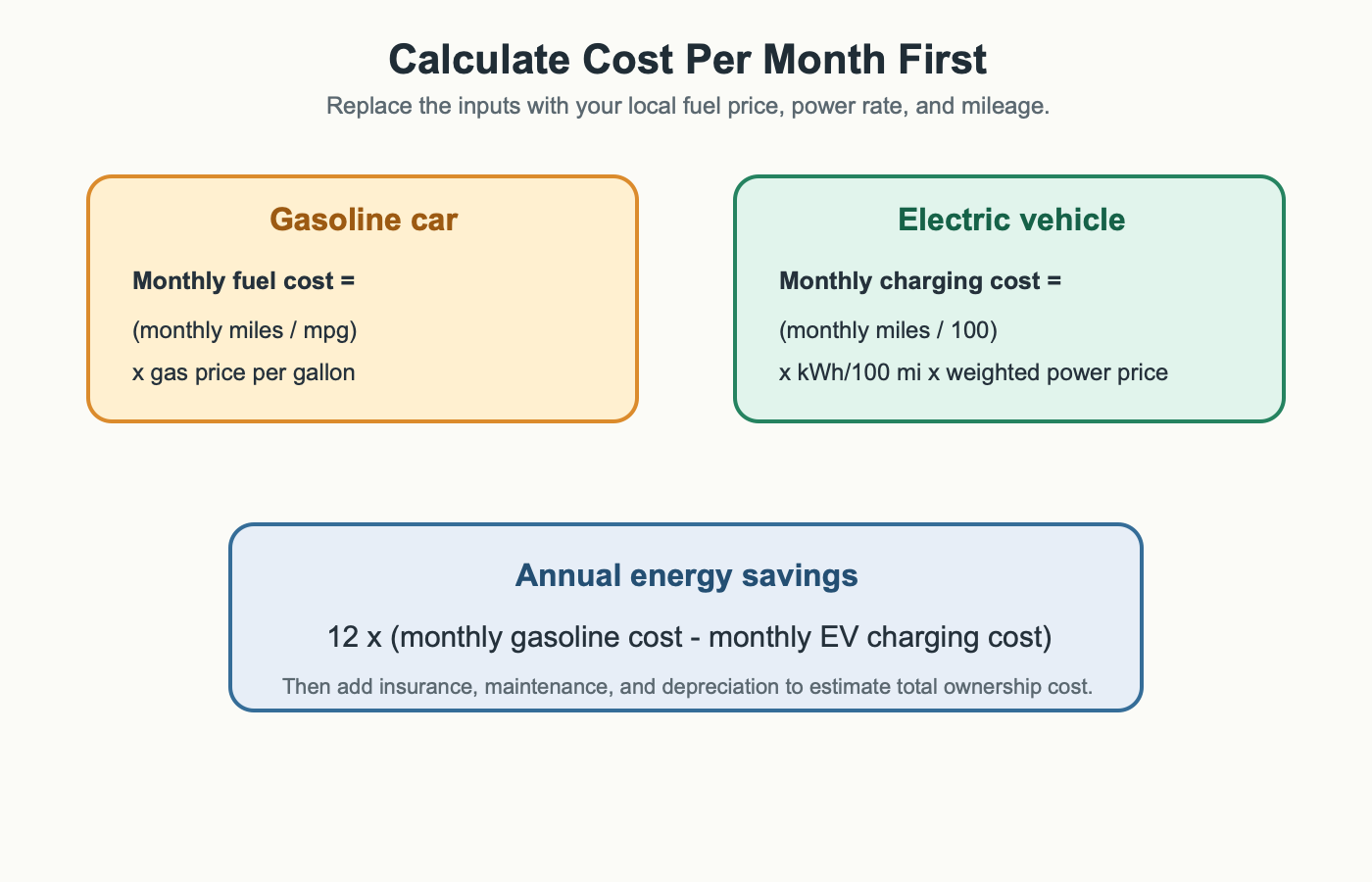
Monthly gasoline cost =
(monthly kilometers / 100) x fuel use (L/100km) x fuel price per litre
U.S. version:
Monthly gasoline cost =
(monthly miles / mpg) x gasoline price per gallon
For cost per distance:
Gasoline cost per km =
fuel use (L/100km) x fuel price per litre / 100

Gasoline cost per mile =
gasoline price per gallon / mpg
This is the baseline. If your current car uses a lot of fuel, rising pump prices hurt faster. If it is a very efficient hybrid, the EV advantage narrows.
The Formula for EVs
For an EV, the biggest mistake is using only the home electricity price if the driver also fast-charges regularly.
Use a weighted electricity price:
Weighted electricity price =
(home charging share x home electricity rate)
+ (public charging share x public charging rate)
Then calculate charging cost:
Metric version:
Monthly EV charging cost =
(monthly kilometers / 100)
x EV consumption (kWh/100km)
x weighted electricity price
x charging loss factor
U.S. version:
Monthly EV charging cost =
(monthly miles / 100)
x EV consumption (kWh/100 miles)
x weighted electricity price
x charging loss factor
The charging loss factor accounts for energy lost between the wall and the battery. A simple estimate is 1.05 to 1.15. For a general consumer article, 1.10 is a reasonable placeholder.
Example Calculation
The example below is only a template. It is not a real-time price claim for any specific country.
Assumptions:
- Monthly driving: 1,200 km
- Gasoline car: 7.5 L/100km
- EV: 17.5 kWh/100km
- Gasoline price: $1.40/L
- Home electricity: $0.16/kWh
- Public fast charging: $0.40/kWh
- Charging mix: 80% home, 20% public
- Charging loss factor: 1.10
Weighted electricity price:
(0.80 x 0.16) + (0.20 x 0.40) = $0.208/kWh| Item | Formula | Example assumption | Example result |
|---|---|---|---|
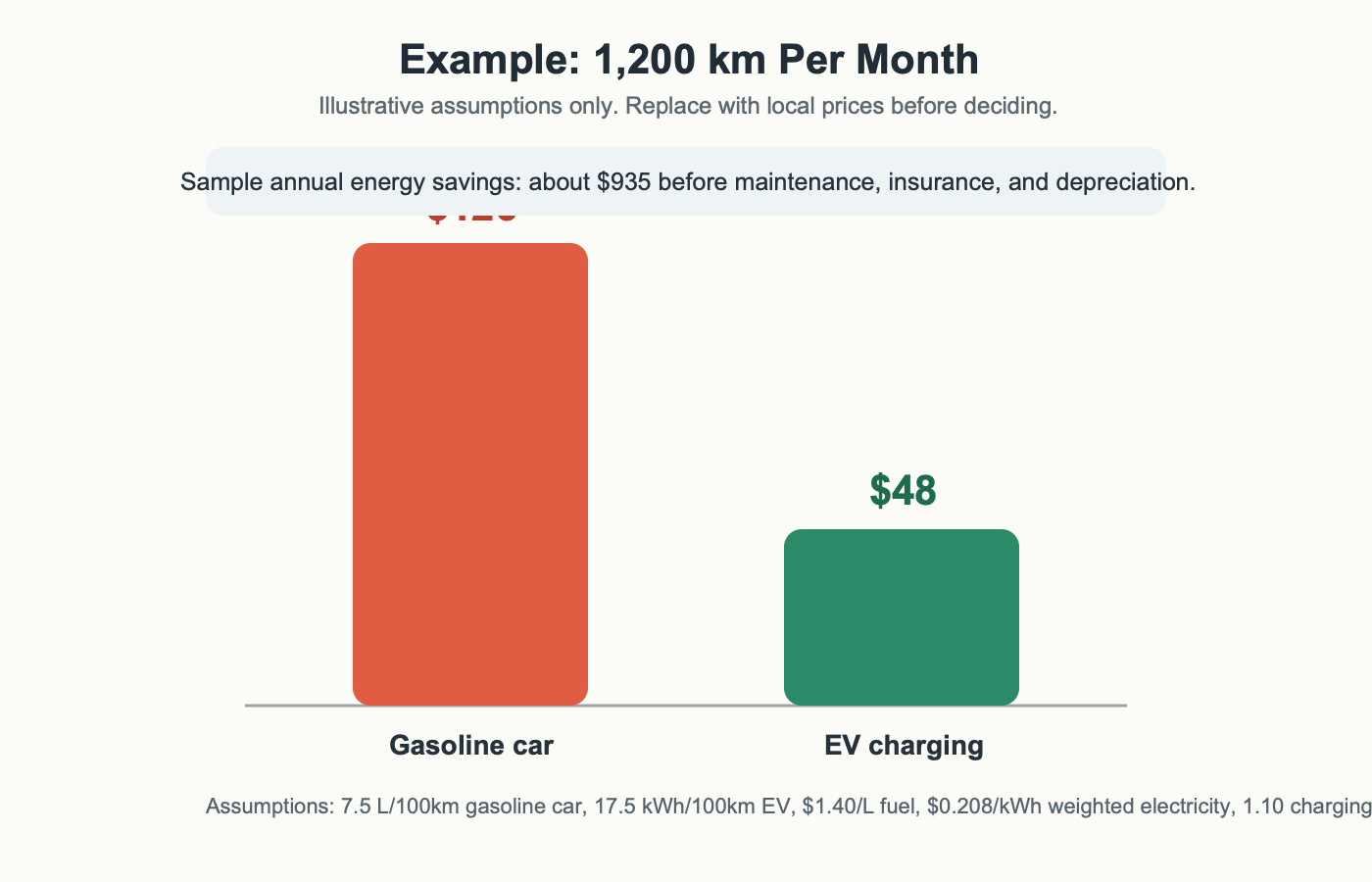
| Monthly gasoline cost | (Monthly km / 100) x ICE fuel use x fuel price | 1,200 km; 7.5 L/100km; $1.40/L | $126.00 |
| Monthly EV charging cost | (Monthly km / 100) x EV use x weighted power price x loss factor | 1,200 km; 17.5 kWh/100km; $0.208/kWh; 1.10 | $48.05 |
| Gasoline cost per km | ICE fuel use x fuel price / 100 | 7.5 x 1.40 / 100 | $0.105 |
| EV charging cost per km | EV use x weighted power price x loss factor / 100 | 17.5 x 0.208 x 1.10 / 100 | $0.040 |
| Annual energy savings | 12 x (monthly gasoline cost – monthly EV charging cost) | Same assumptions | $935 |
In this example, the EV saves about $78 per month on energy and about $935 per year before considering maintenance, insurance, or depreciation.
Now add ownership costs:
| Extra ownership factor | Example annual impact |
|---|---|
| Lower EV maintenance | +$250 |
| Higher EV insurance | -$120 |
| Higher EV depreciation | -$400 |
| Net annual savings after these factors | $665 |
The lesson is not that every EV saves exactly this much. The lesson is that energy savings can be large, but ownership costs can change the final answer.
When an EV Saves the Most
An EV tends to save the most money when five things are true:
- Gasoline prices are high.
- The gasoline alternative has average or poor fuel economy.
- The driver charges mostly at home.
- The EV is efficient, not oversized.
- The purchase price and depreciation are reasonable.
This is why small, efficient EVs and affordable plug-in hybrids are getting attention in markets where fuel prices are painful. A compact BYD Dolphin, Dolphin Surf, Seagull-style city car, or Atto 3-type crossover can be compelling where it is officially sold and supported.
For drivers with home charging, the savings are not only about money. They also avoid weekly fuel stops and reduce exposure to sudden pump-price jumps.
When the Savings Shrink
EV savings can shrink or disappear when the use case changes.
| Situation | What happens |
|---|---|
| Mostly public fast charging | Electricity cost rises and can approach gasoline cost. |
| Low annual mileage | The driver saves less fuel, so payback takes longer. |
| Very efficient hybrid alternative | The gasoline benchmark becomes harder to beat. |
| High insurance cost | EV energy savings may be offset by premiums. |
| High depreciation | The total-cost equation can flip even if charging is cheap. |
| No local service support | Repairs, downtime, and parts risks become real costs. |
That last point matters for Chinese EVs abroad. A BYD that is officially sold in Thailand, Brazil, Mexico, Japan, or Europe is a different proposition from a car imported into a market without official support. Low energy cost does not help if the vehicle cannot be serviced or insured normally.
How to Adapt the Math by Country
Use local official or semi-official sources for fuel and electricity. Do not rely on a single social media post or one day’s pump price.
| Market | Fuel price source | Electricity source | Vehicle efficiency source |
|---|---|---|---|
| United States | EIA weekly gasoline prices | EIA electricity data or utility rates | EPA / FuelEconomy.gov labels |
| Europe | European Commission Weekly Oil Bulletin | Eurostat household electricity prices or local utilities | WLTP figures |
| Mexico | Profeco weekly fuel price reports | CFE household tariffs | Local model specs |
| Brazil | ANP fuel price survey | ANEEL tariff data | Local model specs |
| Thailand | EPPO oil price data | PEA/MEA tariffs and Ft surcharge | Local model specs |
| Japan | ANRE petroleum price survey | Utility tariffs / official energy statistics | Japan-market catalog figures |
For a country-specific article, replace only the inputs:
- local fuel price,
- local electricity price,
- typical annual mileage,
- relevant gasoline comparison car,
- relevant EV or plug-in hybrid model.
The structure remains the same.
Bottom Line
Rising gas prices make EVs more attractive, but the smart answer is a calculation, not a slogan.
If you drive a lot, charge mostly at home, and choose an efficient EV at a reasonable purchase price, the energy savings can be meaningful. If you rarely drive, depend on public fast charging, pay high insurance, or buy a fast-depreciating EV, the savings may be smaller than the headline suggests.
The best consumer advice is simple: compare cost per kilometer or mile first, then add insurance, maintenance, and depreciation before deciding.
FAQ
Do EVs always cost less to run than gas cars?
No. EVs often cost less to power, especially with home charging, but the result depends on local electricity prices, gasoline prices, driving distance, and fast-charging use.
How do I calculate EV charging cost?
Multiply your distance by the EV’s energy use, then multiply by your weighted electricity price and a charging loss factor. For example: (monthly km / 100) x kWh/100km x electricity price x 1.10.
Does public fast charging ruin the savings?
Not always, but it reduces them. Public DC fast charging is usually much more expensive than home charging, so the EV advantage shrinks if most charging happens on the road.
Are plug-in hybrids better when gas prices rise?
They can be, especially for drivers without reliable home charging or in markets where long-distance charging is still uneven. A PHEV can cut fuel use while keeping gasoline backup.
What matters more: gas price or electricity price?
Both. The EV advantage widens when gasoline is expensive and electricity is cheap. It narrows when gasoline is cheap, public charging is expensive, or the gasoline alternative is a very efficient hybrid.
Should I include insurance in the calculation?
Yes. Energy cost is only one part of ownership. Insurance, maintenance, depreciation, financing, taxes, and repair access can change the final savings.
Why are Chinese EVs part of this discussion?
Chinese EV makers such as BYD often compete on value. In markets where they are officially sold and supported, lower purchase prices can strengthen the total-cost argument.
What is the easiest rule of thumb?
Calculate your current fuel cost per kilometer or mile, then calculate the EV charging cost for the same distance. If the EV saves money there, check whether insurance and depreciation preserve the advantage.
Sources
- U.S. Energy Information Administration – Weekly retail gasoline prices: https://www.eia.gov/dnav/pet/pet_pri_gnd_a_epm0_pte_dpgal_m.htm
- U.S. Energy Information Administration – Electricity data: https://www.eia.gov/electricity/data.php
- EPA – Text version of electric vehicle label: https://www.epa.gov/fueleconomy/text-version-electric-vehicle-label
- European Commission – Weekly Oil Bulletin: https://energy.ec.europa.eu/data-and-analysis/weekly-oil-bulletin_en
- Eurostat – Household electricity prices: https://ec.europa.eu/eurostat/web/products-eurostat-news/w/ddn-20260505-1
- European Environment Agency – Real-world emissions and WLTP context: https://climate-energy.eea.europa.eu/topics/transport/real-world-emissions/intro
- Mexico Profeco – Quien es Quien en los Precios de la Gasolina: https://combustibles.profeco.gob.mx/qqpgasolina/
- CFE – Household electricity tariffs: https://app.cfe.mx/Aplicaciones/CCFE/Tarifas/TarifasCRECasa/Casa.aspx
- Brazil ANP – Fuel price survey: https://www.gov.br/anp/pt-br/assuntos/precos-e-defesa-da-concorrencia/precos/levantamento-de-precos-de-combustiveis-ultimas-semanas-pesquisadas
- Brazil ANEEL – Tariff ranking: https://www.gov.br/aneel/pt-br/assuntos/tarifas/ranking-das-tarifas
- Thailand EPPO – Oil prices: https://www.eppo.go.th/epposite/templates/eppo_v15_mixed/eppo_oil/eppo_oil_gen_new.php
- Japan ANRE – Petroleum product price survey: https://www.enecho.meti.go.jp/statistics/petroleum_and_lpgas/pl007/index.html
- IEA – Global EV Outlook 2025, outlook for electric mobility: https://www.iea.org/reports/global-ev-outlook-2025/outlook-for-electric-mobility