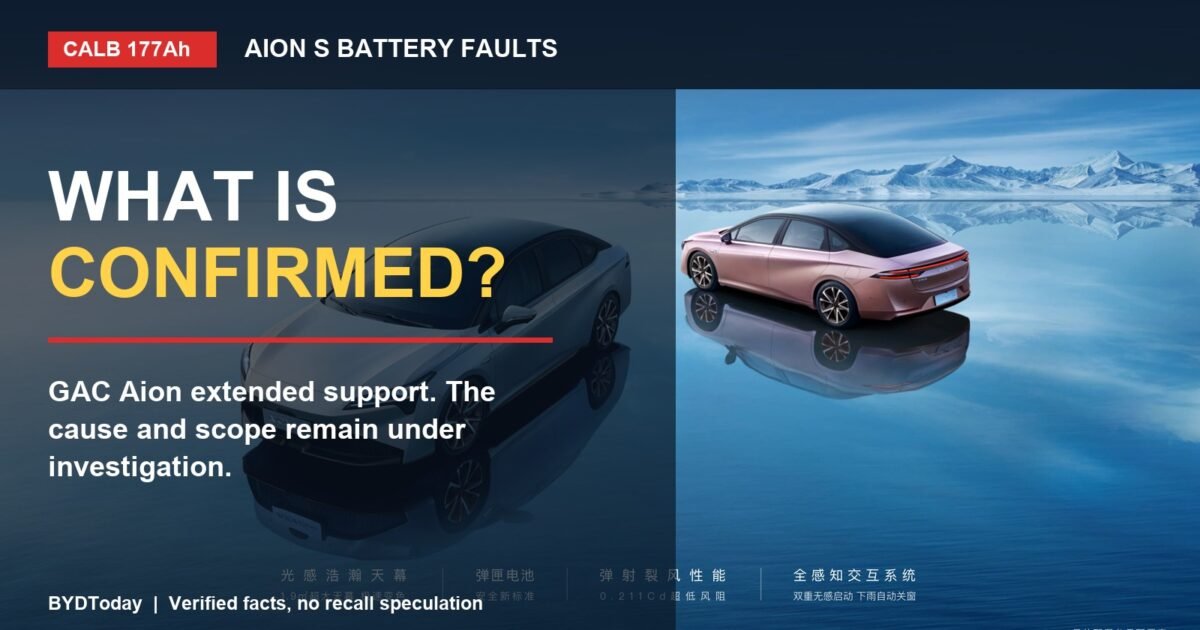
Quick answer: GAC Aion and CALB have confirmed that some AION S vehicles used for commercial operation and equipped with CALB 177Ah lithium iron phosphate cells experienced battery-system faults under specific operating conditions. GAC Aion extended battery coverage for vehicles using the relevant cells from eight years/150,000 km to eight years/300,000 km and announced monitoring, inspection, repair or replacement support. CALB also offered direct free inspection and service. Neither company publicly assigned responsibility or announced a recall in the statements reviewed by BYDToday.
- Confirmed scope: some AION S operating-use vehicles with CALB 177Ah LFP cells.
- Confirmed response: extended coverage, proactive monitoring and free service based on inspection results.
- Still unknown: the total affected population, definitive root cause, responsibility split and whether regulators will require further action.
What GAC Aion confirmed
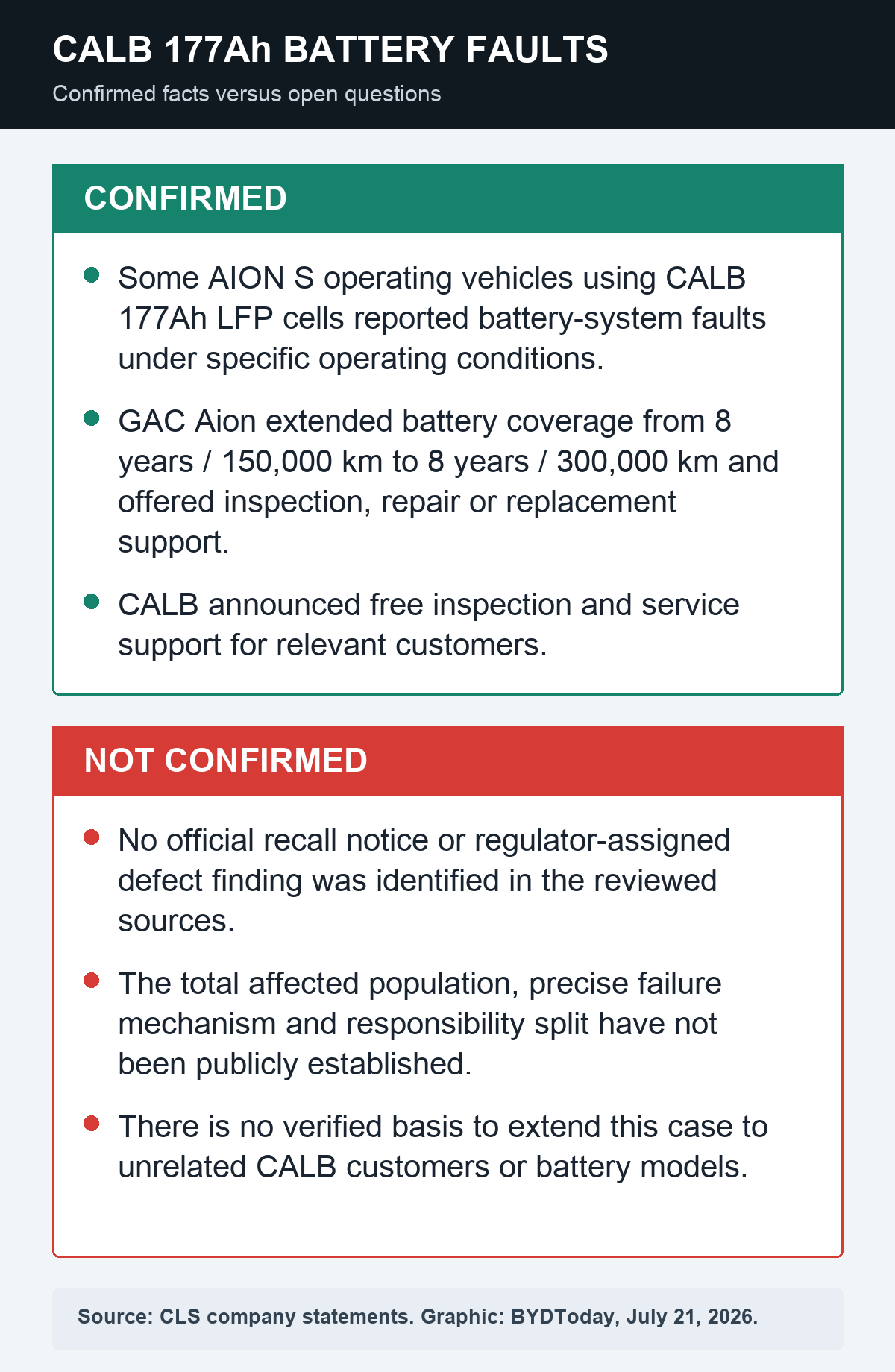
On July 18, GAC Aion said its preliminary investigation found battery faults in some AION S vehicles used for commercial operation and fitted with CALB 177Ah LFP cells. The wording matters: the announcement did not describe every AION S, every 177Ah cell or every CALB product as affected.
GAC Aion announced three customer measures:
- Longer battery coverage: from eight years/150,000 km to eight years/300,000 km for vehicles using the relevant battery.
- Active monitoring and service: stronger battery-data monitoring, customer contact when anomalies are detected, free inspection and free repair or battery-pack replacement according to the result.
- Operating-loss support: compensation under applicable rules when battery repair or replacement disrupts commercial operation and the repair takes more than five days.
What CALB confirmed
CALB said it had noticed battery-system faults under specific operating conditions in some GAC Aion AION S vehicles equipped with its cells. The supplier said it began maintenance support through GAC Aion dealerships and would also allow owners with battery-system faults to obtain free inspection and eligible service through CALB’s network.
CALB’s statement acknowledged the service issue but did not publicly identify a manufacturing defect, a single technical mechanism or a final allocation of responsibility. Those distinctions are essential because complaint allegations are not the same as a completed technical finding.
Which AION S vehicles are in the reported cluster?
The company statements define the relevant group by three conditions: the AION S series, commercial operating use and the CALB 177Ah LFP cell. CLS reported that complaints were concentrated among some 2022-2023 AION S Plus operating vehicles, often after approximately 150,000-300,000 km.
That complaint pattern is useful context, but it is not an official population count. The total AION S series has sold in much larger numbers and includes different model years, uses and battery configurations. A vehicle should not be classified as affected from its model badge alone; the battery configuration and service record need to be checked.
What faults have been reported?
CLS cited owner complaints and third-party reports involving cell swelling, leakage, insulation faults, voltage imbalance and severe range degradation. These reports help explain why the companies expanded service support, but BYDToday has not treated each complaint as an independently verified root-cause finding.
Similar symptoms can arise from different mechanisms, including cell variation, sealing failure, electrical isolation problems, thermal exposure, operating history or pack-level conditions. A conclusive cause requires inspection data, failed-part analysis and a formal technical finding. Neither company published that level of detail in the statements reviewed for this article.
Is this an official recall?
No official recall was identified as of July 21, 2026. GAC Aion’s extended warranty and proactive service campaign are significant, but a company service measure is not automatically the same as a regulator-filed recall. CLS also reported that the two companies had not answered whether a centralized recall would follow.
This could change if a regulator or manufacturer publishes new findings. The available record supports the narrower description “battery faults”; it does not establish a fleet-wide defect rate or justify describing the entire product family as a mass failure.
How China’s new GB 38031-2025 battery standard relates
China’s updated mandatory EV battery safety standard, GB 38031-2025, took effect on July 1, 2026. It strengthens thermal-propagation requirements, adds a bottom-impact test and introduces a post-fast-charge-cycle safety test for batteries capable of charging from 20% to 80% within 15 minutes.
The standard raises the bar for newly tested products; it does not by itself prove the cause of faults in older vehicles or automatically force every existing pack to be rebuilt. Xinhua quoted experts explaining that the standard tests new battery products and that in-use safety still depends on maintenance, damage history and warning response.
CALB’s scale makes the response worth watching
CALB is a large battery manufacturer rather than a small single-product supplier. Its audited 2025 annual report shows revenue of RMB44.400 billion, including RMB30.300 billion from EV batteries.
The size of the company does not establish the scope of this incident. It does mean that the service process, technical findings and any eventual disclosure will be watched across the battery industry. Transparent identification of the affected configuration will be more useful than extrapolating from one cell format to unrelated customers or products.
What owners should do
- Contact an authorized GAC Aion service center and ask it to confirm the battery supplier and cell configuration for the vehicle identification number.
- Do not ignore battery, insulation, charging or high-voltage warnings, sudden range loss or abnormal state-of-charge behavior.
- Keep service orders, diagnostic reports, dates and downtime records, especially if the vehicle is used commercially.
- Avoid opening or repairing a high-voltage pack outside an authorized or properly qualified facility.
FAQ
Did GAC Aion confirm a problem with every AION S?
No. Its statement referred to some commercial operating-use AION S vehicles equipped with CALB 177Ah LFP cells.
Did CALB admit a manufacturing defect?
CALB acknowledged battery-system faults under specific operating conditions and offered service. The reviewed statement did not publish a final root cause or admit a defined manufacturing defect.
Has a recall been announced?
No official recall was identified as of July 21, 2026. GAC Aion announced extended coverage, monitoring and free service measures.
Does the case involve BYD vehicles?
The reviewed company statements concern certain AION S vehicles and CALB 177Ah cells. They do not identify BYD vehicles, so the case should not be generalized to BYD packs.
Does GB 38031-2025 solve the problem for existing cars?
No. The standard improves requirements for newly tested battery products. Service and remediation for existing vehicles depend on diagnosis, manufacturer action and any regulator decisions.